Beschreibung
Produktdetails
Einband
Gebundene Ausgabe
Erscheinungsdatum
17.10.2011
Abbildungen
Photos: 55 B&W, 0 Color; Drawings: 50 B&W, 0 Color
Verlag
John Wiley & Sons IncSeitenzahl
330
Maße (L/B/H)
24/16,1/2,2 cm
Gewicht
665 g
Auflage
1. Auflage
Sprache
Englisch
ISBN
978-1-118-03829-1
How Geographic Redundancy Can Improve Service Availability and Reliability of Computer-Based Systems
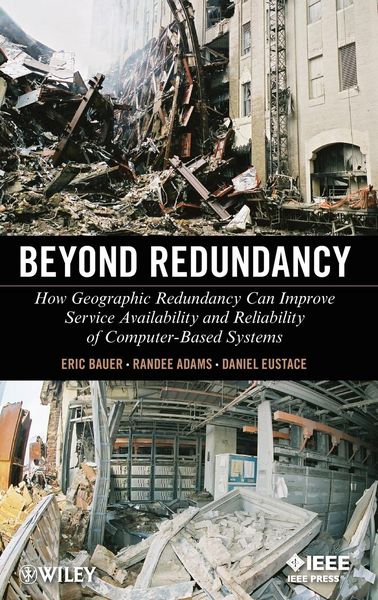
Enterprises make significant investments in geographically redundant systems to mitigate the very unlikely risk of a natural or man-made disaster rendering their primary site inaccessible or destroying it completely. While geographic redundancy has obvious benefits for disaster recovery, it is far less obvious what benefit georedundancy offers for more common hardware, software, and human failures. Beyond Redundancy provides both a theoretical and practical treatment of the feasible and likely benefits from geographic redundancy for both service availability and service reliability.
The book is organized into three sections:
Basics provides the necessary background on georedundancy and service availability
Modeling and Analysis of Redundancy gives the technical and mathematical details of service availability modeling of georedundant configurations
Recommendations offers specific recommendations on architecture, requirements, design, testing, and analysis of georedundant configurations
A complete georedundant case study is included to illustrate the recommendations. The book considers both georedundant systems and georedundant solutions. The text also provides a general discussion about the capital expense/operating expense tradeoff that frames system redundancy and georedundancy. These added features make Beyond Redundancy an invaluable resource for network/system planners, IS/IT personnel, system architects, system engineers, developers, testers, and disaster recovery/business continuity consultants and planners.
Enterprises make significant investments in geographically redundant systems to mitigate the very unlikely risk of a natural or man-made disaster rendering their primary site inaccessible or destroying it completely. While geographic redundancy has obvious benefits for disaster recovery, it is far less obvious what benefit georedundancy offers for more common hardware, software, and human failures. Beyond Redundancy provides both a theoretical and practical treatment of the feasible and likely benefits from geographic redundancy for both service availability and service reliability.
The book is organized into three sections:
Basics provides the necessary background on georedundancy and service availability
Modeling and Analysis of Redundancy gives the technical and mathematical details of service availability modeling of georedundant configurations
Recommendations offers specific recommendations on architecture, requirements, design, testing, and analysis of georedundant configurations
A complete georedundant case study is included to illustrate the recommendations. The book considers both georedundant systems and georedundant solutions. The text also provides a general discussion about the capital expense/operating expense tradeoff that frames system redundancy and georedundancy. These added features make Beyond Redundancy an invaluable resource for network/system planners, IS/IT personnel, system architects, system engineers, developers, testers, and disaster recovery/business continuity consultants and planners.
Noch keine Bewertungen vorhanden
Verfassen Sie die erste Bewertung zu diesem Artikel
Helfen Sie anderen Kundinnen und Kunden durch Ihre Meinung.
Kurze Frage zu unserer Seite
Vielen Dank für Ihr Feedback
Wir nutzen Ihr Feedback, um unsere Produktseiten zu verbessern. Bitte haben Sie Verständnis, dass wir Ihnen keine Rückmeldung geben können. Falls Sie Kontakt mit uns aufnehmen möchten, können Sie sich aber gerne an unseren Kund*innenservice wenden.
zum Kundenservice