• Produktbild: Political Economy of Institutions, Democracy and Voting
  • Produktbild: Political Economy of Institutions, Democracy and Voting
- 11%

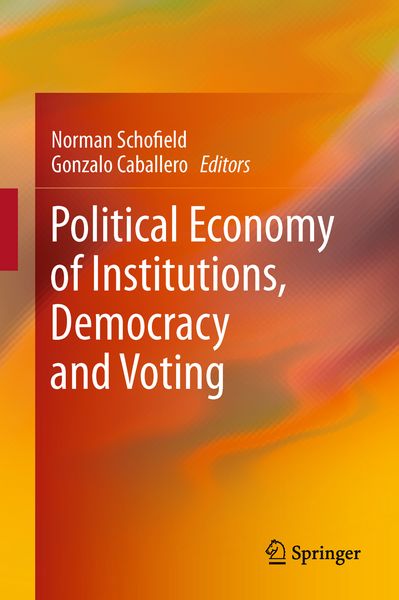
Political Economy of Institutions, Democracy and Voting

11% sparen

96,99 € UVP 109,99 €

inkl. gesetzl. MwSt., Versandkostenfrei


Beschreibung

Produktdetails

Einband

Gebundene Ausgabe

Erscheinungsdatum

12.06.2011

Abbildungen

IX, 425 p.

Herausgeber

Norman Schofield + weitere

Verlag

Springer Berlin

Seitenzahl

425

Maße (L/B/H)

24,1/16/2,8 cm

Gewicht

816 g

Auflage

2011

Sprache

Englisch

ISBN

978-3-642-19518-1

Beschreibung

Produktdetails

Einband

Gebundene Ausgabe

Erscheinungsdatum

12.06.2011

Abbildungen

IX, 425 p.

Herausgeber

Verlag

Springer Berlin

Seitenzahl

425

Maße (L/B/H)

24,1/16/2,8 cm

Gewicht

816 g

Auflage

2011

Sprache

Englisch

ISBN

978-3-642-19518-1

Herstelleradresse

Springer-Verlag KG
Sachsenplatz 4-6
1201 Wien
AT

Email: ProductSafety@springernature.com

Noch keine Bewertungen vorhanden

Verfassen Sie die erste Bewertung zu diesem Artikel

Helfen Sie anderen Kundinnen und Kunden durch Ihre Meinung.

Kundinnen und Kunden meinen

Bewertungen (0)

  • Produktbild: Political Economy of Institutions, Democracy and Voting
  • Produktbild: Political Economy of Institutions, Democracy and Voting
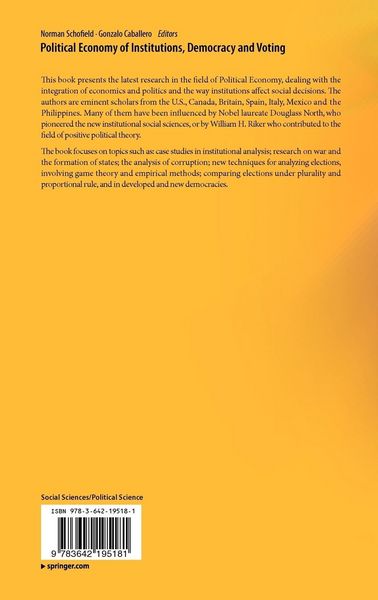
  • Introduction.- Institutions: Rules or Equilibria?.- War, Wealth, and the Formation of States.- Why Do Weak States Prefer Prohibition to Taxation?.- Self-enforcing, Public-order Institutions for Contract Enforcement: Litigation, Regulation, and Limited Government in Venice, 1050 - 1350.- Judicial Stability During Regime Change: Apex Courts in India 1937-1960.- Institutional Arrangements Matter for Both Efficiency and Distribution: Contributions and Challenges of the New Institutional Economics.- Institutional Foundations, Committee System and Amateur Legislators in the Governance of the Spanish Congress: An Institutional Comparative Perspective (USA, Argentina, Spain).- Coalition Governments and Electoral Behavior: Who Is Accountable?.- Democracy and Voting: Empirical and Formal Models of the United States Presidential Elections in 2000 and 2004.- Modelling Elections in Post-Communist Regimes: Voter Perceptions, Political Leaders and Activists.- Electoral Systems and Party Responsiveness.- Electoral Institutions and Political Corruption: Ballot Structure, Electoral Formula, and Graft.- A Model of Party Entry in Parliamentary Systems with Proportional Representation.- Moving in Time: Legislative Party Switching as Time-Contingent Choice.- On the Distribution of Particularistic Goods.- Vote Revelation: Empirical Content of Scoring Rules.