Gutscheinbedingungen

**Gültig bis 06.07.2026 auf fremdsprachige Bücher online auf thalia.at, in der Thalia App ab einem Mindestbestellwert von 30€ und in allen Thalia Buchhandlungen in Österreich. In den Buchhandlungen nur gültig auf lagernde Ware. Einzelne Artikel können ausgeschlossen sein. Ausgenommen sind preisgebundene Artikel & eBooks. Pro Einkauf einmal einlösbar. Nur gültig gegen Vorlage oder im Onlineshop hinterlegter Bonuscard. Infos zur Einlösung in der Buchhandlung sind auf der Bonuscard-Vorteilspreisseite zu finden. Click & Collect nur bei Onlinevorabzahlung möglich. Keine Einlösung bei Scan & Go-Bezahlung. Keine Barauszahlung. Nicht kombinierbar mit anderen Aktionen und Gutscheinen. Gutschein wird auf max. 500€ Bestellwert angerechnet. Nicht gültig für Versandkosten und Services.

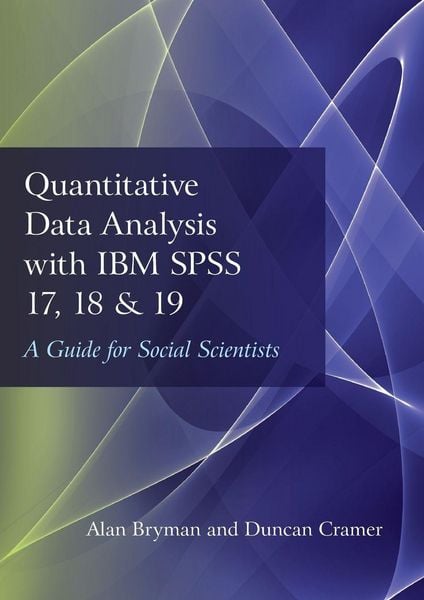
Produktbild: Quantitative Data Analysis with IBM SPSS 17, 18 & 19

Quantitative Data Analysis with IBM SPSS 17, 18 & 19 A Guide for Social Scientists

88,99 €

inkl. gesetzl. MwSt., Versandkostenfrei


Beschreibung

Produktdetails

Einband

Taschenbuch

Erscheinungsdatum

18.05.2011

Verlag

Taylor & Francis

Seitenzahl

408

Maße (L/B/H)

24,6/17,4/2,2 cm

Gewicht

748 g

Sprache

Englisch

ISBN

978-0-415-57919-3

Beschreibung

Rezension

"Alan Bryman and Duncan Cramer take the reader on a journey through their first steps in using SPSS and data entry, through to how to decide which statistical technique is the most appropriate for their research and how to interpret each aspect of their analyses. This book is one of the most comprehensive and accessible books available on the market." - Professor Dominic Upton, Head of Psychology, University of Worcester, UK

"Bryman and Cramer's Quantitative Data Analysis has long been one of the best texts in the field. Crucially it explains why something is done, as well as how. Most importantly it does it without recourse to daunting formulae and calculations. It takes students from the beginnings of data analysis, assuming no knowledge of either statistics or SPSS and by the end of it a student can be an accomplished analyst." - Malcolm Williams, Director, Cardiff University. School of Social Sciences, UK

Zitat

"A helpful, user friendly introduction for quantitative data analysis using SPSS designed for students in both psychology and sociology fields." - Andrada Ivanescu, East Carolina University, US, in The American Statistician "Alan Bryman and Duncan Cramer take the reader on a journey through their first steps in using SPSS and data entry, through to how to decide which statistical technique is the most appropriate for their research and how to interpret each aspect of their analyses. This book is one of the most comprehensive and accessible books available on the market." - Professor Dominic Upton, Head of Psychology, University of Worcester, UK "Bryman and Cramer's Quantitative Data Analysis has long been one of the best texts in the field. Crucially, it explains why something is done, as well as how. Most importantly, it does it without recourse to daunting formulae and calculations. It takes students from the beginnings of data analysis, assuming no knowledge of either statistics or SPSS, and by the end of it a student can be an accomplished analyst." - Malcolm Williams, Director, Cardiff University. School of Social Sciences, UK

Produktdetails

Einband

Taschenbuch

Erscheinungsdatum

18.05.2011

Verlag

Taylor & Francis

Seitenzahl

408

Maße (L/B/H)

24,6/17,4/2,2 cm

Gewicht

748 g

Sprache

Englisch

ISBN

978-0-415-57919-3

Herstelleradresse

Libri GmbH
Europaallee 1
36244 Bad Hersfeld
DE

Email: gpsr@libri.de

Noch keine Bewertungen vorhanden

Verfassen Sie die erste Bewertung zu diesem Artikel

Helfen Sie anderen Kundinnen und Kunden durch Ihre Meinung.

Kundinnen und Kunden meinen

Bewertungen (0)

Die Leseprobe wird geladen.
  • Produktbild: Quantitative Data Analysis with IBM SPSS 17, 18 & 19
  • Preface. 1. Data Analysis and the Research Process. 2. Analyzing Data with Computers: First Steps with SPSS 19, 18 and 17. 3. Analyzing Data with Computers: Further Steps with SPSS 19, 18 and 17. 4. Concepts and Their Measurement. 5. Summarizing Data. 6. Sampling and Statistical Significance. 7. Bivariate Analysis: Exploring Differences between Scores on Two Variables. 8. Bivariate Analysis: Exploring Relationships. 9. Multivariate Analysis: Exploring Differences among Three or More Variables. 10. Multivariate Analysis: Exploring Relationships among Three or More Variables. 11. Aggregating Variables: Exploratory Factor Analysis. Answers to Exercises. Glossary. Bibliography. Index.