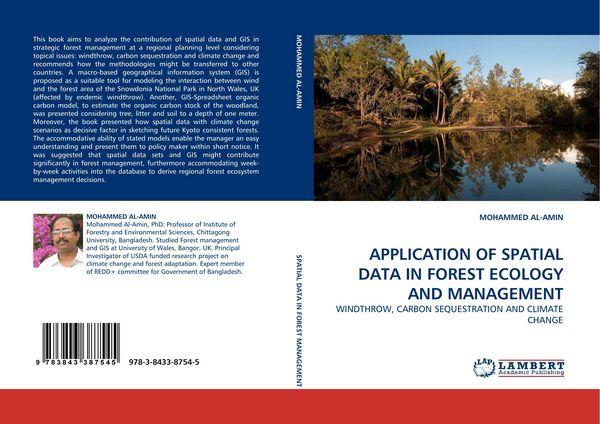
Application Of Spatial Data in Forest Ecology and Management WINDTHROW, CARBON SEQUESTRATION AND CLIMATE CHANGE
-
- Englisch ausgewählt
66,99 €
UVP
81,30 €
inkl. gesetzl. MwSt.,
Beschreibung
Produktdetails
Einband
Taschenbuch
Erscheinungsdatum
18.01.2011
Verlag
LAP LAMBERT Academic PublishingSeitenzahl
252
Maße (L/B/H)
22/15/1,6 cm
Gewicht
393 g
Auflage
1. Auflage
Sprache
Englisch
ISBN
978-3-8433-8754-5
This book aims to analyze the contribution of spatial data and GIS in strategic forest management at a regional planning level considering topical issues: windthrow, carbon sequestration and climate change and recommends how the methodologies might be transferred to other countries. A macro-based geographical information system (GIS) is proposed as a suitable tool for modeling the interaction between wind and the forest area of the Snowdonia National Park in North Wales, UK (affected by endemic windthrow). Another, GIS-Spreadsheet organic carbon model, to estimate the organic carbon stock of the woodland, was presented considering tree, litter and soil to a depth of one meter. Moreover, the book presented how spatial data with climate change scenarios as decisive factor in sketching future Kyoto consistent forests. The accommodative ability of stated models enable the manager an easy understanding and present them to policy maker within short notice. It was suggested that spatial data sets and GIS might contribute significantly in forest management, furthermore accommodating week-by-week activities into the database to derive regional forest ecosystem management decisions.
Noch keine Bewertungen vorhanden
Verfassen Sie die erste Bewertung zu diesem Artikel
Helfen Sie anderen Kundinnen und Kunden durch Ihre Meinung.
Kurze Frage zu unserer Seite
Vielen Dank für Ihr Feedback
Wir nutzen Ihr Feedback, um unsere Produktseiten zu verbessern. Bitte haben Sie Verständnis, dass wir Ihnen keine Rückmeldung geben können. Falls Sie Kontakt mit uns aufnehmen möchten, können Sie sich aber gerne an unseren Kund*innenservice wenden.
zum Kundenservice