KI-Beratung Beta

  • Produktbild: Who One Is
  • Produktbild: Who One Is
Band 189 - 12%

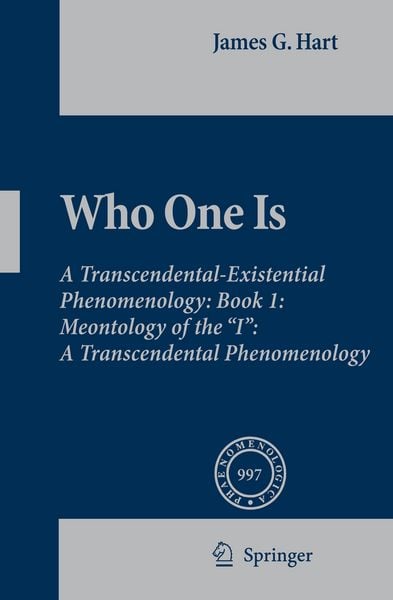
Who One Is Book 1: Meontology of the "I": A Transcendental Phenomenology

Aus der Reihe Phaenomenologica
12% sparen

192,99 € UVP 219,99 €

inkl. gesetzl. MwSt., Versandkostenfrei


Beschreibung

Both volumes of this work have as their central concern to sort out who one is from what one is. In this Book 1, the focus is on transcendental-phenomenological ontology. When we refer to ourselves we refer both non-ascriptively in regard to non-propertied as well as ascriptively in regard to propertied...

Beschreibung

Both volumes of this work have as their central concern to sort out
who
one is from
what
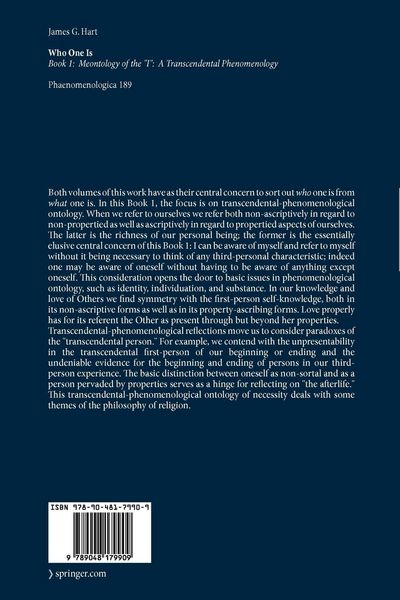
one is. In this Book 1, the focus is on transcendental-phenomenological ontology. When we refer to ourselves we refer both non-ascriptively in regard to non-propertied as well as ascriptively in regard to propertied aspects of ourselves. The latter is the richness of our personal being; the former is the essentially elusive central concern of this Book 1: I can be aware of myself and refer to myself without it being necessary to think of any third-personal characteristic; indeed one may be aware of oneself without having to be aware of anything except oneself. This consideration opens the door to basic issues in phenomenological ontology, such as identity, individuation, and substance. In our knowledge and love of Others we find symmetry with the first-person self-knowledge, both in its non-ascriptive forms as well as in its property-ascribing forms. Love properly has for its referent the Other as present through but beyond her properties.


Transcendental-phenomenological reflections move us to consider paradoxes of the “transcendental person”. For example, we contend with the unpresentability in the transcendental first-person of our beginning or ending and the undeniable evidence for the beginning and ending of persons in our third-person experience. The basic distinction between oneself as non-sortal and as a person pervaded by properties serves as a hinge for reflecting on “the afterlife”. This transcendental-phenomenological ontology of necessity deals with some themes of the philosophy of religion.

Rezension

From the reviews:

“James G. Hart’s … presents the results of several decades of research on self- and personhood, combining transcendental phenomenology and existential philosophy. … Hart has undoubtedly given us a thought-provoking study that enriches many ongoing debates and deserves increasing scholarly attention. I appreciate the breadth and insight of this work and heartily recommend it to anyone who wishes to learn more about who one is and about what it means to be a human being … .” (Claudia Welz, Philosophy Today, 2010)

“James Hart offers the reader an insightful and comprehensive treatment of the perplexing manner in which we, each of us, are aware of our own selves. The book is comprehensive in two senses: in regard to the topics treated, and in regard to the authorities invoked. … His book could serve as a reference work for someone who wished to explore this topic and wanted to know how it has been treated in philosophical and theological traditions other than his own.” (Robert Sokolowski, Journal of Phenomenological Psychology, Vol. 41, 2010)

Produktdetails

Einband

Taschenbuch

Erscheinungsdatum

28.10.2010

Abbildungen

XVI, 566 p.

Verlag Springer Netherland

Produktdetails

Einband

Taschenbuch

Erscheinungsdatum

28.10.2010

Abbildungen

XVI, 566 p.

Verlag Springer Netherland
Seitenzahl

566

Maße (L/B/H)

23,5/15,5/3,2 cm

Gewicht

873 g

Auflage

Softcover reprint of hardcover 1st ed. 2009

Sprache

Englisch

ISBN

978-90-481-7990-9

Herstelleradresse

Springer-Verlag KG
Sachsenplatz 4-6
1201 Wien
AT

Email: ProductSafety@springernature.com

Noch keine Bewertungen vorhanden

Verfassen Sie die erste Bewertung zu diesem Artikel

Helfen Sie anderen Kundinnen und Kunden durch Ihre Meinung.

Kundinnen und Kunden meinen

Bewertungen (0)

  • Produktbild: Who One Is
  • Produktbild: Who One Is
  • Phenomenological Preliminaries.- The First Person and the Transcendental I.- Ipseity's Ownness and Uniqueness.- Love as the Fulfillment of the Second-Person Perspective.- Ontology and Meontology of I-ness.- The Paradoxes of the Transcendental Person.- The Death of the Transcendental Person.- The Afterlife and the Transcendental I.