Zitat
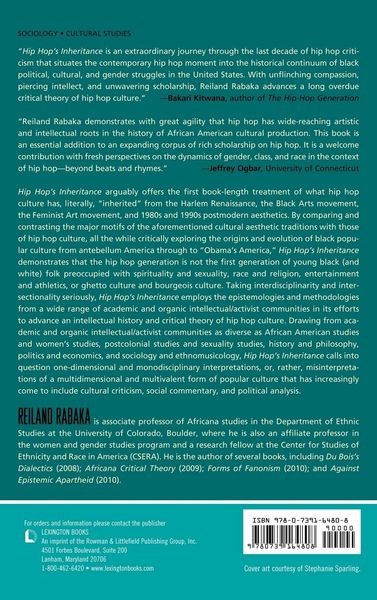
Rabaka (Univ. of Colorado, Boulder) offers a sweeping historical assessment of cultural ideologies connecting hip-hop to artistic innovations of the Harlem Renaissance and Black Arts movements. He mobilizes cultural theorists - Baraka, Foucault, DuBois, Jameson, Said, Fanon, Hurston - to describe the evolution of African American intellectual and cultural history via 'radical humanism, and democratic socialism.' Sprawling overviews of Africana critical theory, feminist theory, and queer theory imagine, 'anti-racist, anti-capitalist, anti-colonialist, and sexual orientation-sensitive critical theory of contemporary society.' The author provides interesting, if diffuse, discussion of gay literary voices in the Harlem Renaissance in relation to the contemporary homo-hop movement; Black Arts Movement members' perception of the 'aesthetic radicalism of the Harlem Renaissance'; and the 'black aesthetic' sensibility that "authentic' black art was always historically grounded, politically engaged, socially uplifting, and consciousness-raising.' In exploring the relationships between the black women's liberation, feminist art, and hip-hop feminist movements, Rabaka mines work by Patricia Collins. In a final chapter, he considers postmodernist approaches to popular culture while asserting that 'rap music re-Africanizes and reanimates African American music, all the while continuing the African Americanization of mainstream American music and popular culture...' Summing Up: Recommended. Upper-division undergraduates, graduate students. CHOICE You remember when you fell in love with hip-hop. Now, be reminded why. SoulTrain.com Reiland Rabaka demonstrates, with great agility, that hip-hop has wide-reaching artistic and intellectual roots in the history of African American cultural production. This book is an essential addition to an expanding corpus of rich scholarship on hip-hop. It is a welcome contribution with fresh perspectives on the dynamics of gender, class and race in the context of hip-hop-beyond beats and rhymes. -- Jeffrey Ogbar, University of Connecticut Hip-Hop's Inheritance is an extraordinary journey through the last decade of hip-hop criticism that situates the contemporary hip-hop moment into the historical continuum of black political, cultural and gender struggles in the US. With unflinching compassion, piercing intellect and unwavering scholarship,Reiland Rabaka advances a long overdue critical theory of hip-hop culture. -- Bakari Kitwana, Author of Hip-Hop Activism in the Obama Era