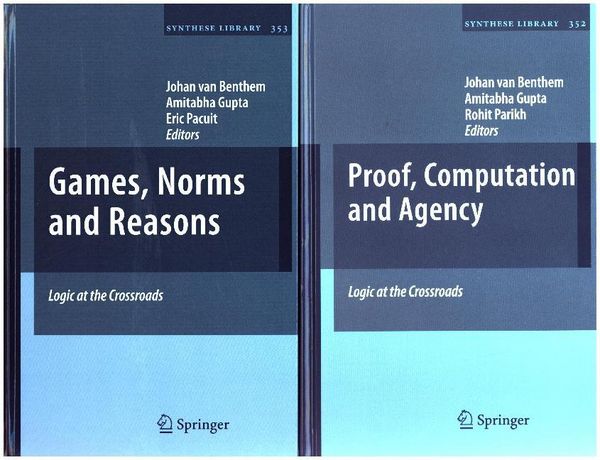
Logic at the Crossroads (set) Proof, Computation and Agency Games, Norms and Reasons
-
- Englisch ausgewählt
144,99 €
UVP
164,99 €
inkl. gesetzl. MwSt.,
Beschreibung
Produktdetails
Einband
Set mit diversen Artikeln
Erscheinungsdatum
30.09.2012
Abbildungen
Approx. 650 p. 2 volume-set.
Herausgeber
Amitabha Gupta + weitereVerlag
Springer NetherlandSeitenzahl
2
Maße (B/H)
15,5/23,5 cm
Gewicht
1241 g
Auflage
2012
Sprache
Englisch
ISBN
978-94-007-0920-1
Proof, Computation and Agency
Proof, Computation and Agency: Logic at the Cross Roads
provides an overview of Logic and its relationship with other disciplines, and some of the emerging areas in terms. The volume brings out an inspiring paradigm, called 'Social Software', the study of patterns of social interaction by means of techniques from logic and computer science. Besides, it demonstrates how an extended view of logic can join forces with the social sciences, game theory or social choice theory, in studying patterns and procedures in social agency, and systematizing this field. Moreover, the study of Logic-Language- Cognition connection forms an important component of the fresh approach the volume.
Finally, the volume explores the nature of the contributions made in Indian tradition in logic by demonstrating that the validity of inference is not a purely formal notion and logic could be placed in the context of epistemology and the Indian scientific tradition. The book takes up Indian logic in its connections with philosophical epistemology and the philosophy of science and exhibits how topics ran naturally into each other.
Games, Norms and Reasons
The explanation as to why logic is perceived as standing at the crossroads has to do with fact that in the recent past logic, in relationship with several academic disciplines closely related to it, has been a catalyst in giving rise to new research programmes or even innovative academic fields.
Games, Norms, and Reasons: Logic at the Crossroads
provides an overview of Logic and its relationship with other disciplines, and some of the emerging areas in terms of leading articles by pioneers in the field. The first part of this is devoted to exploring aspects of norms, reasons, preferences and beliefs in human agency, human interaction or structured groups, sometimes using the logic of games or by developing novel frameworks, concepts and ideas appropriate for such exploration. The papers in the second part of the volume are dedicated to Rohit Parikh who embodies some of the new trends in the explorations mentioned above that are not only seminal, but shaped the direction of a field, sometimes even creating it.
Noch keine Bewertungen vorhanden
Verfassen Sie die erste Bewertung zu diesem Artikel
Helfen Sie anderen Kundinnen und Kunden durch Ihre Meinung.
Kurze Frage zu unserer Seite
Vielen Dank für Ihr Feedback
Wir nutzen Ihr Feedback, um unsere Produktseiten zu verbessern. Bitte haben Sie Verständnis, dass wir Ihnen keine Rückmeldung geben können. Falls Sie Kontakt mit uns aufnehmen möchten, können Sie sich aber gerne an unseren Kund*innenservice wenden.
zum Kundenservice