KI-Beratung Beta

Gutscheinbedingungen

**Gültig bis 30.11.2026 auf Spielzeug, Schreibwaren, Filme, Geschenke & Trends, Musik, tolino eReader & Zubehör, Hörbücher und Hörbuch-Downloads, nicht preisgebundene Bücher und Kalender online auf thalia.at und in der Thalia App. Einzelne Artikel können ausgeschlossen sein. Aufgrund der Buchpreisbindung sind deutschsprachige Bücher und eBooks ausgenommen. Zusätzlich ausgenommen sind Abos & Flatrates, Games, Geschenkkarten/-boxen, Shelfies, Software, Zeitschriften sowie einzelne Artikel von tonies®. Pro Einkauf einmal einlösbar. Nur gültig mit im Onlineshop hinterlegter Bonuscard. Click & Collect nur bei Onlinevorabzahlung möglich. Keine Barauszahlung. Nicht kombinierbar mit anderen Aktionen und Gutscheinen. Gutschein wird auf max. 500€ Bestellwert angerechnet. Nicht gültig für Versandkosten und Services.

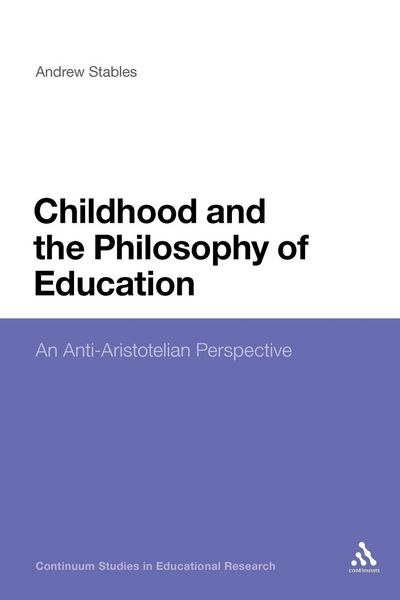
Produktbild: Childhood and the Philosophy of Education

Childhood and the Philosophy of Education An Anti-Aristotelian Perspective

107,99 €

inkl. gesetzl. MwSt., Versandkostenfrei


Beschreibung

Philosophical accounts of childhood have tended to derive from Plato and Aristotle, who portrayed children (like women, animals, slaves, and the mob) as unreasonable and incomplete in terms of lacking formal and final causes and ends. Despite much rhetoric concerning either the sinfulness or purity...

Beschreibung

Philosophical accounts of childhood have tended to derive from Plato and Aristotle, who portrayed children (like women, animals, slaves, and the mob) as unreasonable and incomplete in terms of lacking formal and final causes and ends. Despite much rhetoric concerning either the sinfulness or purity of children (as in Puritanism and Romanticism respectively), the assumption that children are marginal has endured. Modern theories, including recent interpretations of neuroscience, have re-enforced this sense of children's incompleteness. 
This fascinating monograph seeks to overturn this philosophical tradition. It develops instead a "fully semiotic" perspective, arguing that in so far as children are no more or less interpreters of the world than adults, they are no more or less reasoning agents. This, the book shows, has radical implications, particularly for the question of how we seek to educate children. One Aristotelian legacy is the unquestioned belief that societies must educate the young irrespective of the latter's wishes. Another is that childhood must be grown out of and left behind.

Produktdetails

Einband

Taschenbuch

Erscheinungsdatum

07.04.2011

Verlag Continnuum-3pl
Seitenzahl

212

Produktdetails

Einband

Taschenbuch

Erscheinungsdatum

07.04.2011

Verlag Continnuum-3pl
Seitenzahl

212

Maße (L/B/H)

23,4/15,6/1,2 cm

Gewicht

330 g

Sprache

Englisch

ISBN

978-1-4411-9833-4

Herstelleradresse

Libri GmbH
Europaallee 1
36244 Bad Hersfeld
DE

Email: gpsr@libri.de

Noch keine Bewertungen vorhanden

Verfassen Sie die erste Bewertung zu diesem Artikel

Helfen Sie anderen Kundinnen und Kunden durch Ihre Meinung.

Kundinnen und Kunden meinen

Bewertungen (0)

  • Produktbild: Childhood and the Philosophy of Education
  • Introduction: The conception of childhood \ Part I: The Aristotelian Heritage \ 1.1. How Anti-Aristotelian can one be? \ 1.2. Aristotle's debt to Plato \ 1.3. Aristotle: children as people in formation \ 1.4. Histories of childhood: footnotes to Aristotle? \ 1.5. Pessimism and sin: the Puritan child \ 1.6. Optimism and enlightenment: the liberal child \ 1.7. Trailing clouds of glory: the romantic child \ 1.8. The postmodern child: less than not much? \ Part II: A Fully Semiotic View of Childhood \ 2.1. Living as semiotic engagement \ 2.2. The meaning-making semiotic child \ 2.3 Learning and schooling: Dewey and beyond \ Part III: Education Reconsidered \ 3.1. The roots of compulsory schooling \ 3.2 The extension of the in-between years \ 3.3 Teaching for significant events: identity and non-identity \ Part IV: The Child in Society \ 4.1 The child and the law \ 4.2 Semiosis and social policy \
    4.3 Doing children justice \ References \ Index