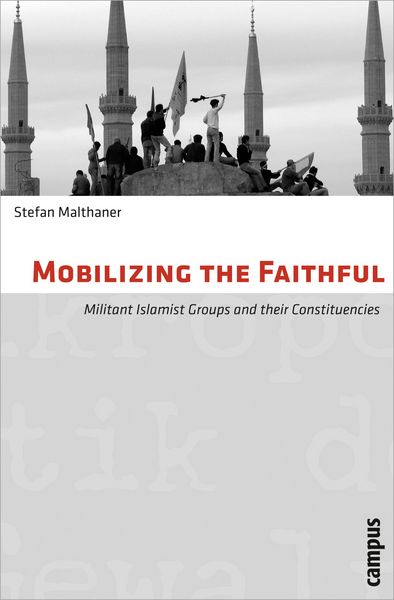
Produktbild: Mobilizing the Faithful
Band 4

Mobilizing the Faithful Militant Islamist Groups and their Constituencies

Aus der Reihe Mikropolitik der Gewalt

40,10 €

inkl. gesetzl. MwSt., Versandkostenfrei


Beschreibung

Produktdetails

Einband

Taschenbuch

Erscheinungsdatum

09.05.2011

Abbildungen

3 Abbildungen

Verlag

Campus

Seitenzahl

273

Maße (L/B/H)

21,2/14,4/2,3 cm

Gewicht

370 g

Auflage

1

Sprache

Englisch

ISBN

978-3-593-39412-1

Beschreibung

Rezension

Malthaner leistet mit der relationalen Analyse der Beziehungsdynamiken zwischen Gewaltgruppen und ihren Unterstützern einen wesentlichen Beitrag zur Konfliktforschung im Hinblick auf islamistische Bewegungen. (portal für politikwissenschaft, 15.09.2011)

Produktdetails

Einband

Taschenbuch

Erscheinungsdatum

09.05.2011

Abbildungen

3 Abbildungen

Verlag

Campus

Seitenzahl

273

Maße (L/B/H)

21,2/14,4/2,3 cm

Gewicht

370 g

Auflage

1

Sprache

Englisch

ISBN

978-3-593-39412-1

Herstelleradresse

Beltz Verlagsgruppe GmbH & Co. KG
Werderstr. 10
69469 Weinheim
DE
info@campus.de

Kundinnen und Kunden meinen

0 Bewertungen

Informationen zu Bewertungen

Zur Abgabe einer Bewertung ist eine Anmeldung im Konto notwendig. Die Authentizität der Bewertungen wird von uns nicht überprüft. Wir behalten uns vor, Bewertungstexte, die unseren Richtlinien widersprechen, entsprechend zu kürzen oder zu löschen.

Die Bewertungen sind nach Format, Anzahl Sterne und Datum sortiert.

Verfassen Sie die erste Bewertung zu diesem Artikel

Helfen Sie anderen Kund*innen durch Ihre Meinung

Kundinnen und Kunden meinen

0 Bewertungen filtern

Die Leseprobe wird geladen.
  • Produktbild: Mobilizing the Faithful
  • Contents

    Acknowledgements 9

    1. Introduction 11
    1.1 Militant Islamist groups and their constituencies in social science research 15
    1.2 Research question and design of this study 24
    1.3 The case studies and criteria for comparison 25
    1.4 Central concepts 27
    1.5 Research strategies, methods, and sources 30
    1.6 The structure of this book 36

    2. Violent insurgencies and relationships of support: Outlines of an analytical framework 38
    2.1 Engaging in relationships: Forms of orientation and reference groups 39
    2.2 Support relationships: Setting and basic forms 42
    2.3 Forms of influence in relationships of support 51
    2.4 Summary 55

    3. Between Islamic revolution and resistance: The militant groups' aims and perspectives 56
    3.1 Killing the Pharaoh, creating an Islamic society: Al-Jamaa al-Islamiyya and al-Jihad in Egypt 57
    3.2 Resistance against occupation and the Islamic revolution in Lebanon: Hizbullah 77
    3.3 Summary: Aims and patterns of orientation 93

    4. The setting: Militant Islamist groups and their social environment 95
    4.1 Al-Jamaa al-Islamiyya: Rebellion in the Sa'id and Cairo's shantytowns 96
    4.2 Hizbullah: Insurgency in South Lebanon, ruling the suburbs 108
    4.3 Summary 116

    5. Support relationships I: Al-Jamaa al-Islamiyya - Spreading the Call and ruling the neighborhood 118
    5.1 "They were just good Muslims": Support for the Islamist movement and al-Jamaa al-Islamiyya in Ayn Shams 119
    5.2 Al-Jamaa al-Islamiyya in Imbaba: "Ruling" the neighborhood 127
    5.3 Establishing a following at the university and beyond: Al-Jamaa al-Islamiyya in Assiut 131
    5.4 Breaking with the past: Family relationships and al-Jamaa al-Islamiyya 136
    5.5 Al-Jihad: Preparing clandestinely for a coup d'état 140
    5.6 Summary: Relationships of support between al-Jamaa al-Islamiyya and its constituency 141

    6. Development patterns I: Al-Jamaa al-Islamiyya - Escalation, estrangement, and radicalization 144
    6.1 Fragmentation under pressure: The development of support relationships in Ayn Shams and Imbaba 145
    6.2 Losing ground: Al-Jamaa al-Islamiyya's insurgency in Assiut 150
    6.3 The war against collaborators: Al-Jamaa al-Islamiyya in al-Minya 159
    6.4 From ambushes to massacres: Decline of the insurgency and loss of constraints on violent practices 164
    6.5 From ambivalence to condemnation: Al-Jamaa al-Islamiyya and their audiences in public discourse 167
    6.6 The development of al-Jihad 169
    6.7 Summary: Dynamics of estrangement and fragmentation 171

    7. Support Relationships II: Outcast, defender, provider - Hizbullah and the Shiite community in Lebanon 174
    7.1 Building a movement and providing for the neighborhood: Hizbullah in the southern suburbs of Beirut 175
    7.2 Reigning in the clans: Hizbullah in the Beqaa 182
    7.3 Becoming part of the community: The Islamic Resistance in South Lebanon 185
    7.4 Joining a subculture and an army: Becoming a member of Hizbullah 195
    7.5 Summary: Relationships of support between Hizbullah and the Shiite community in Lebanon 198

    8. Development Patterns II: Hizbullah - Resilience, adaptation, and consolidation of support 201
    8.1 Support for the "resistance" and its resilience under pressure 202
    8.2 Bringing Iran to Lebanon and "wasting" the community's sons: Elements of controversy and friction 204
    8.3 Adaptation and strategic re-orientation: Hizbullah's response to opposition and weakening support 211
    8.4 Consolidation of support and control 218
    8.5 Summary: Dynamics of support, adaptation, and control 230

    9. Conclusion: Militant Islamist groups and their constituencies - Relationships of support and control 232
    9.1 Relationship structures: Forms of reference, ties of support, and forms of influence 233
    9.2 Development patterns 246
    9.3 Militant groups and their constituencies: The logic of relational analysis 255

    10. List of maps and tables 260

    11. References 261