Gutscheinbedingungen

**Gültig bis 06.07.2026 auf fremdsprachige Bücher online auf thalia.at, in der Thalia App ab einem Mindestbestellwert von 30€ und in allen Thalia Buchhandlungen in Österreich. In den Buchhandlungen nur gültig auf lagernde Ware. Einzelne Artikel können ausgeschlossen sein. Ausgenommen sind preisgebundene Artikel & eBooks. Pro Einkauf einmal einlösbar. Nur gültig gegen Vorlage oder im Onlineshop hinterlegter Bonuscard. Infos zur Einlösung in der Buchhandlung sind auf der Bonuscard-Vorteilspreisseite zu finden. Click & Collect nur bei Onlinevorabzahlung möglich. Keine Einlösung bei Scan & Go-Bezahlung. Keine Barauszahlung. Nicht kombinierbar mit anderen Aktionen und Gutscheinen. Gutschein wird auf max. 500€ Bestellwert angerechnet. Nicht gültig für Versandkosten und Services.

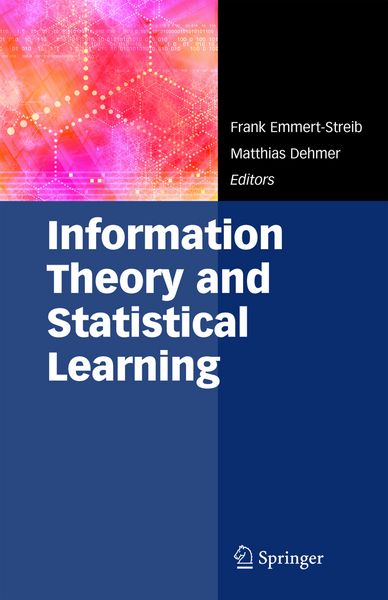
  • Produktbild: Information Theory and Statistical Learning
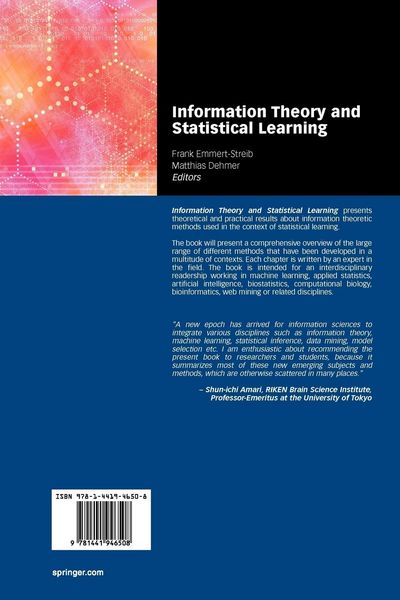
  • Produktbild: Information Theory and Statistical Learning
- 12%

Information Theory and Statistical Learning

12% sparen

95,99 € UVP 109,99 €

inkl. gesetzl. MwSt., Versandkostenfrei


Beschreibung

Produktdetails

Einband

Taschenbuch

Erscheinungsdatum

04.11.2010

Herausgeber

Frank Emmert-Streib + weitere

Verlag

Springer Us

Seitenzahl

439

Maße (L/B/H)

23,5/15,5/2,5 cm

Gewicht

688 g

Auflage

Softcover reprint of hardcover 1st ed. 2009

Sprache

Englisch

ISBN

978-1-4419-4650-8

Beschreibung

Portrait

Matthias Dehmer studied mathematics at the University of Siegen (Germany) and received his PhD in computer science from the Technical University of Darmstadt (Germany). Afterwards, he was a research fellow at Vienna Bio Center (Austria), Vienna University of Technology and University of Coimbra (Portugal). Currently, he is Professor at UMIT - The Health and Life Sciences University (Austria). His research interests are in bioinformatics, cancer analysis, chemical graph theory, systems biology, complex networks, complexity, statistics and information theory. In particular, he is also working on machine learning-based methods to design new data analysis methods for solving problems in computational biology and medicinal chemistry.
Frank Emmert-Streib studied physics at the University of Siegen (Germany) and received his Ph.D. in Theoretical Physics from the University of Bremen (Germany). He was a postdoctoral research associate at the Stowers Institute for Medical Research (Kansas City, USA) in the Department for Bioinformatics and a Senior Fellow at the University of Washington (Seattle, USA) in the Department of Biostatistics and the Department of Genome Sciences. Currently, he is Lecturer/Assistant Professor at the Queen's University Belfast at the Center for Cancer Research and Cell Biology (CCRCB) leading the Computational Biology and Machine Learning Lab. His research interests are in the field of computational biology, machine learning and biostatistics in the development and application of methods from statistics and machine learning for the analysis of high-throughput data from genomics and genetics experiments.

Produktdetails

Einband

Taschenbuch

Erscheinungsdatum

04.11.2010

Herausgeber

Verlag

Springer Us

Seitenzahl

439

Maße (L/B/H)

23,5/15,5/2,5 cm

Gewicht

688 g

Auflage

Softcover reprint of hardcover 1st ed. 2009

Sprache

Englisch

ISBN

978-1-4419-4650-8

Herstelleradresse

Springer-Verlag KG
Sachsenplatz 4-6
1201 Wien
AT

Email: GPSR Kontakt

Noch keine Bewertungen vorhanden

Verfassen Sie die erste Bewertung zu diesem Artikel

Helfen Sie anderen Kundinnen und Kunden durch Ihre Meinung.

Kundinnen und Kunden meinen

Bewertungen (0)

  • Produktbild: Information Theory and Statistical Learning
  • Produktbild: Information Theory and Statistical Learning
  • Algorithmic Probability: Theory and Applications.- Model Selection and Testing by the MDL Principle.- Normalized Information Distance.- The Application of Data Compression-Based Distances to Biological Sequences.- MIC: Mutual Information Based Hierarchical Clustering.- A Hybrid Genetic Algorithm for Feature Selection Based on Mutual Information.- Information Approach to Blind Source Separation and Deconvolution.- Causality in Time Series: Its Detection and Quantification by Means of Information Theory.- Information Theoretic Learning and Kernel Methods.- Information-Theoretic Causal Power.- Information Flows in Complex Networks.- Models of Information Processing in the Sensorimotor Loop.- Information Divergence Geometry and the Application to Statistical Machine Learning.- Model Selection and Information Criterion.- Extreme Physical Information as a Principle of Universal Stability.- Entropy and Cloning Methods for Combinatorial Optimization, Sampling and Counting Using the Gibbs Sampler.