Gutscheinbedingungen

**Gültig bis 06.07.2026 auf fremdsprachige Bücher online auf thalia.at, in der Thalia App ab einem Mindestbestellwert von 30€ und in allen Thalia Buchhandlungen in Österreich. In den Buchhandlungen nur gültig auf lagernde Ware. Einzelne Artikel können ausgeschlossen sein. Ausgenommen sind preisgebundene Artikel & eBooks. Pro Einkauf einmal einlösbar. Nur gültig gegen Vorlage oder im Onlineshop hinterlegter Bonuscard. Infos zur Einlösung in der Buchhandlung sind auf der Bonuscard-Vorteilspreisseite zu finden. Click & Collect nur bei Onlinevorabzahlung möglich. Keine Einlösung bei Scan & Go-Bezahlung. Keine Barauszahlung. Nicht kombinierbar mit anderen Aktionen und Gutscheinen. Gutschein wird auf max. 500€ Bestellwert angerechnet. Nicht gültig für Versandkosten und Services.

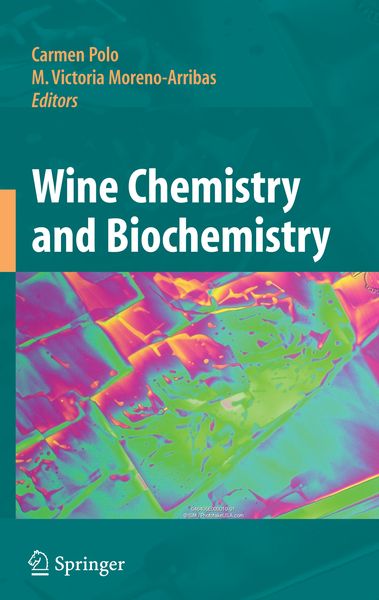
  • Produktbild: Wine Chemistry and Biochemistry
  • Produktbild: Wine Chemistry and Biochemistry
- 13%

Wine Chemistry and Biochemistry

13% sparen

266,99 € UVP 307,99 €

inkl. gesetzl. MwSt., Versandkostenfrei


Beschreibung

Produktdetails

Einband

Taschenbuch

Erscheinungsdatum

29.10.2010

Herausgeber

M. Victoria Moreno-Arribas + weitere

Verlag

Springer Us

Seitenzahl

735

Maße (L/B/H)

23,5/15,5/4,1 cm

Gewicht

1118 g

Auflage

Softcover reprint of hardcover 1st ed. 2009

Sprache

Englisch

ISBN

978-1-4419-2548-0

Beschreibung

Portrait

Carmen Polo is Research Professor at the Institute of Industrial Fermentations of the Spanish National Research Council (CSIC) at Madrid, Spain. She was the Director of the Institute from 1991 through 2002. She is member of the experts group of the Sub-Commission of Methods of Analysis from the International Organisation of Vine and Wine (OIV). She was awarded with the OIV prize for the book "El vinagre de vino". Dr. Polo is author of more than 90 research papers in peer reviewer journals and more than 20 books chapters in books of scientific editorials. M. Victoria Moreno-Arribas is a Senior at the Institute of Industrial Fermentations of the Spanish National Research Council (CSIC) at Madrid, Spain. She is member of the Spanish Delegation as an expertise in the International Organization of Vine and Wine (OIV). She is also been appointed Professor of Enology by the Autonoma University of Madrid (UAM). She is author in over 70 SCI papers and 18 book chapters in books of scientific editorials.

Produktdetails

Einband

Taschenbuch

Erscheinungsdatum

29.10.2010

Herausgeber

Verlag

Springer Us

Seitenzahl

735

Maße (L/B/H)

23,5/15,5/4,1 cm

Gewicht

1118 g

Auflage

Softcover reprint of hardcover 1st ed. 2009

Sprache

Englisch

ISBN

978-1-4419-2548-0

Herstelleradresse

Springer-Verlag KG
Sachsenplatz 4-6
1201 Wien
AT

Email: GPSR Kontakt

Noch keine Bewertungen vorhanden

Verfassen Sie die erste Bewertung zu diesem Artikel

Helfen Sie anderen Kundinnen und Kunden durch Ihre Meinung.

Kundinnen und Kunden meinen

Bewertungen (0)

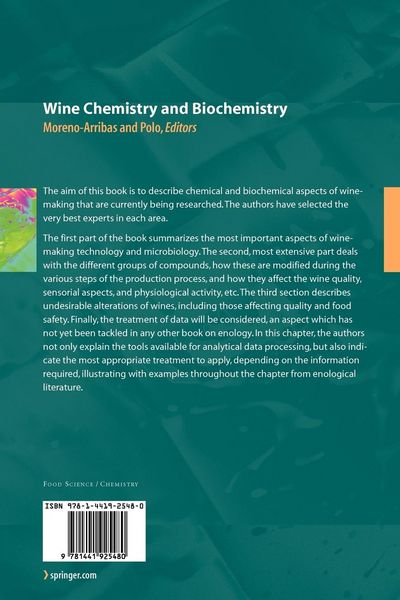
  • Produktbild: Wine Chemistry and Biochemistry
  • Produktbild: Wine Chemistry and Biochemistry
  • Chemical and Biochemical Aspects ofWinemaking.- Biochemistry of Alcoholic Fermentation.- Biochemical Transformations Produced by Malolactic Fermentation.- Special Wines Production.- SparklingWines and Yeast Autolysis.- Biologically Aged Wines.- Enzymes in Winemaking.- Use of Enological Additives for Colloid and Tartrate Salt Stabilization in White Wines and for Improvement of Sparkling Wine Foaming Properties.- Wine Chemical Compounds and Biochemical Processes.- Nitrogen Compounds.- Amino Acids and Biogenic Amines.- Peptides.- Proteins.- Carbohydrates.- Volatile and Aroma Compounds.- Wine Aroma Precursors.- Polyfunctional Thiol Compounds.- Volatile Compounds and Wine Aging.- Yeasts and Wine Flavour.- Identification of Impact Odorants of Wines.- Interactions Between Wine Matrix Macro-Components and Aroma Compounds.- Phenolic Compounds.- Anthocyanins and Anthocyanin-Derived Compounds.- Flavanols, Flavonols and Dihydroflavonols.- Non-flavonoid Phenolic Compounds.- Influence of Phenolics on Wine Organoleptic Properties.- Health-Promoting Effects of Wine Phenolics.- Spoilage ofWines.- Aromatic Spoilage of Wines by Raw Materials and Enological Products.- Wine Spoilage by Fungal Metabolites.- Automatic Analysers and Data Processing.- Automatic Analysers in Oenology.- Statistical Techniques for the Interpretation of Analytical Data.