Gutscheinbedingungen

**Gültig nur für Bestellungen an die Wunsch-Poststation bis 10.06.2026 auf Spielzeug, Schreibwaren, Filme, Geschenke & Trends, Musik, tolino eReader & Zubehör, Hörbücher und Hörbuch-Downloads (außer Abo), nicht preisgebundene Bücher und Kalender online auf thalia.at und in der Thalia App. Einzelne Artikel können ausgeschlossen sein. Aufgrund der Buchpreisbindung sind deutschsprachige Bücher und eBooks ausgenommen. Zusätzlich ausgenommen sind preisgebundene Artikel, Abos & Flatrates, eBooks, Games, Geschenkkarten/-boxen, Shelfies, Software, Zeitschriften sowie einzelne Artikel von tonies®. Pro Einkauf einmal einlösbar. Kein Click & Collect möglich. Keine Barauszahlung. Nicht kombinierbar mit anderen Aktionen und Gutscheinen. Gutschein wird auf max. 500€ Bestellwert angerechnet. Nicht gültig für Versandkosten und Services.

  • Produktbild: Environmental Economics
  • Produktbild: Environmental Economics

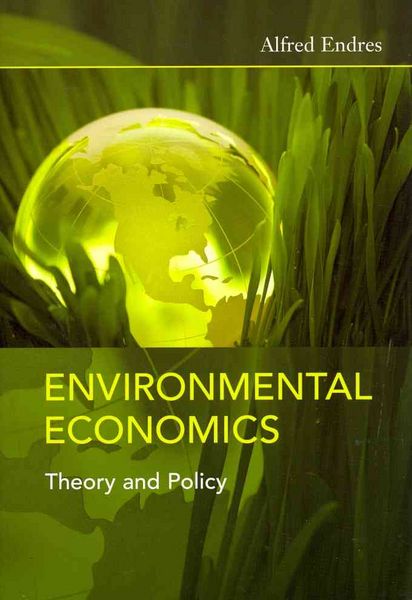
Environmental Economics Theory and Policy

98,99 €

inkl. gesetzl. MwSt., Versandkostenfrei


Beschreibung

Produktdetails

Einband

Taschenbuch

Erscheinungsdatum

03.02.2011

Verlag

Cambridge University Press

Seitenzahl

400

Maße (L/B/H)

25,4/17,8/2,1 cm

Gewicht

690 g

Übersetzt von

Iain L. Fraser

Sprache

Englisch

ISBN

978-0-521-17392-6

Beschreibung

Rezension

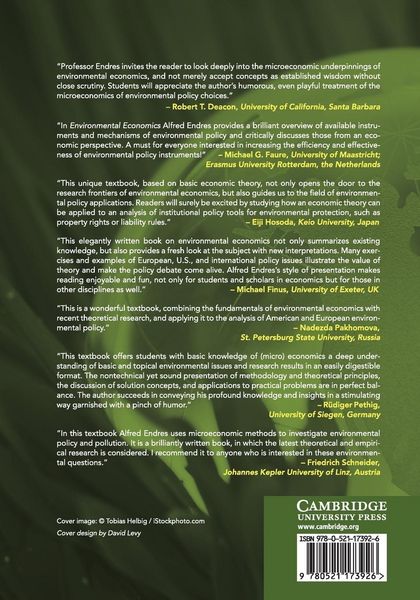
'Professor Endres invites the reader to look deeply into the microeconomic underpinnings of environmental economics, and not merely accept concepts as established wisdom without close scrutiny. Students will appreciate the author's humorous, even playful treatment of the microeconomics of environmental policy choices.' Robert T. Deacon, University of California, Santa Barbara

Zitat

'Professor Endres invites the reader to look deeply into the microeconomic underpinnings of environmental economics, and not merely accept concepts as established wisdom without close scrutiny. Students will appreciate the author's humorous, even playful treatment of the microeconomics of environmental policy choices.' Robert T. Deacon, University of California, Santa Barbara 'In Environmental Economics Alfred Endres provides a brilliant overview of available instruments and mechanisms of environmental policy and critically discusses those from an economic perspective. A must for everyone interested in increasing the efficiency and effectiveness of environmental policy instruments!' Michael G. Faure, University of Maastricht and Erasmus University Rotterdam, the Netherlands 'This unique textbook, based on basic economic theory, not only opens the door to the research frontiers of environmental economics, but also guides us to the field of environmental policy applications. Readers will surely be excited by studying how an economic theory can be applied to an analysis of institutional policy tools for environmental protection, such as property rights or liability rules.' Eiji Hosoda, Keio University, Japan 'This elegantly written book on environmental economics not only summarizes existing knowledge, but also provides a fresh look at the subject with new interpretations. Many exercises and examples of European, U.S., and international policy issues illustrate the value of theory and make the policy debate come alive. Alfred Endres's style of presentation makes reading enjoyable and fun, not only for students and scholars in economics but for those in other disciplines as well.' Michael Finus, University of Exeter 'This is a wonderful textbook, combining the fundamentals of environmental economics with recent theoretical research, and applying it to the analysis of American and European environmental policy.' Nadezda Pakhomova, St Petersburg State University 'This textbook offers students with basic knowledge of (micro) economics a deep understanding of basic and topical environmental issues and research results in an easily digestible format. The nontechnical yet sound presentation of methodology and theoretical principles, the discussion of solution concepts, and applications to practical problems are in perfect balance. The author succeeds in conveying his profound knowledge and insights in a stimulating way garnished with a pinch of humor.' Rudiger Pethig, University of Siegen 'In this textbook Alfred Endres uses microeconomic methods to investigate environmental policy and pollution. It is a brilliantly written book, in which the latest theoretical and empirical research is considered. I recommend it to anyone who is interested in these environmental questions.' Friedrich Schneider, Johannes Kepler University of Linz

Produktdetails

Einband

Taschenbuch

Erscheinungsdatum

03.02.2011

Verlag

Cambridge University Press

Seitenzahl

400

Maße (L/B/H)

25,4/17,8/2,1 cm

Gewicht

690 g

Übersetzt von

Iain L. Fraser

Sprache

Englisch

ISBN

978-0-521-17392-6

Herstelleradresse

Libri GmbH
Europaallee 1
36244 Bad Hersfeld
DE

Email: Libri GmbH

Kundinnen und Kunden meinen

0 Bewertungen

Informationen zu Bewertungen

Zur Abgabe einer Bewertung ist eine Anmeldung im Konto notwendig. Die Authentizität der Bewertungen wird von uns nicht überprüft. Wir behalten uns vor, Bewertungstexte, die unseren Richtlinien widersprechen, entsprechend zu kürzen oder zu löschen.

Die Bewertungen sind nach Format, Anzahl Sterne und Datum sortiert.

Verfassen Sie die erste Bewertung zu diesem Artikel

Helfen Sie anderen Kund*innen durch Ihre Meinung

Kundinnen und Kunden meinen

0 Bewertungen filtern

Die Leseprobe wird geladen.
  • Produktbild: Environmental Economics
  • Produktbild: Environmental Economics
  • Part I. The Internalization of Externalities as Central Theme of Environmental Policy: 1. Foundations; 2. Implications of making the concept of internalization programmatic in environment policy; Part II. Strategies for Internalizing Externalities: 3. Negotiations; 4. Environmental liability law; 5. Pigovian tax; Part III. Standard-Oriented Instruments of Environmental Policy: 6. Introduction; 7. Types of environmental policy instruments; 8. Assessment of environmental policy instruments; Part IV. Extensions of the Basic Environmental-Economics Model: 9. Environmental policy with pollutant interactions; 10. Environmental policy with imperfect competition; 11. Internalization negotiations with asymmetrical information; 12. The 'double dividend' of the green tax; 13. The induction of advances in environmental technology through environment policy; Part V. International Environmental Problems: 14. Introduction; 15. International environmental agreements; 16. Instruments of international environmental policy - the example of the EU's emissions trading; 17. Epilogue: the vision of a federal US emission trading system; Part VI. Natural Resources and Sustainable Development: 18. Resource exhaustion - the end of mankind?; 19. Renewable resources; 20. Sustainable development; Epilogue: three types of externality and the increasing difficulty of internalizing them.