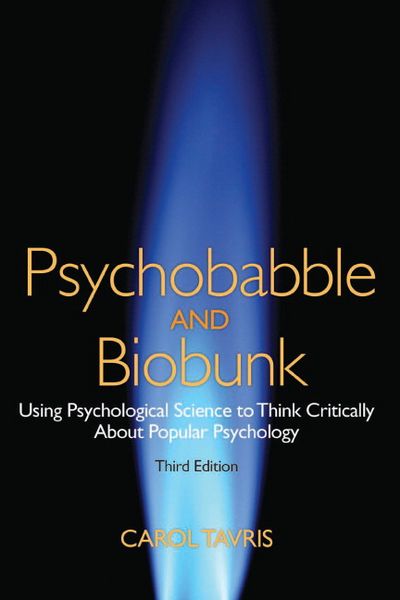
Psychobabble and Biobunk: Using Psychological Science to Think Critically About Popular Psychology
-
- Englisch ausgewählt
62,99 €
UVP
69,99 €
inkl. gesetzl. MwSt.,
Beschreibung
Produktdetails
Einband
Taschenbuch
Erscheinungsdatum
10.10.2024
Verlag
Pearson StudiumSeitenzahl
120
Maße (L/B/H)
23,4/15,6/0,7 cm
Gewicht
308 g
Auflage
3
Sprache
Englisch
ISBN
978-0-205-01591-7
This revised and updated handbook features a selection of essay-style book reviews by Carol Tavris, written for the Times Literary Supplement, The Chronicle of Higher Education, American Scientist, and The New York Times Book Review. These reviews apply psychological research and principles of scientific thinking to ideas presented in the books. They aim to show how critical thinking can help people assess arguments promoted in the popular culture, and how to separate those that are scientifically sound from those based on "psychobabble"-pop-psych notions dressed up in fancy, sciency-sounding language. These essays may be used to encourage debate in the classroom or as a basis for student papers. Students can be asked to write or present their own points of view on a topic, drawing on other research and the guidelines of critical thinking (defined and described in a prefatory "Note to the Reader") to support their conclusions. Although these reviews can be used in many social science and composition courses, the topics covered and the critical-thinking guidelines that apply to them correspond to specific material in Carole Wade and Carol Tavris's Psychology and Invitation to Psychology.
Noch keine Bewertungen vorhanden
Verfassen Sie die erste Bewertung zu diesem Artikel
Helfen Sie anderen Kundinnen und Kunden durch Ihre Meinung.
Kurze Frage zu unserer Seite
Vielen Dank für Ihr Feedback
Wir nutzen Ihr Feedback, um unsere Produktseiten zu verbessern. Bitte haben Sie Verständnis, dass wir Ihnen keine Rückmeldung geben können. Falls Sie Kontakt mit uns aufnehmen möchten, können Sie sich aber gerne an unseren Kund*innenservice wenden.
zum Kundenservice