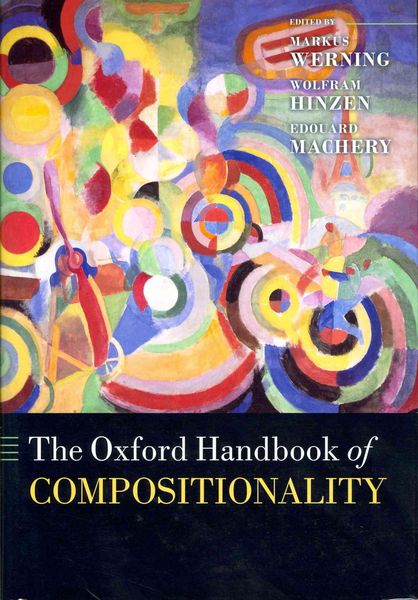
Produktbild: Oxford Handbook of Compositionality

Oxford Handbook of Compositionality

271,99 €

inkl. gesetzl. MwSt., Versandkostenfrei


Beschreibung

Produktdetails

Einband

Gebundene Ausgabe

Erscheinungsdatum

09.02.2012

Herausgeber

Werning Markus + weitere

Verlag

Oxford Academic

Seitenzahl

766

Maße (L/B/H)

25/17,5/4,5 cm

Gewicht

1477 g

Sprache

Englisch

ISBN

978-0-19-954107-2

Beschreibung

Produktdetails

Einband

Gebundene Ausgabe

Erscheinungsdatum

09.02.2012

Herausgeber

Verlag

Oxford Academic

Seitenzahl

766

Maße (L/B/H)

25/17,5/4,5 cm

Gewicht

1477 g

Sprache

Englisch

ISBN

978-0-19-954107-2

Herstelleradresse

Libri GmbH
Europaallee 1
36244 Bad Hersfeld
DE

Email: gpsr@libri.de

Noch keine Bewertungen vorhanden

Verfassen Sie die erste Bewertung zu diesem Artikel

Helfen Sie anderen Kundinnen und Kunden durch Ihre Meinung.

Kundinnen und Kunden meinen

Bewertungen (0)

  • Produktbild: Oxford Handbook of Compositionality

    • Introduction


    • Part I: History and Overview


    • 1: Theo Janssen: Compositionality: Its Historic Context


    • 2: Marcus Kracht: Compositionality in Montague Grammar


    • 3: Zoltan Szabo: The Case for Compositionality


    • 4: Ede Zimmermann: Compositionality Problems and How to Solve Them


    • Part II: Compositionality in Language


    • 5: Sebastian Löbner: Sub-Compositionality


    • 6: Pauline Jacobson: Direct Compositionality


    • 7: Jeff Pelletier: Holism and Compositionality


    • 8: Francois Recanati: Compositionality, Flexibility, and Context-dependence


    • 9: Dag Westerstahl: Compositionality in Kaplan Style Semantics


    • 10: Paul Pietroski: Semantic Monadicity with Conceptual Polyadicity


    • Part III: Compositionality in Formal Semantics


    • 11: Wilfrid Hodges: Formalising the Relationship Between Meaning and Syntax


    • 12: Tim Fernando: Compositionality in Discourse From a Logical Perspective


    • 13: Gabriel Sandu: Compositionality and the Context Principle


    • Part IV: Lexical Decomposition


    • 14: Dieter Wunderlich: Lexical Decomposition in Grammar


    • 15: Wolfram Hinzen: Syntax in the Atom


    • 16: Heidi Harley: Lexical Decomposition in Modern Syntactic Theory


    • 17: James Pustejovsky: Co-compositionality


    • Part V: The Compositionality of Mind


    • 18: Lila Gleitman,Andrew Connolly, and Sharon L. Armstrong: Can Prototype Representations Support Composition and Decomposition?


    • 19: James Hampton and Martin Jönsson: Typicality and Compositionality: The Logic of Combining Vague Concepts


    • 20: Edward Wisniewski and Jing Wu: Emergency!!! Challenges to a Compositional Understanding of Noun-noun Combinations


    • 21: Edouard Machery and Lisa Lederer: Simple Heuristics for Concept Combination


    • 22: Jesse Prinz: Regaining Composure: A Defense of Prototype Compositionality


    • Part VI: Evolutionary and Communicative Success of Compositional Structures


    • 23: Gerhard Schurz: Prototypes and their Composition from an Evolutionary Point of View


    • 24: Kenny Smith and Simon Kirby: Compositionality and Linguistic Evolution


    • 25: Michael Arbib: Compositionality and Holophrasis: From Action and Perception Through Protolanguage to Language


    • 26: Peter Pagin: Communication and the Complexity of Semantics


    • Part VII: Neural Models fo Compositional Representation


    • 27: Terry Horgan: Connectionism, Dynamical Cognition, and Non-Classical Compositional Representation


    • 28: Martina Penke: The Dual-Mechanism Debate


    • 29: Terrence Stewart and Chris Eliasmith: Compositionality and Biologically Plausible Models


    • 30: Andreas K. Engel and Alexander Maye: Neural Assemblies, the Binding Problem, and Neural Synchrony


    • 31: Markus Werning: Non-symbolic Compositional Representation and Its neuronal Foundation: Towards an Emulative Semantics


    • 32: Giosue Baggio, Michiel van Lambalgen, and Peter Hagoort: The Processing Consequences of Compositionality


    • Appendix


    • References


    • Index