KI-Beratung Beta

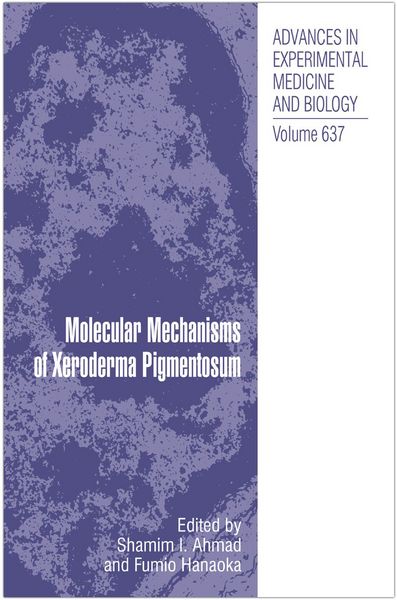
Produktbild: Molecular Mechanisms of Xeroderma Pigmentosum
Band 637 - 12%

Molecular Mechanisms of Xeroderma Pigmentosum

12% sparen

192,99 € UVP 219,99 €

inkl. gesetzl. MwSt., Versandkostenfrei


Beschreibung

Produktdetails

Einband

Taschenbuch

Erscheinungsdatum

25.11.2010

Abbildungen

XXVII, 166 p. 34 illus., 1 illus. in color.

Herausgeber

Shamim Ahmad + weitere

Verlag

Springer Us

Seitenzahl

166

Maße (L/B/H)

23,5/15,5/1,1 cm

Gewicht

306 g

Auflage

Softcover reprint of hardcover 1st ed. 2009

Sprache

Englisch

ISBN

978-1-4419-1870-3

Beschreibung

Portrait

Sham im I. Ahma d is a Senior Lecturer at Nottingham Trent University, Nottingham, England. After obtaining his MSc from Patna University, India, and his PhD from Leicester University, England, he joined Nottingham Polytechnic which subsequently became Nottingham Trent University. For about three decades he has been working in the field of DNA damage and repair particularly on Near UV photolysis of biological compounds, production of free radicals and their implications on human health including skin cancer and xeroderma pigmentosum. Also compounds inducing double strand DNA damage, 8-methoxypsoralen +UVA, mitomycin C, and nitrogen mustard have been under investigation including their importance in psoriasis treatment and Fanconi anemia. Additional research included: thymineless death in bacteria, genetic control of nucleotides catabolism, development of anti-AIDS drug, control of microbial infections of burns, phages of thermophiles and microbial flora of Chernobyl after the accident. In 2003 he received a prestigious “Asian Jewel Award” in Britain for “Excellence in Education”. He is also the Editor of the book, Molecular Mechanisms of Fanconi Anemia, published by Landes Bioscience.

Fumio Hanaoka is a Professor at the Graduate School of Frontier Biosciences, Osaka University and the Program Leader of the Solution Oriented Research for Science and Technology of the Japan Science and Technology Agency, Japan. He received his undergraduate and PhD degrees from the University of Tokyo and did his Postdoctoral at McArdle Laboratory for Cancer Research, University of Wisconsin, Madison, USA. He joined the University of Tokyo in 1980 and in 1989 moved to RIKEN Institute as the Head of the Radiation Research Laboratory. In 1995, he joined the Institute for Molecular and Cellular Biology (now known as Graduate School of Frontier Biosciences), Osaka University. His main research interests include the molecular mechanisms of DNA replication and repair in eukaryotes. He served as the President of Molecular Biology Society of Japan (2005-2007) and has been serving on several editorial boards, including Journal of Biological Chemistry and Genes to Cells.

Produktdetails

Einband

Taschenbuch

Erscheinungsdatum

25.11.2010

Abbildungen

XXVII, 166 p. 34 illus., 1 illus. in color.

Herausgeber

Verlag

Springer Us

Seitenzahl

166

Maße (L/B/H)

23,5/15,5/1,1 cm

Gewicht

306 g

Auflage

Softcover reprint of hardcover 1st ed. 2009

Sprache

Englisch

ISBN

978-1-4419-1870-3

Herstelleradresse

Springer-Verlag KG
Sachsenplatz 4-6
1201 Wien
AT

Email: ProductSafety@springernature.com

Noch keine Bewertungen vorhanden

Verfassen Sie die erste Bewertung zu diesem Artikel

Helfen Sie anderen Kundinnen und Kunden durch Ihre Meinung.

Kundinnen und Kunden meinen

Bewertungen (0)

  • Produktbild: Molecular Mechanisms of Xeroderma Pigmentosum
  • Historical Aspects of Xeroderma Pigmentosum and Nucleotide Excision Repair.- Clinical Features of Xeroderma Pigmentosum.- Xeroderma Pigmentosum and Skin Cancer.- XPA Gene, Its Product and Biological Roles.- XPB and XPD between Transcription and DNA Repair.- XPC: Its Product and Biological Roles.- The XPE Gene of Xeroderma Pigmentosum, Its Product and Biological Roles.- XPF/ERCC4 and ERCC1: Their Products and Biological Roles.- XPG: Its Products and Biological Roles.- Xeroderma Pigmentosum Variant, XP-V: Its Product and Biological Roles.- Other Proteins Interacting with XP Proteins.- The Nucleotide Excision Repair of DNA in Human Cells and Its Association with Xeroderma Pigmentosum.- Roles of Oxidative Stress in Xeroderma Pigmentosum.- Xeroderma Pigmentosum: Its Overlap with Trichothiodystrophy, Cockayne Syndrome and Other Progeroid Syndromes.- Population Distribution of Xeroderma Pigmentosum.- Progress and Prospects of Xeroderma Pigmentosum Therapy.- Animal Models of Xeroderma Pigmentosum.