KI-Beratung Beta

Gutscheinbedingungen

**Gültig am 20.11.2026 ab einem Mindestbestellwert von 30€ auf Spielzeug, Schreibwaren, Filme, Geschenke & Trends, Musik, tolino eReader & Zubehör, Hörbücher und Hörbuch-Downloads, nicht preisgebundene Bücher und Kalender online auf thalia.at und in der Thalia App. Einzelne Artikel können ausgeschlossen sein. Aufgrund der Buchpreisbindung sind deutschsprachige Bücher und eBooks ausgenommen. Zusätzlich ausgenommen sind Abos & Flatrates, Games, Geschenkkarten/-boxen, Shelfies, Software, Zeitschriften sowie einzelne Artikel von tonies®. Pro Einkauf einmal einlösbar. Click & Collect nur bei Onlinevorabzahlung möglich. Keine Barauszahlung. Nicht kombinierbar mit anderen Aktionen und Gutscheinen. Gutschein wird auf max. 500€ Bestellwert angerechnet. Nicht gültig für Versandkosten und Services. Preisgebundene Artikel sind vom Mindestbestellwert ausgeschlossen.

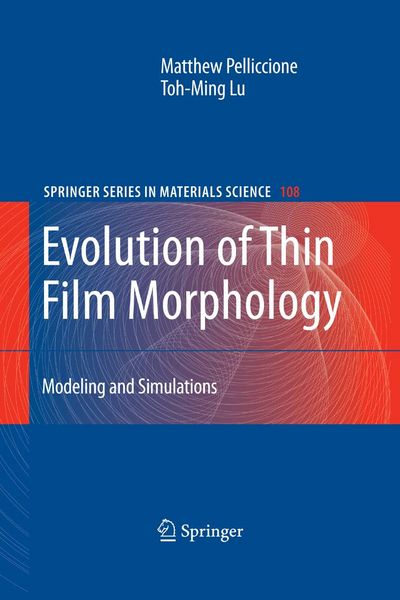
Produktbild: Evolution of Thin Film Morphology
Band 108

Evolution of Thin Film Morphology Modeling and Simulations

148,99 €

inkl. gesetzl. MwSt., Versandkostenfrei


Beschreibung

Thin?lmdepositionisthemostubiquitousandcriticaloftheprocessesusedto manufacture high-tech devices such as microprocessors, memories, solar cells, microelectromechanicalsystems(MEMS),lasers,solid-statelighting,andp- tovoltaics. The morphology and microstructure of thin ?lms directly controls their optical,...

Beschreibung

Thin?lmdepositionisthemostubiquitousandcriticaloftheprocessesusedto manufacture high-tech devices such as microprocessors, memories, solar cells, microelectromechanicalsystems(MEMS),lasers,solid-statelighting,andp- tovoltaics. The morphology and microstructure of thin ?lms directly controls their optical, magnetic, and electrical properties, which are often signi?cantly di?erent from bulk material properties. Precise control of morphology and microstructure during thin ?lm growth is paramount to producing the - sired ?lm quality for speci?c applications. To date, many thin ?lm deposition techniques have been employed for manufacturing ?lms, including thermal evaporation,sputterdeposition,chemicalvapordeposition,laserablation,and electrochemical deposition. The growth of ?lms using these techniques often occurs under highly n- equilibrium conditions (sometimes referred to as far-from-equilibrium), which leads to a rough surface morphology and a complex temporal evolution. As atoms are deposited on a surface, atoms do not arrive at the surface at the same time uniformly across the surface. This random ?uctuation, or noise, which is inherent to the deposition process, may create surface growth front roughness. The noise competes with surface smoothing processes, such as surface di?usion, to form a rough morphology if the experiment is performed at a su?ciently low temperature and / or at a high growth rate. In addition, growth front roughness can also be enhanced by growth processes such as geometrical shadowing. Due to the nature of the deposition process, atoms approaching the surface do not always approach in parallel; very often atoms arrive at the surface with an angular distribution.

Produktdetails

Einband

Taschenbuch

Erscheinungsdatum

19.11.2010

Abbildungen

XI, 206 p.

Verlag Springer Us

Produktdetails

Einband

Taschenbuch

Erscheinungsdatum

19.11.2010

Abbildungen

XI, 206 p.

Verlag Springer Us
Seitenzahl

206

Maße (L/B/H)

23,5/15,5/1,3 cm

Gewicht

341 g

Auflage

Softcover reprint of hardcover 1st edition 2008

Sprache

Englisch

ISBN

978-1-4419-2580-0

Herstelleradresse

Springer-Verlag GmbH
Tiergartenstr. 17
69121 Heidelberg
DE

Email: ProductSafety@springernature.com

Noch keine Bewertungen vorhanden

Verfassen Sie die erste Bewertung zu diesem Artikel

Helfen Sie anderen Kundinnen und Kunden durch Ihre Meinung.

Kundinnen und Kunden meinen

Bewertungen (0)

  • Produktbild: Evolution of Thin Film Morphology
  • Description of Thin Film Morphology.- Surface Statistics.- Self-Affine Surfaces.- Mounded Surfaces.- Continuum Surface Growth Models.- Stochastic Growth Equations.- Small World Growth Model.- Discrete Surface Growth Models.- Monte Carlo Simulations.- Solid-on-Solid Models.- Ballistic Aggregation Models.- Concluding Remarks.