KI-Beratung Beta

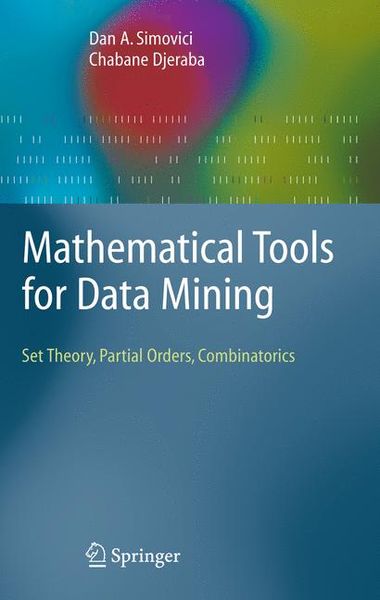
Produktbild: Mathematical Tools for Data Mining
- 12%

Mathematical Tools for Data Mining Set Theory, Partial Orders, Combinatorics

12% sparen

144,99 € UVP 164,99 €

inkl. gesetzl. MwSt., Versandkostenfrei


Beschreibung

The maturing of the field of data mining has brought about an increased level of mathematical sophistication. Such disciplines like topology, combinatorics, partially ordered sets and their associated algebraic structures (lattices and Boolean algebras), and metric spaces are increasingly applied in...

Beschreibung

The maturing of the field of data mining has brought about an increased level of mathematical sophistication. Such disciplines like topology, combinatorics, partially ordered sets and their associated algebraic structures (lattices and Boolean algebras), and metric spaces are increasingly applied in data mining research. This book presents these mathematical foundations of data mining integrated with applications to provide the reader with a comprehensive reference.
Mathematics is presented in a thorough and rigorous manner offering a detailed explanation of each topic, with applications to data mining such as frequent item sets, clustering, decision trees also being discussed. More than 400 exercises are included and they form an integral part of the material. Some of the exercises are in reality supplemental material and their solutions are included. The reader is assumed to have a knowledge of elementary analysis.
Features and topics: Study of functions and relations Applications are provided throughout Presents graphs and hypergraphs Covers partially ordered sets, lattices and Boolean algebras Finite partially ordered sets Focuses on metric spaces Includes combinatorics Discusses the theory of the Vapnik-Chervonenkis dimension of collections of sets
This wide-ranging, thoroughly detailed volume is self-contained and intended for researchers and graduate students, and will prove an invaluable reference tool. This book integrates the mathematics of data mining with its applications, offering the reader a reference to the mathematical tools required for data mining.
Dedicated to the study of set-theoretical foundations of data mining, this book is focused on set theory and several closely related areas: partially ordered sets and lattice theory, metric spaces and combinatorics. The book is structured into 4 parts and presents a comprehensive discussion of the subject.
Features and topics include: - Study of functions and relations, - Applications are provided throughout, - Presents graphs and hypergraphs, - Covers partially ordered sets, lattices and Boolean algebras, - Finite partially ordered sets, - Focuses on metric spaces, - Includes combinatorics, - Discusses the theory of the Vapnik-Chervonenkis dimension of collections of sets.
Intended as a reference for the working data miner and researchers, a good knowledge of calculus is required to make the best use of this book, which will prove a useful reference.

Produktdetails

Einband

Taschenbuch

Abbildungen

81 SW-Abb., 5 Tabellen

Verlag Springer London
Seitenzahl

616

Produktdetails

Einband

Taschenbuch

Abbildungen

81 SW-Abb., 5 Tabellen

Verlag Springer London
Seitenzahl

616

Maße (B/H)

15,5/23,5 cm

Auflage

Softcover reprint of hardcover 1st ed. 2008

Sprache

Englisch

ISBN

978-1-84996-751-8

Herstelleradresse

Springer Heidelberg
Tiergartenstr. 17
69121 Heidelberg
DE
buchhandel-buch@springer.com

Noch keine Bewertungen vorhanden

Verfassen Sie die erste Bewertung zu diesem Artikel

Helfen Sie anderen Kundinnen und Kunden durch Ihre Meinung.

Kundinnen und Kunden meinen

Bewertungen (0)

  • Produktbild: Mathematical Tools for Data Mining
  • Set Theory.- Sets, Relations, and Functions.- Algebras.- Graphs and Hypergraphs.- Partial Orders.- Partially Ordered Sets.- Lattices and Boolean Algebras.- Topologies and Measures.- Frequent Item Sets and Association Rules.- Applications to Databases and Data Mining.- Rough Sets.- Metric Spaces.- Dissimilarities, Metrics, and Ultrametrics.- Topologies and Measures on Metric Spaces.- Dimensions of Metric Spaces.- Clustering.- Combinatorics.- Combinatorics.- The Vapnik-Chervonenkis Dimension.