KI-Beratung Beta

Gutscheinbedingungen

**Gültig bis 30.11.2026 auf Spielzeug, Schreibwaren, Filme, Geschenke & Trends, Musik, tolino eReader & Zubehör, Hörbücher und Hörbuch-Downloads, nicht preisgebundene Bücher und Kalender online auf thalia.at und in der Thalia App. Einzelne Artikel können ausgeschlossen sein. Aufgrund der Buchpreisbindung sind deutschsprachige Bücher und eBooks ausgenommen. Zusätzlich ausgenommen sind Abos & Flatrates, Games, Geschenkkarten/-boxen, Shelfies, Software, Zeitschriften sowie einzelne Artikel von tonies®. Pro Einkauf einmal einlösbar. Nur gültig mit im Onlineshop hinterlegter Bonuscard. Click & Collect nur bei Onlinevorabzahlung möglich. Keine Barauszahlung. Nicht kombinierbar mit anderen Aktionen und Gutscheinen. Gutschein wird auf max. 500€ Bestellwert angerechnet. Nicht gültig für Versandkosten und Services.

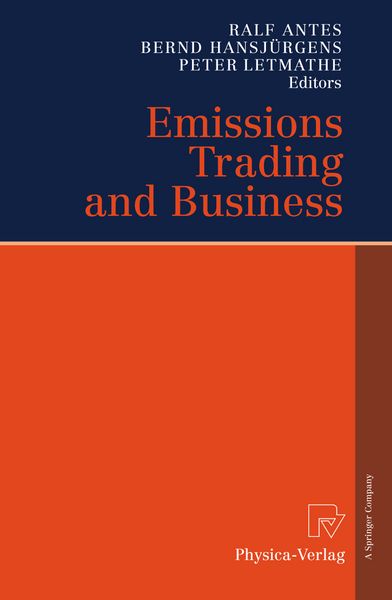
Produktbild: Emissions Trading and Business

Emissions Trading and Business

99,99 €

inkl. gesetzl. MwSt., Versandkostenfrei


Beschreibung

Emissions trading challenges the management of companies in an entirely new manner. It does not only allow for a bigger flexibility in management decisions concerning emission issues like other marked based environmental policy instruments. Furthermore it changes the code by which environmental policy...

Beschreibung

Emissions trading challenges the management of companies in an entirely new manner. It does not only allow for a bigger flexibility in management decisions concerning emission issues like other marked based environmental policy instruments. Furthermore it changes the code by which environmental policy steers management decisions from hierarchical to monetary information. But is this change transmitted and mirrored in management decisions, processes and structures? And, how do they change? When flexibility is given to the companies they have several opportunities to react. Moreover different institutional architectures of emissions trading schemes are possible and have been implemented, like in the US, the UK or the EU. The 24 contributions discuss theoretically and empirically in four parts the following subjects: 1. Institutional design, decision making and innovation, 2. Investment and management strategies, 3. ET and business administration, 4. Effects of ET schemes existing and being implemented.

Rezension

From the reviews:


"This book is an intellectual exchange between two disciplines, economics and business/management studies … . An interesting book for economists working with emissions trading schemes or for environmentalist which want to know more about the economical factors involved in emissions trading schemes." (European Circular, Issue 33, Winter 2008-2009)

Portrait

Prof. Dr. Peter Letmathe ist Inhaber des Lehrstuhls für Betriebswirtschaftslehre mit dem Schwerpunkt Wertschöpfungsmanagement insbesondere in kleinen und mittleren Unternehmen an der Universität Siegen.

Produktdetails

Einband

Taschenbuch

Erscheinungsdatum

19.10.2010

Abbildungen

XIV, 400 p.

Herausgeber Ralf Antes + weitere

Produktdetails

Einband

Taschenbuch

Erscheinungsdatum

19.10.2010

Abbildungen

XIV, 400 p.

Herausgeber
Verlag Physica
Seitenzahl

400

Maße (L/B/H)

23,5/15,5/2,3 cm

Gewicht

628 g

Auflage

1. Auflage

Sprache

Englisch

ISBN

978-3-7908-2529-9

Herstelleradresse

Physica Verlag
Tiergartenstr. 17
69121 Heidelberg
DE

Email: ProductSafety@springernature.com

Noch keine Bewertungen vorhanden

Verfassen Sie die erste Bewertung zu diesem Artikel

Helfen Sie anderen Kundinnen und Kunden durch Ihre Meinung.

Kundinnen und Kunden meinen

Bewertungen (0)

  • Produktbild: Emissions Trading and Business
  • Institutional design, decision making and innovation.- Abatement costs vs. compliance costs in multi-period emissions trading — the firms’ perspective.- Generous allocation and a ban on banking — implications of a simulation game for EU emissions trading.- Emissions trading and innovation in the German electricity industry — impact of possible design options for an emissions trading scheme on innovation strategies in the German electricity industry.- A dynamic game of technology diffusion under emissions trading: an experiment.- Sustainability entrepreneurship in the context of emissions trading.- Investment and management strategies under emissions trading.- Optimal strategies for emissions trading in a Putty-Clay Vintage Model.- Strategic production management of companies participating in the European greenhouse gas emission allowance trading scheme.- Decision making in the emissions-market under uncertainty.- The impact of climate policy on heat and power capacity investment decisions.- Implications of the European emissions trading scheme for strategic energy management in small and medium enterprises.- Management and optimization of environmental data within emissions trading markets — VEREGISTER and TEMPI.- Emissions trading with changing future commitments — some initial thoughts.- Emissions trading and business administration.- Emission Trading North — important findings from a business perspective.- Corporate greenhouse gas management in the context of emissions trading regimes.- Accounting for emission rights.- The role of stakeholder driven corporate governance — the example of BP’s climate change strategy.- Emissions trading and effects on financial markets.- Effects of emissions trading schemes existing and being implemented.- The EUemissions trading scheme and its competitiveness effects upon European business — results from the CGE model DART.- Implementing the EU emissions trading directive in Spain: a comparative study of corporate concerns and strategies in different industrial sectors.- UK’s climate change levy and emissions trading scheme: implications for businesses’ productivity and economic efficiency.- The sources of emission reductions: evidence from U.S. SO2 emissions from 1985 through 2002.- Policy-business interaction in emissions trading between multiple regions.- The changing role of the project mechanisms in emissions trading.- Prevailing technologies and locations of CDM projects: the current situation compared with expectations.