
• Produktbild: Agrobacterium Protocols
  • Produktbild: Agrobacterium Protocols
Band 344 - 12%

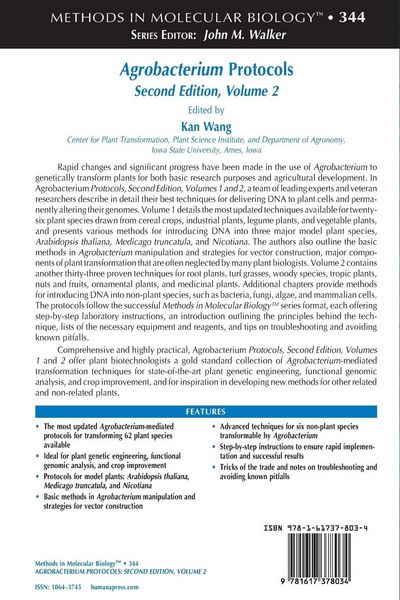
Agrobacterium Protocols Volume II

12% sparen

144,99 € UVP 164,99 €

inkl. gesetzl. MwSt., Versandkostenfrei


Beschreibung

Produktdetails

Einband

Taschenbuch

Erscheinungsdatum

09.12.2010

Abbildungen

87 illus., 6 illus. in color., schwarz-weiss Illustrationen, farbige Illustrationen

Herausgeber

Kan Wang

Verlag

Humana Press

Seitenzahl

512

Maße (L/B/H)

22,9/15,2/2,8 cm

Gewicht

734 g

Auflage

2nd Edition.

Sprache

Englisch

ISBN

978-1-61737-803-4

Beschreibung

Rezension

From the reviews of the second edition:


"This is, as the title suggests, a laboratory manual with protocols for using Agrobacterium tumefaciens to transform plant species … . the book will be a valuable addition to the laboratory bookshelf. The protocols … are clearly set out and the notes explain things … . I was also pleased that some chapters mentioned the need to consider regulatory issues regarding disposal of genetically modified materials, something that is often ignored in lab manuals." (Heather Macdonald, SGM – Society for General Microbiology, 2007)

Produktdetails

Einband

Taschenbuch

Erscheinungsdatum

09.12.2010

Abbildungen

87 illus., 6 illus. in color., schwarz-weiss Illustrationen, farbige Illustrationen

Herausgeber

Kan Wang

Verlag

Humana Press

Seitenzahl

512

Maße (L/B/H)

22,9/15,2/2,8 cm

Gewicht

734 g

Auflage

2nd Edition.

Sprache

Englisch

ISBN

978-1-61737-803-4

Herstelleradresse

Springer-Verlag GmbH
Tiergartenstr. 17
69121 Heidelberg
DE

Email: ProductSafety@springernature.com

Noch keine Bewertungen vorhanden

Verfassen Sie die erste Bewertung zu diesem Artikel

Helfen Sie anderen Kundinnen und Kunden durch Ihre Meinung.

Kundinnen und Kunden meinen

Bewertungen (0)

  • Produktbild: Agrobacterium Protocols
  • Produktbild: Agrobacterium Protocols
  • Root Plants.- Carrot (Daucus carota L.).- Cassava (Manihot esculenta Crantz).- Potato (Solanum tuberosum L.).- Sweet Potato [Ipomoea batatas (L.) Lam.].- Turf Grasses.- Bermudagrass (Cynodon spp.).- Perennial Ryegrass (Lolium perenne L.).- Switchgrass (Panicum virgatum L.).- Tall Fescue (Festuca arundinacea Schreb.).- Turf Grasses.- Woody Species.- American Elm (Ulmus americana).- Cork Oak Trees (Quercus suber L.).- Eucalyptus.- Pine (Pinus radiata).- Poplar (Populus spp.).- Rubber Tree (Hevea brasiliensis Muell. Arg).- Tropic Plants.- Banana (Musa sp.).- Citrus.- Coffee (Coffea sp.).- Papaya (Carica papaya L.).- Pineapple [Ananas comosus (L.) Merr.].- Sugarcane (Saccharum spp.).- Nuts and Fruits.- American Chestnut [Castanea dentata (Marsh.) Borkh.].- Apple (Malus × domestica).- Blueberry (Vaccinium corymbosum L.).- Grapevine (Vitis vinifera L.).- Strawberry (Fragaria × ananassa).- Walnut (Juglans).- Ornamental Plants.- Carnation (Dianthus caryophylus L.).- Chrysanthemum (Dendranthema × grandiflora).- Orchids (Cymbidium spp., Oncidium, and Phalaenopsis).- Petunia (Petunia hybrida).- Rose (Rosa hybrida L.).- Medicinal Plants.- Ginseng (Panax ginseng).- Hemp (Cannabis sativa L.).- Opium Poppy (Papaver somniferum).- Non-Plants.- Actinomycetes (Streptomyces lividans).- Filamentous Fungi (Magnaporthe grisea and Fusarium oxysporum).- Green Alga (Chlamydomonas reinhardtii).- Mammalian Cells.- Mushroom (Agaricus bisporus).- Yeast (Saccharomyces cerevisiae).