KI-Beratung Beta

Gutscheinbedingungen

**Gültig am 27.11.2026 auf Spielzeug, Schreibwaren, Filme, Geschenke & Trends, Musik, tolino eReader & Zubehör, Hörbücher und Hörbuch-Downloads, nicht preisgebundene Bücher und Kalender online auf thalia.at und in der Thalia App. Einzelne Artikel können ausgeschlossen sein. Aufgrund der Buchpreisbindung sind deutschsprachige Bücher und eBooks ausgenommen. Zusätzlich ausgenommen sind Abos & Flatrates, Games, Geschenkkarten/-boxen, Shelfies, Software, Zeitschriften sowie einzelne Artikel von tonies®. Pro Einkauf einmal einlösbar. Click & Collect nur bei Onlinevorabzahlung möglich. Keine Barauszahlung. Nicht kombinierbar mit anderen Aktionen und Gutscheinen. Gutschein wird auf max. 500€ Bestellwert angerechnet. Nicht gültig für Versandkosten und Services.

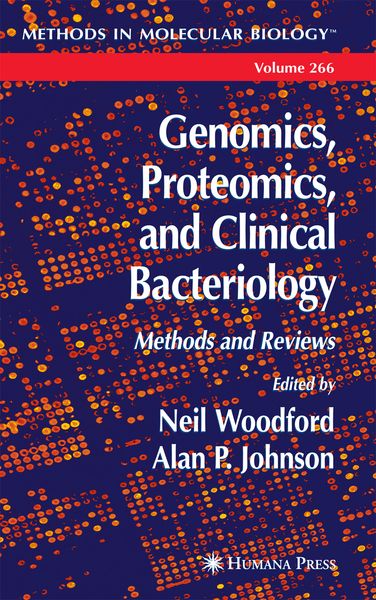
Produktbild: Genomics, Proteomics, and Clinical Bacteriology
Band 266 - 13%

Genomics, Proteomics, and Clinical Bacteriology Methods and Reviews

13% sparen

142,99 € UVP 164,99 €

inkl. gesetzl. MwSt., Versandkostenfrei


Beschreibung

Gazing into crystal balls is beyond the expertise of most scientists. Yet, as we look further into the 21st century, one does not have to be Nostradamus to predict that the current genomics and proteomics "revolution" will have an immense impact on medical bacteriology. This impact is already being re-...

Beschreibung

Gazing into crystal balls is beyond the expertise of most scientists. Yet, as we look further into the 21st century, one does not have to be Nostradamus to predict that the current genomics and proteomics "revolution" will have an immense impact on medical bacteriology. This impact is already being re- ized in many academic departments, and although encroachment on routine diagnostic bacteriology, particularly in the hospital setting, is likely to occur at a slower pace, it remains nonetheless inevitable. Therefore, it is important that no one working in bacteriology should find themselves distanced from these fundamental developments. The involvement of all clinical bacteriologists is essential if the significant achievements of genome sequencing and analysis are to be turned into tangible advances, with resulting benefits for patient care and m- agement. It is our hope that Genomics, Proteomics, and Clinical Bacteriology: Methods and Reviews will play a part in bringing such a development to fruition. The advances in genomics and proteomics have already given us frequent opportunities to reassess our knowledge and understanding of established b- terial adversaries, and have provided us with the means to identify new foes. The new knowledge gained is enabling us to reconsider, for example, our c- cepts of bacterial pathogenicity, phylogeny and novel targets for antibacterial chemotherapy. These topics, and others, are considered in Genomics, Proteomics, and Clinical Bacteriology: Methods and Reviews.

Produktdetails

Einband

Taschenbuch

Erscheinungsdatum

09.12.2010

Abbildungen

X, 398 p.

Herausgeber Neil Woodford + weitere

Produktdetails

Einband

Taschenbuch

Erscheinungsdatum

09.12.2010

Abbildungen

X, 398 p.

Herausgeber
Verlag Humana Press
Seitenzahl

398

Maße (L/B/H)

22,9/15,2/2,3 cm

Gewicht

594 g

Sprache

Englisch

ISBN

978-1-61737-428-9

Herstelleradresse

Libri GmbH
Europaallee 1
36244 Bad Hersfeld
DE

Email: gpsr@libri.de

Noch keine Bewertungen vorhanden

Verfassen Sie die erste Bewertung zu diesem Artikel

Helfen Sie anderen Kundinnen und Kunden durch Ihre Meinung.

Kundinnen und Kunden meinen

Bewertungen (0)

  • Produktbild: Genomics, Proteomics, and Clinical Bacteriology
  • Principles of Bacterial Genomics.- Bacterial Genomes for the Masses.- Public Databases.- Genome Sequencing and Annotation.- Comparative Genomics.- Genome Plasticity.- Exploring and Exploiting Bacterial Proteomes.- Application of Genomics to Diagnostic Bacteriology.- Molecular Diagnostics.- Molecular Diagnostics.- Real-Time PCR.- Microarrays for Bacterial Typing.- Interrogating Bacterial Genomes.- Genomic Approaches to Antibacterial Discovery.- Using the Genome to Understand Pathogenicity.- Identification of Novel Pathogenicity Genes by PCR Signature-Tagged Mutagenesis and Related Technologies.- Discovering New Pathogens.- Exploring the Concept of Clonality in Bacteria.- Bacterial Taxonomics.