KI-Beratung Beta

Gutscheinbedingungen

**Gültig am 12.10.2026 auf englische Krimis & Thriller (krimis-thriller-15521) online auf thalia.at und in der Thalia App. Einzelne Artikel können ausgeschlossen sein. Ausgenommen sind preisgebundene Artikel, Abos & Flatrates. Pro Einkauf einmal einlösbar. Click & Collect nur bei Onlinevorabzahlung möglich. Keine Barauszahlung. Nicht kombinierbar mit anderen Aktionen und Gutscheinen. Gutschein wird auf max. 500€ Bestellwert angerechnet. Nicht gültig für Geschenkkarten, Versandkosten und Services.

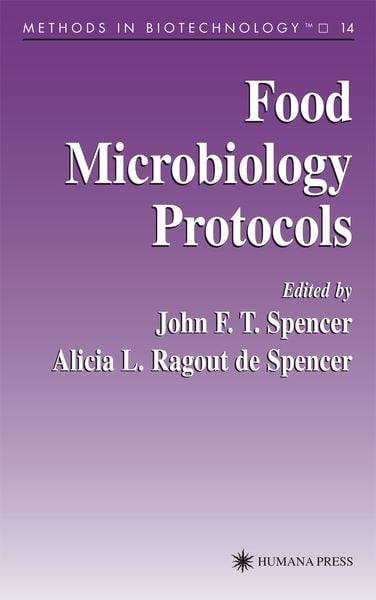
  • Produktbild: Food Microbiology Protocols
  • Produktbild: Food Microbiology Protocols
Band 14 - 12%

Food Microbiology Protocols

Aus der Reihe Methods in Biotechnology
12% sparen

144,99 € UVP 164,99 €

inkl. gesetzl. MwSt., Versandkostenfrei


Beschreibung

Produktdetails

Einband

Taschenbuch

Erscheinungsdatum

19.11.2010

Abbildungen

XIV, 494 p.

Herausgeber

John F. T. Spencer + weitere

Verlag

Humana Press

Seitenzahl

494

Maße (L/B/H)

23,5/15,5/3,2 cm

Gewicht

861 g

Auflage

Softcover reprint of hardcover 1st edition 2001

Sprache

Englisch

ISBN

978-1-61737-230-8

Beschreibung

Produktdetails

Einband

Taschenbuch

Erscheinungsdatum

19.11.2010

Abbildungen

XIV, 494 p.

Herausgeber

Verlag

Humana Press

Seitenzahl

494

Maße (L/B/H)

23,5/15,5/3,2 cm

Gewicht

861 g

Auflage

Softcover reprint of hardcover 1st edition 2001

Sprache

Englisch

ISBN

978-1-61737-230-8

Herstelleradresse

Springer-Verlag GmbH
Tiergartenstr. 17
69121 Heidelberg
DE

Email: ProductSafety@springernature.com

Noch keine Bewertungen vorhanden

Verfassen Sie die erste Bewertung zu diesem Artikel

Helfen Sie anderen Kundinnen und Kunden durch Ihre Meinung.

Kundinnen und Kunden meinen

Bewertungen (0)

  • Produktbild: Food Microbiology Protocols
  • Produktbild: Food Microbiology Protocols
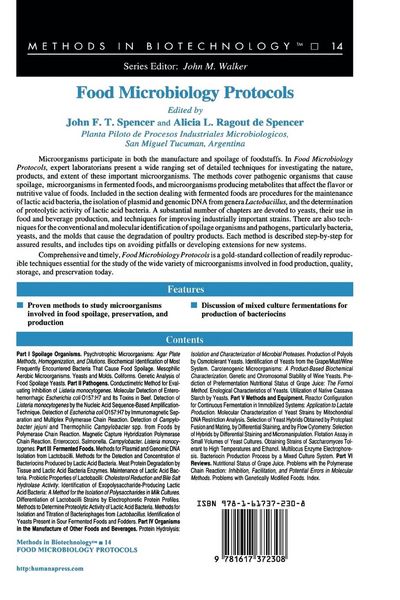
  • Spoilage Organisms.- Psychrotrophic Microorganisms.- Biochemical Identification of Most Frequently Encountered Bacteria That Cause Food Spoilage.- Mesophilic Aerobic Microorganisms.- Yeasts and Molds.- Coliforms.- Genetic Analysis of Food Spoilage Yeasts.- Pathogens.- Conductimetric Method for Evaluating Inhibition of Listeria monocytogenes.- Molecular Detection of Enterohemorrhagic Escherichia coli O157:H7 and Its Toxins in Beef.- Detection of Listeria monocytogenes by the Nucleic Acid Sequence-Based Amplification Technique.- Detection of Escherichia coli O157:H7 by Immunomagnetic Separation and Multiplex Polymerase Chain Reaction.- Detection of Campylobacter jejuni and Thermophilic Campylobacter spp. from Foods by Polymerase Chain Reaction.- Magnetic Capture Hybridization Polymerase Chain Reaction.- Enterococci.- Salmonella.- Campylobacter.- Listeria monocytogenes.- Fermented Foods.- Methods for Plasmid and Genomic DNA Isolation from Lactobacilli.- Methods for the Detection and Concentration of Bacteriocins Produced by Lactic Acid Bacteria.- Meat Protein Degradation by Tissue and Lactic Acid Bacteria Enzymes.- Maintenance of Lactic Acid Bacteria.- Probiotic Properties of Lactobacilli.- Identification of Exopolysaccharide-Producing Lactic Acid Bacteria.- Differentiation of Lactobacilli Strains by Electrophoretic Protein Profiles.- Methods to Determine Proteolytic Activity of Lactic Acid Bacteria.- Methods for Isolation and Titration of Bacteriophages from Lactobacillus.- Identification of Yeasts Present in Sour Fermented Foods and Fodders.- Organisms in the Manufacture of Other Foods and Beverages.- Protein Hydrolysis.- Production of Polyols by Osmotolerant Yeasts.- Identification of Yeasts from the Grape/Must/Wine System.- Carotenogenic Microorganisms.- Genetic and Chromosomal Stability of Wine Yeasts.- Prediction of Prefermentation Nutritional Status of Grape Juice.- Enological Characteristics of Yeasts.- Utilization of Native Cassava Starch by Yeasts.- Methods and Equipment.- Reactor Configuration for Continuous Fermentation in Immobilized Systems.- Molecular Characterization of Yeast Strains by Mitochondrial DNA Restriction Analysis.- Selection of Yeasts Hybrids Obtained by Protoplast Fusion and Mating, by Differential Staining, and by Flow Cytometry.- Selection of Hybrids by Differential Staining and Micromanipulation.- Flotation Assay in Small Volumes of Yeast Cultures.- Obtaining Strains of Saccharomyces Tolerant to High Temperatures and Ethanol.- Multilocus Enzyme Electrophoresis.- Bacteriocin Production Process by a Mixed Culture System.- Reviews.- Nutritional Status of Grape Juice.- Problems with the Polymerase Chain Reaction.- Problems with Genetically Modified Foods.