Gutscheinbedingungen

**Gültig bis 02.09.2026 auf fremdsprachige Bücher in der Thalia App. Einzelne Artikel können ausgeschlossen sein. Ausgenommen sind preisgebundene Artikel & eBooks. Pro Einkauf einmal einlösbar. Click & Collect nur bei Onlinevorabzahlung möglich. Keine Barauszahlung. Nicht kombinierbar mit anderen Aktionen und Gutscheinen. Gutschein wird auf max. 500€ Bestellwert angerechnet. Nicht gültig für Geschenkkarten, Versandkosten und Services.

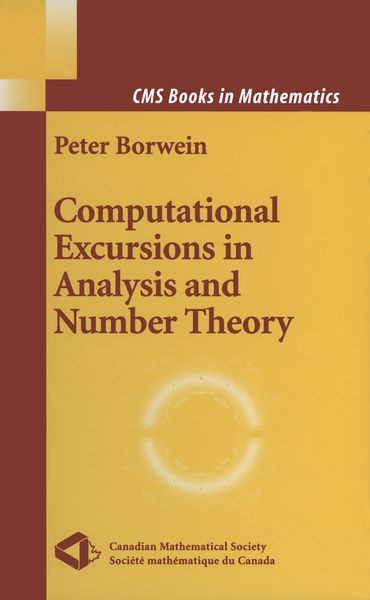
Produktbild: Computational Excursions in Analysis and Number Theory
- 11%

Computational Excursions in Analysis and Number Theory

Aus der Reihe CMS Books in Mathematics
11% sparen

96,99 € UVP 109,99 €

inkl. gesetzl. MwSt., Versandkostenfrei


Beschreibung

Produktdetails

Einband

Taschenbuch

Erscheinungsdatum

03.12.2010

Abbildungen

X, 220 p. 4 illus.

Verlag

Springer Us

Seitenzahl

220

Maße (L/B/H)

23,5/15,5/1,3 cm

Gewicht

359 g

Auflage

Softcover reprint of the original 1st ed. 2002

Sprache

Englisch

ISBN

978-1-4419-3000-2

Beschreibung

Rezension

From the reviews of the first edition:


MAA ONLINE


"Explanations are thorough but not easy to understand. Nevertheless, they can be understood by the determined graduate student in mathematics. However, the ideal mix would be a collection of mathematics and computer science students, as the level of computer expertise needed to code the solutions to the problems is at the upper division level…Research mathematicians often need to be able to write code to attack specific problems when no appropriate software tool is available. This book is ideal for a course designed to teach graduate students how to do that as long as they have or can obtain the necessary programming knowledge."


P. Borwein


Computational Excursions in Analysis and Number Theory


"Borwein has collected known results in the direction of several related, appealing, old, open problems (Integer Chebyshev, Prouhet-Tarry-Escott, Erdos-Szekeres, Littlewood). Far from narrow, this interdisciplinary book draws on Diophantine, analytic, and probabilistic techniques. Also, by dint of the celebrated lattice reduction algorithm, some aspects of these problems admit attack by computer; a handful of intriguing computer graphics offer visceral evidence of the intrinsic complexity of the underlying phenomena. Pisot and Salam numbers make terrific enrichment material for undergraduates. As in all Borwein's books, we get beautiful mathematics gracefully explained."
—CHOICE


"This extraordinary book brings together a variety of old problems – old, but very much alive - about polynomials with integer co-efficients. … The necessary background is also presented, which makes the book self-contained … . this book is suitable for advanced students of analysis and analytic number theory. It is very well written, rather concise and to the point. … Strongly recommended for specialists in computational analysis and number theory." (R. Stroeker, NieuwArchief voor Wiskunde, Vol. 7 (3), 2006)

Produktdetails

Einband

Taschenbuch

Erscheinungsdatum

03.12.2010

Abbildungen

X, 220 p. 4 illus.

Verlag

Springer Us

Seitenzahl

220

Maße (L/B/H)

23,5/15,5/1,3 cm

Gewicht

359 g

Auflage

Softcover reprint of the original 1st ed. 2002

Sprache

Englisch

ISBN

978-1-4419-3000-2

Herstelleradresse

Springer-Verlag GmbH
Tiergartenstr. 17
69121 Heidelberg
DE

Email: ProductSafety@springernature.com

Noch keine Bewertungen vorhanden

Verfassen Sie die erste Bewertung zu diesem Artikel

Helfen Sie anderen Kundinnen und Kunden durch Ihre Meinung.

Kundinnen und Kunden meinen

Bewertungen (0)

  • Produktbild: Computational Excursions in Analysis and Number Theory
  • 1 Introduction.- 2 LLL and PSLQ.- 3 Pisot and Salem Numbers.- 4 Rudin-Shapiro Polynomials.- 5 Fekete Polynomials.- 6 Products of Cyclotomic Polynomials.- 7 Location of Zeros.- 8 Maximal Vanishing.- 9 Diophantine Approximation of Zeros.- 10 The Integer Chebyshev Problem.- 11 The Prouhet-Tarry-Escott Problem.- 12 The Easier Waring Problem.- 13 The Erd?s-Szekeres Problem.- 14 Barker Polynomials and Golay Pairs.- 15 The Littlewood Problem.- 16 Spectra.- A A Compendium of Inequalities.- B Lattice Basis Reduction and Integer Relations.- C Explicit Merit Factor Formulae.- D Research Problems.