Gutscheinbedingungen

**Gültig bis 28.07.2026 auf Spielzeug, Schreibwaren, Filme, Geschenke & Trends, Musik, tolino eReader & Zubehör, Hörbücher und Hörbuch-Downloads (außer Abo), nicht preisgebundene Bücher und Kalender in der Thalia App. Einzelne Artikel können ausgeschlossen sein. Aufgrund der Buchpreisbindung sind deutschsprachige Bücher und eBooks ausgenommen. Zusätzlich ausgenommen sind preisgebundene Artikel, Abos & Flatrates, eBooks, Games, Geschenkkarten/-boxen, Shelfies, Software, Zeitschriften sowie einzelne Artikel von tonies®. Pro Einkauf einmal einlösbar. Click & Collect nur bei Onlinevorabzahlung möglich. Keine Barauszahlung. Nicht kombinierbar mit anderen Aktionen und Gutscheinen. Gutschein wird auf max. 500€ Bestellwert angerechnet. Nicht gültig für Versandkosten und Services.

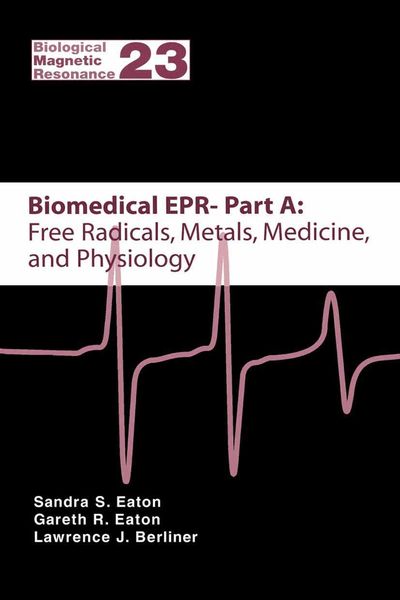
  • Produktbild: Biomedical EPR - Part A: Free Radicals, Metals, Medicine and Physiology
  • Produktbild: Biomedical EPR - Part A: Free Radicals, Metals, Medicine and Physiology
Band 23 - 12%

Biomedical EPR - Part A: Free Radicals, Metals, Medicine and Physiology

12% sparen

289,99 € UVP 329,99 €

inkl. gesetzl. MwSt., Versandkostenfrei


Beschreibung

Produktdetails

Einband

Taschenbuch

Erscheinungsdatum

19.11.2010

Abbildungen

XXIV, 261 illus., schwarz-weiss Illustrationen

Herausgeber

Sandra S. Eaton + weitere

Verlag

Springer Us

Seitenzahl

522

Maße (L/B/H)

22,9/15,2/3 cm

Gewicht

783 g

Auflage

Softcover reprint of hardcover 1st edition 2005

Sprache

Englisch

ISBN

978-1-4419-3456-7

Beschreibung

Portrait

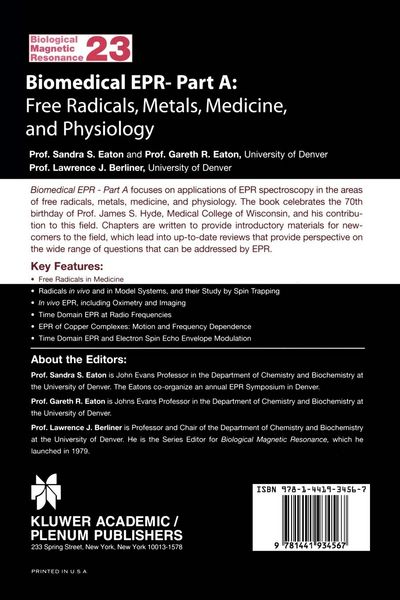
Prof. Sandra S. Eaton is John Evans Professor in the Department of Chemistry and Biochemistry at the University of Denver. Her research interests include distance measurements in proteins, EPR of metal ions in biological systems, electron spin relaxation times, and EPR instrumentation. The Eatons co-organize an annual EPR Symposium in Denver.

Prof. Gareth R. Eaton is John Evans Professor in the Department of Chemistry and Biochemistry at the University of Denver. His research interests include EPR instrumentation, distance measurements in proteins, EPR of metal ions in biological systems, and electron spin relaxation times.

Dr. Lawrence J. Berliner is currently Professor and Chair of the Department of Chemistry and Biochemistry at the University of Denver after retiring from Ohio State University, where he spent a 32-year career in the area of biological magnetic resonance (EPR and NMR). He is the Series Editor for Biological Magnetic Resonance, which he launched in 1979.

Produktdetails

Einband

Taschenbuch

Erscheinungsdatum

19.11.2010

Abbildungen

XXIV, 261 illus., schwarz-weiss Illustrationen

Herausgeber

Verlag

Springer Us

Seitenzahl

522

Maße (L/B/H)

22,9/15,2/3 cm

Gewicht

783 g

Auflage

Softcover reprint of hardcover 1st edition 2005

Sprache

Englisch

ISBN

978-1-4419-3456-7

Herstelleradresse

Springer-Verlag GmbH
Tiergartenstr. 17
69121 Heidelberg
DE

Email: GPSR Kontakt

Noch keine Bewertungen vorhanden

Verfassen Sie die erste Bewertung zu diesem Artikel

Helfen Sie anderen Kundinnen und Kunden durch Ihre Meinung.

Kundinnen und Kunden meinen

Bewertungen (0)

  • Produktbild: Biomedical EPR - Part A: Free Radicals, Metals, Medicine and Physiology
  • Produktbild: Biomedical EPR - Part A: Free Radicals, Metals, Medicine and Physiology
  • Section I. Instrumentation and Methodology Chapter 1 Saturation Recovery EPR; Sandra S. Eaton and Gareth R. Eaton 1. Motivation 2. Brief History 3. Information Content of Saturation Recovery Curves 4. Practical Aspects of Experimental Methodology 5. Applications 6. Prognosis 7. References Chapter 2 Loop-Gap Resonators; George A. Rinard and Gareth R. Eaton 1. Introduction 2. History 3. Why should one use loop-gap resonators? 4. Basics 5. Topologies of loop gap resonators 6. Coupling to Resonators 7. Design equations 8. Magnetic Field Modulation 9. LGR for Time Domain EPR 10. Selection of the Q of a LGR 11. Measuring B1 in the LGR 12. Variable Temperature 13. Mechanical Considerations 14. Commercial Resonators 15. Applications of Lumped-Circuit Resonators 16. Further information 17. References Chapter 3 EPR Interfaced To Rapid Mixing; Charles P. Scholes 1. Introduction 2. The Loop Gap Resonator Based Stopped-Flow System 3. Dielectric Resonator-based Stopped-Flow EPR 4. Applications of Stopped-Flow and Flow EPR to Naturally Occurring Transient Radicals 5. Future Developments and Applications of Flow and Stopped-Flow EPR 6. References Chapter 4 Application of Angle-Selected Electron Nuclear Double Resonance to Characterize Structured Solvent in Small Molecules and Macromolecules; Devkumar Mustafi and Marvin W. Makinen 1. Introduction 2. ENDOR Assignment of Molecular Structure and Conformation with VO2+ and Nitroxyl Spin-Labels 3. ENDOR Characterization of Structured Solvent in Small Molecule Complexes and in Proteins 4. Future Perspectives and Concluding Remarks 5. References Chapter 5 Solution-ENDOR of Some Biologically Interesting Radical Ions; Fabian Gerson and Georg Gescheidt 1. Solution ENDOR Spectroscopy 2. Quinones 3. Porphyrinoids 4. References Chapter 6 Electron-Electron Double Resonance; Lowell D. Kispert 1. Introduction 2. Instrumental Techniques 3. Dynamics of Biomolecules in Liquid Crystals, Glassy Solids, Polymers and Crystals 4. Practical Aspects of Measurements 5. References Chapter 7 Digital Detection by Time-Locked Sampling in EPR; James S. Hyde, Theodore G. Camenisch, Joseph J. Ratke, Robert A. Strangeway, Wojciech Froncisz 1. Introduction 2. Time Locking and Superheterodyne Detection – EPR Instrument Design Background 3. Time-Locked Subsampling Detection for CW EPR 4. Pulse Saturation Recovery Using Time-Locked Subsampling 5. Selected Engineering Considerations 6. Conclusion 7. References Chapter 8 Measurement of Distances Between Electron Spins Using Pulsed EPR; Sandra S. Eaton and Gareth R. Eaton 1. Introduction 2. Fundamental Principles of Interaction between Electron Spins 3. Distance between Two Slowly Relaxing Centers 4. Distance between a Slowly Relaxing Center and a Rapidly-Relaxing Center 5. Some Practical Considerations 6. Recent Examples for Distances between Two Slowly-Relaxing Radicals 7. Recent Examples for Distances between a Rapidly-Relaxing and a Slowly-Relaxing Spin 8. Prognosis 9. References Section II. Motion, Proteins, and Membranes Chapter 9 ESR and Molecular Dynamics; Jack H. Freed 1. Motional Narrowing and Organic Radicals 2. Double Resonance and Molecular Dynamics 3. Slow Motional ESR and Molecular Dynamics 4. High Field ESR and Molecular Dynamics 5. Spin-Echoes and