
• Produktbild: A Classical Introduction to Cryptography
  • Produktbild: A Classical Introduction to Cryptography
- 10%

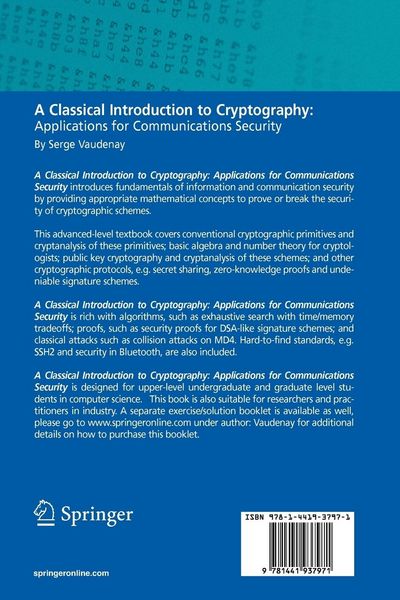
A Classical Introduction to Cryptography Applications for Communications Security

10% sparen

83,99 € UVP 93,49 €

inkl. gesetzl. MwSt., Versandkostenfrei


Rezension

From the reviews:


"This impressive hardback introduces fundamentals of information and communications security by providing mathematical concepts to prove or break the security of cryptographic schemes. … The book is designed for upper-level undergraduates and graduate level students in computer science. This comprehensive volume is also suitable for researchers and practitioners in industry." (Cryptologia, Vol. 30, 2006)


"This book presents, using a chronological order, both conventional cryptography and public-key cryptography, as well as the two sides of cryptanalysis: adversary modelling and proof reduction. … This advanced-level textbook is recommended for those interested in cryptography and its applications: students, researchers, computer scientists, mathematicians, engineers, and practitioners in industry." (Michael M. Dediu, Mathematical Reviews, Issue 2007 b)

Produktdetails

Einband

Taschenbuch

Erscheinungsdatum

29.10.2010

Verlag

Springer Us

Seitenzahl

336

Maße (L/B/H)

23,5/15,5/2 cm

Gewicht

540 g

Auflage

Softcover reprint of hardcover 1st ed. 2006

Sprache

Englisch

ISBN

978-1-4419-3797-1

Rezension

Produktdetails

Einband

Taschenbuch

Erscheinungsdatum

29.10.2010

Verlag

Springer Us

Seitenzahl

336

Maße (L/B/H)

23,5/15,5/2 cm

Gewicht

540 g

Auflage

Softcover reprint of hardcover 1st ed. 2006

Sprache

Englisch

ISBN

978-1-4419-3797-1

Herstelleradresse

Springer-Verlag KG
Sachsenplatz 4-6
1201 Wien
AT

Email: GPSR Kontakt

Noch keine Bewertungen vorhanden

Verfassen Sie die erste Bewertung zu diesem Artikel

Helfen Sie anderen Kundinnen und Kunden durch Ihre Meinung.

Kundinnen und Kunden meinen

Bewertungen (0)

  • Produktbild: A Classical Introduction to Cryptography
  • Produktbild: A Classical Introduction to Cryptography
  • Preamble
    1: Prehistory of Cryptography
    1.1 Foundations of Conventional Cryptography
    1.2 Roots of Modern Cryptography
    1.3 The Shannon Theory of Secrecy
    1.4 Exercises

    2: Conventional Cryptography
    2.1 The Data Encryption Standard (DES)
    2.2 DES Modes of Operation
    2.3 Multiple Encryption
    2.4 An Application of DES: UNIX Passwords
    2.5 Classical Cipher Skeletons
    2.6 Other Block Cipher Examples
    2.7 The Advanced Encryption Standard (AES)
    2.8 Stream Ciphers
    2.9 Brute Force Attacks
    2.10 Exercises

    3: Dedicated Conventional Cryptographic Primitives
    3.1 Cryptographic Hashing
    3.2 The Birthday Paradox
    3.3 A Dedicated Attack on MD4
    3.4 Message Authentication Codes
    3.5 Cryptographic Pseudorandom Generators
    3.6 Exercises
    4: Conventional Security Analysis
    4.1 Differential Cryptanalysis
    4.2 Linear Cryptanalysis
    4.3 Classical Security Strengthening
    4.4 Modern Security Analysis
    4.5 Exercises

    5: Security Protocols with Conventional Cryptography
    5.1 Password Access Control
    5.2 Challenge-Response Protocols
    5.3 One-Time Password
    5.4 Key Distribution
    5.5 Authentication Chains
    5.6 Wireless Communication: Two Case Studies
    5.7 Exercises 6: Algorithmic Algebra
    6.1 Basic Group Theory
    6.2 The Ring Zn
    6.3 The Finite Field Zn
    6.4 Finite Fields
    6.5 Elliptic Curves over Finite Fields
    6.6 Exercises
    7: Algorithmic Number Theory
    7.1 Primality
    7.2 Factorization
    7.3 Computing Orders in Groups
    7.4 Discrete Logarithm
    7.5 Exercises
    8: Elements of Complexity Theory
    8.1 Formal Computation
    8.2 Ability Frontiers
    8.3 Complexity Reduction
    8.4 Exercises

    9: Public-Key Cryptography
    9.1 Diffie-Hellman
    9.2 Experiment with NP-Completeness
    9.3 Rivest-Shamir-Adleman (RSA)
    9.4 ElGamal Encryption
    9.5 Exercises

    10: Digital Signature
    10.1 Digital Signature Schemes
    10.2 RSA Signature
    10.3 ElGamal Signature Family
    10.4 Toward Provable Security for Digital Signatures
    10.5 Exercises

    11: Cryptographic Protocols
    11.1 Zero-Knowledge
    11.2 Secret Sharing
    11 3 Special Purpose Digital Signatures
    11.4 Other Protocols
    11.5 Exercises
    12: From Cryptography to Communication Security
    12.1 Certificates
    12.2 SSH: Secure Shell
    12.3 SSL: Secure Socket Layer
    12.4 PGP: Pretty Good Privacy
    12.5 Exercises

    Further Readings
    Bibliography
    Index