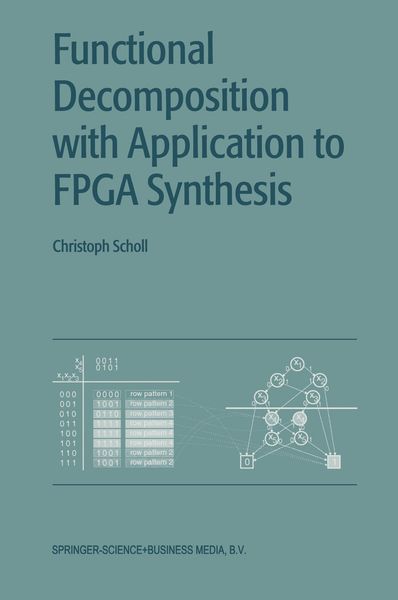
Functional Decomposition with Applications to FPGA Synthesis
-
- Hardcover
- Taschenbuch ausgewählt
- eBook
-
Sprache:Englisch
144,99 €
UVP
164,99 €
inkl. gesetzl. MwSt.,
Beschreibung
Produktdetails
Einband
Taschenbuch
Erscheinungsdatum
03.12.2010
Verlag
Springer UsSeitenzahl
264
Maße (L/B/H)
23,5/15,5/1,6 cm
Gewicht
454 g
Auflage
Softcover reprint of hardcover 1st edition 2002
Sprache
Englisch
ISBN
978-1-4419-4929-5
Functional decomposition has emerged as an essential technique in automatic logic synthesis for FPGAs. Functional decomposition as a technique to find realizations for Boolean functions was already introduced in the late fifties and early sixties by Ashenhurst, Curtis, Roth and Karp. In recent years, however, it has attracted a great deal of renewed attention, for several reasons. First, it is especially well suited for the synthesis of lookup-table based FPGAs. Also, the increased capacities of today's computers as well as the development of new methods have made the method applicable to larger-scale problems. Modern techniques for functional decomposition profit from the success of Reduced Ordered Binary Decision Diagrams (ROBDDs), data structures that provide compact representations for many Boolean functions occurring in practical applications. We have now seen the development of algorithms for functional decomposition which work directly based on ROBDDs, so that the decomposition algorithm works based on compact representations and not on function tables or decomposition matrices as in previous approaches.
The book presents, in a consistent manner, a comprehensive presentation of a multitude of results stemming from the author's as well as various researchers' work in the field. Apart from the basic method, it also covers functional decomposition for incompletely specified functions, decomposition for multi-output functions and non-disjoint decomposition.
Functional Decomposition with Application to FPGA Synthesis will be of interest both to researchers and advanced students in logic synthesis, VLSI CAD, and Design Automation as well as professionals working in FPGA design and the developmentof algorithms for FPGA synthesis.
Noch keine Bewertungen vorhanden
Verfassen Sie die erste Bewertung zu diesem Artikel
Helfen Sie anderen Kundinnen und Kunden durch Ihre Meinung.
Kurze Frage zu unserer Seite
Vielen Dank für Ihr Feedback
Wir nutzen Ihr Feedback, um unsere Produktseiten zu verbessern. Bitte haben Sie Verständnis, dass wir Ihnen keine Rückmeldung geben können. Falls Sie Kontakt mit uns aufnehmen möchten, können Sie sich aber gerne an unseren Kund*innenservice wenden.
zum Kundenservice