Gutscheinbedingungen

**Gültig bis 25.06.2026 auf fremdsprachige Bücher online auf thalia.at und in der Thalia App. Einzelne Artikel können ausgeschlossen sein. Ausgenommen sind preisgebundene Artikel & eBooks. Pro Einkauf einmal einlösbar. Click & Collect nur bei Onlinevorabzahlung möglich. Keine Barauszahlung. Nicht kombinierbar mit anderen Aktionen und Gutscheinen. Gutschein wird auf max. 500€ Bestellwert angerechnet. Nicht gültig für Geschenkkarten, Versandkosten und Services.

Produktbild: Constructing the Infrastructure for the Knowledge Economy

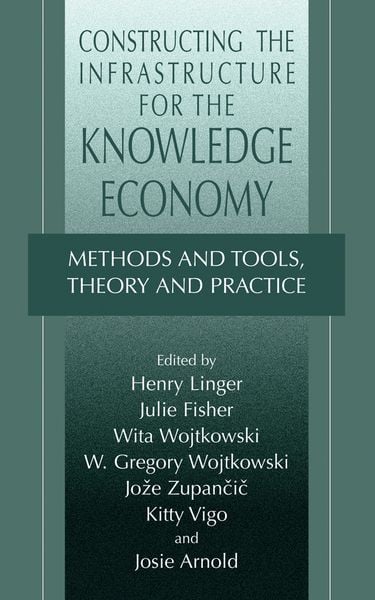
Constructing the Infrastructure for the Knowledge Economy Methods and Tools, Theory and Practice

192,99 €

inkl. gesetzl. MwSt., Versandkostenfrei


Beschreibung

Produktdetails

Einband

Taschenbuch

Erscheinungsdatum

03.12.2010

Herausgeber

Henry Linger + weitere

Verlag

Springer Us

Seitenzahl

716

Maße (L/B/H)

24,4/17/4 cm

Gewicht

1359 g

Auflage

Softcover reprint of hardcover 1st ed. 2004

Sprache

Englisch

ISBN

978-1-4419-3459-8

Beschreibung

Produktdetails

Einband

Taschenbuch

Erscheinungsdatum

03.12.2010

Herausgeber

Verlag

Springer Us

Seitenzahl

716

Maße (L/B/H)

24,4/17/4 cm

Gewicht

1359 g

Auflage

Softcover reprint of hardcover 1st ed. 2004

Sprache

Englisch

ISBN

978-1-4419-3459-8

Herstelleradresse

Springer-Verlag KG
Sachsenplatz 4-6
1201 Wien
AT

Email: ProductSafety@springernature.com

Kundinnen und Kunden meinen

0 Bewertungen

Informationen zu Bewertungen

Zur Abgabe einer Bewertung ist eine Anmeldung im Konto notwendig. Die Authentizität der Bewertungen wird von uns nicht überprüft. Wir behalten uns vor, Bewertungstexte, die unseren Richtlinien widersprechen, entsprechend zu kürzen oder zu löschen.

Die Bewertungen sind nach Format, Anzahl Sterne und Datum sortiert.

Verfassen Sie die erste Bewertung zu diesem Artikel

Helfen Sie anderen Kund*innen durch Ihre Meinung

Kundinnen und Kunden meinen

0 Bewertungen filtern

  • Produktbild: Constructing the Infrastructure for the Knowledge Economy
  • Keynotes.- 1. ISD Discourses and the Emancipation of Meaning.- 2. E-Documents as Tools for the Humanized Management of Community Knowledge.- 3. Enterprise Integration Using Enterprise Architecture.- Theoretical Foundations.- 4. The Formulation of Design Theories for Information Systems.- 5. Justifying ISD Knowledge Claims.- 6. The RO Theory, Discovery of BUI, and IS: Beginning of Theoretical Foundations.- 7. The Dynamics of an Information System in Light of Chaos Theory.- ISD Methods.- 8. Information Systems Development Methodologies in Practice.- 9. Software Development Methodology Evaluation Model.- 10. Representing Part-Whole Relations in Conceptual Modelling: A Comparison of Object-Oriented and Entity Relationship Modellers.- 11. Existence Dependency and Information Structure.- 12. Towards a Generic Model for Agile Processes.- 13. Continuous Integration as a Means of Coordination: A Case Study of Two Open Source Projects.- 14. On Business Rules Approach to the Information Systems Development.- 15. Business Functions Prototyping via XSLT.- 16. Old Trick, New Dogs: Learning to Use Crud Matrices Early in Object-Oriented Information System Development.- 17. From Vernacular to Rational Design in Software Engineering: Consequences of the Designer’s Changing Role.- Requirements for ISD.- 18. Picturing Problems.- 19. Using Cognitive Mapping for Problem Analysis in Information Requirements Determination.- 20. A Quality Model for the Evaluation of Software Requirements Specifications.- 21. A Qualitative Method for Identifying Factors That Influence User Satisfaction.- 22. Domain Model Driven Approach to Change Impact Assessment.- 23. Tracking Business Rules from Their Source to Their Implementation to Support is Maintenance.- 24. Process of Requirements Evolution in Web-Enabled Employee Service Systems.- 25. Distributing Usability: The Implications for Usability Testing.- 26. Integrating Security Design into Information Systems Development.- 27. Integrating Security Properties with Systems Design Artefacts.- Knowledge Management.- 28. Knowledge Creation through Systems Development.- 29. From Philosophy to Knowledge Management and Back Again.- 30. Knowledge Management Strategies: Leaders and Leadership.- 31. Trust, Control, and Design: A Study of Computer Scientists.- 32. Building an Open Document Management System with Components for Trust.- 33. Knowledge Reuse in Project Management.- 34. Developing Knowledge Management Systems in BPM Context.- 35. Modelling Emergent Processes in Knowledge-Intensive Environments.- 36. Enabling Problem Domain Knowledge Transformation during Object Oriented Software Development.- Web and Internet Based Systems.- 37. Web Development: The Differences, Similarities and in-betweens.- 38. Searching for a Methodology for Smart Internet Technology Development.- 39. A Proposed Taxonomy of Media Collections and Its Implications for Design and Management of Multimedia Databases.- 40. XML Data Warehouse Possibilities and Solutions.- 41. “Web Presence”: Formulating a “Wicked” Research Problem.- 42. Automatic Topic Map Creation Using Term Crawling and Clustering Hierarchy Projection.- 43. Discovering WWW User Interface Problems via User Surveys and Log File Analysis.- 44. E-Government Services: One Local Government’s Approach.- 45. Web Auctions: An Impact Analysis for Baltic Region SMES.- 46. Experiences in Using a Web-Based GDSS to Coordinate Distributed Group Decision-Making Processes.- 47. Whispers from a Discourse: Digital Television in Australia.- Education.- 48. Walking the Walk of Eteaching and E-Learning: Enchancing Teaching and Learning Using the New Technologies.- 49. Effective Teaching of Groupware Development: A Conceptual Model.- 50. Application of System Engineering Methods in Information Systems Curricula Development.- Case Studies.- 51. Considerations in Systems Development of Applications for Mobile Devices: A Case Study.- 52. Outsourcing: An Information Systems Development Case Study in an Indonesian SME.- 53. Current Status and Trends in Customer Relationship Management: The Case of Slovenia.- 54. Information System Development for Demolition Material Management.- 55. A Distributed Logistic Support Communication System.