Gutscheinbedingungen

**Gültig nur für Bestellungen an die Wunsch-Poststation bis 10.06.2026 auf Spielzeug, Schreibwaren, Filme, Geschenke & Trends, Musik, tolino eReader & Zubehör, Hörbücher und Hörbuch-Downloads (außer Abo), nicht preisgebundene Bücher und Kalender online auf thalia.at und in der Thalia App. Einzelne Artikel können ausgeschlossen sein. Aufgrund der Buchpreisbindung sind deutschsprachige Bücher und eBooks ausgenommen. Zusätzlich ausgenommen sind preisgebundene Artikel, Abos & Flatrates, eBooks, Games, Geschenkkarten/-boxen, Shelfies, Software, Zeitschriften sowie einzelne Artikel von tonies®. Pro Einkauf einmal einlösbar. Kein Click & Collect möglich. Keine Barauszahlung. Nicht kombinierbar mit anderen Aktionen und Gutscheinen. Gutschein wird auf max. 500€ Bestellwert angerechnet. Nicht gültig für Versandkosten und Services.

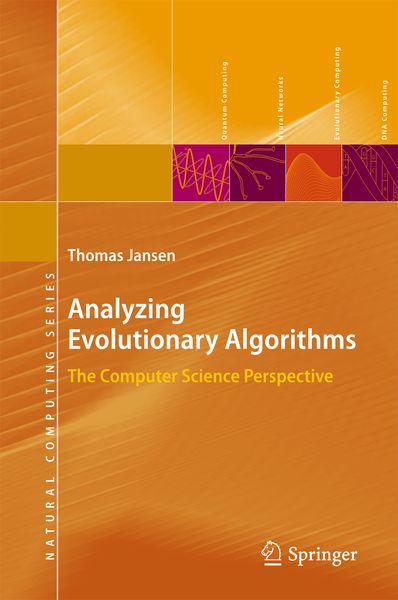
Produktbild: Analyzing Evolutionary Algorithms

Analyzing Evolutionary Algorithms The Computer Science Perspective

Aus der Reihe Natural Computing Series

49,99 €

inkl. gesetzl. MwSt., Versandkostenfrei


Beschreibung

Produktdetails

Einband

Gebundene Ausgabe

Erscheinungsdatum

19.12.2012

Verlag

Springer Berlin

Seitenzahl

258

Maße (L/B/H)

24,1/16/2 cm

Gewicht

571 g

Auflage

2013

Sprache

Englisch

ISBN

978-3-642-17338-7

Beschreibung

Rezension

From the book reviews:“This book focuses on the theoretical analysis of evolutionary algorithms as one of the randomized algorithms in computer science. … This book serves as a very useful source for researchers who are interested in exploring these challenging topics. … I highly recommend it for anyone who is looking to explore both the theoretical aspects of evolutionary algorithms and the practical aspects of designing more efficient algorithms.” (R. Qu, Interfaces, Vol. 44 (4), July-August, 2014)“‘Analyzing evolutionary algorithms’ is a beautiful book that has a lot to offer to people with different backgrounds. It not only explains evolutionary algorithms and puts them into relationship with other randomized search algorithms, it also provides detailed information for specialists who want to understand in depth how, why, and when evolutionary algorithms work. … The book is complemented by an extended list of references and suggestions for further reading.” (Manfred Kerber, zbMATH, Vol. 1282, 2014)“This textbook provides a self-contained introduction into this exciting research subject. It can be used as a course text for advanced undergraduate or graduate levels, and it is at the same time a much welcome reference book for active researchers in this area. … Each chapter is therefore complemented by a remarks section that briefly summarizes the advances in the respective topics. In many cases pointers are given to recent research reports.” (Carola Doerr, Mathematical Reviews, October, 2013)“Analyzing Evolutionary Algorithms is aimed at evolutionary computation researchers and enthusiasts who are interested in the theoretical analysis of evolutionary algorithms. It will be accessible to post-graduates and advanced undergraduates in mathematics and/or computer science, and generally anyone with a working background in discrete mathematics, algorithms, and basic probability theory. Theoreticianswill benefit from this book because it works well as a convenient reference for essential analytical strategies and many up-to-date results.” (Andrew M. Sutton, Genetic Programming and Evolvable Machines, Vol. 14, 2013)

Zitat

"[The book] is aimed at evolutionary computation researchers and enthusiasts who are interested in the theoretical analysis of evolutionary algorithms. [It] will be accessible to post-graduates and advanced undergraduates in mathematics and/or computer science, and generally anyone with a working background in discrete mathematics, algorithms, and basic probability theory. Theoreticians will benefit from this book because it works well as a convenient reference for essential analytical strategies and many up-to-date results. Students and newcomers to the field will find the book a handy compendium of techniques that have become indispensable for writing runtime proofs in the evolutionary computation theory community such as black box complexity, drift analysis, fitness-based partitions, and the method of typical runs. Each of these techniques is carefully motivated and presented in a manner that is suitably rigorous, yet again not needlessly arcane. Additionally, at the end of each chapter, there are useful citations to contemporary work that provide more detailed treatments of many of the topics presented in the chapter. Practitioners can also benefit from [the book] since the theoretical foundations it presents serve to illuminate the working principles behind evolutionary algorithms and offer insights into the random processes that govern their behavior. Thus it can cultivate a deeper understanding of these aspects, and such an understanding is crucial for an informed approach to the design of good algorithms."[A.M. Sutton, Genetic Programming and Evolvable Machines (2013) 14:473-475]

Produktdetails

Einband

Gebundene Ausgabe

Erscheinungsdatum

19.12.2012

Verlag

Springer Berlin

Seitenzahl

258

Maße (L/B/H)

24,1/16/2 cm

Gewicht

571 g

Auflage

2013

Sprache

Englisch

ISBN

978-3-642-17338-7

Herstelleradresse

Springer-Verlag GmbH
Tiergartenstr. 17
69121 Heidelberg
DE

Email: ProductSafety@springernature.com

Kundinnen und Kunden meinen

0 Bewertungen

Informationen zu Bewertungen

Zur Abgabe einer Bewertung ist eine Anmeldung im Konto notwendig. Die Authentizität der Bewertungen wird von uns nicht überprüft. Wir behalten uns vor, Bewertungstexte, die unseren Richtlinien widersprechen, entsprechend zu kürzen oder zu löschen.

Die Bewertungen sind nach Format, Anzahl Sterne und Datum sortiert.

Verfassen Sie die erste Bewertung zu diesem Artikel

Helfen Sie anderen Kund*innen durch Ihre Meinung

Kundinnen und Kunden meinen

0 Bewertungen filtern

  • Produktbild: Analyzing Evolutionary Algorithms
  • Introduction.- Evolutionary Algorithms and Other Randomized Search Heuristics.- Theoretical Perspectives on Evolutionay Algorithms.- General Limits in Black-Box Optimization.- Methods for the Analysis of Evolutionary Algorithms.- Selected Topics in the Analysis of Evolutionary Algorithms.- App. A, Landau Notation.- App. B, Tail Estimations.- App. C, Martingales and Applications.