Gutscheinbedingungen

**Gültig bis 17.08.2026 auf Schreibwaren & Office-Artikel online auf thalia.at, in der Thalia App und in teilnehmenden Thalia Buchhandlungen in Österreich mit Schulsortiment. In den Buchhandlungen nur gültig auf lagernde Ware. Einzelne Artikel können ausgeschlossen sein. Ausgenommen sind preisgebundene Artikel. Pro Einkauf einmal einlösbar. Nur gültig gegen Vorlage oder im Onlineshop hinterlegter Bonuscard. Infos zur Einlösung in der Buchhandlung sind auf der Bonuscard-Vorteilspreisseite zu finden. Click & Collect nur bei Onlinevorabzahlung möglich. Keine Einlösung bei Scan & Go-Bezahlung. Keine Barauszahlung. Nicht kombinierbar mit anderen Aktionen und Gutscheinen. Gutschein wird auf max. 500€ Bestellwert angerechnet. Nicht gültig für Geschenkkarten, Versandkosten und Services.

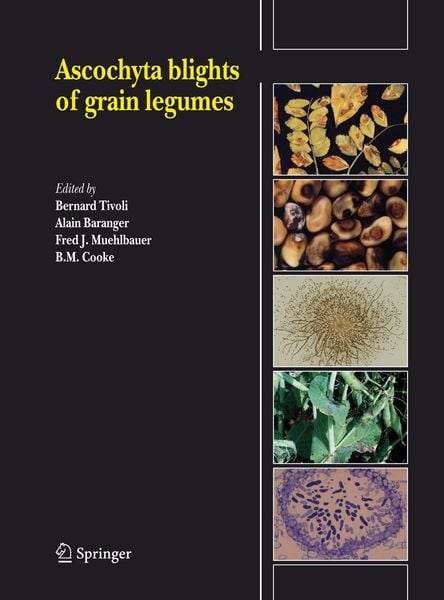
Produktbild: Ascochyta blights of grain legumes
- 12%

Ascochyta blights of grain legumes

12% sparen

95,99 € UVP 109,99 €

inkl. gesetzl. MwSt., Versandkostenfrei


Beschreibung

Produktdetails

Einband

Taschenbuch

Erscheinungsdatum

19.10.2010

Abbildungen

VI, 142 p.

Herausgeber

Bernard Tivoli + weitere

Verlag

Springer Netherland

Seitenzahl

142

Maße (L/B/H)

28/21/0,9 cm

Gewicht

381 g

Auflage

Softcover reprint of hardcover 1st ed. 2007

Sprache

Englisch

ISBN

978-90-481-7524-6

Beschreibung

Portrait

- B. Tivoli is a scientist in plant disease epidemiology at INRA (French National Institute of Agronomical Research), Le Rheu, France and member of AEP (European Association of Grain Legumes) and SFP (French Plant Pathology Society).

- F. J. Muehlbauer is a geneticist and breeder of grain legumes at USDA Agricultural Research Service, Pullman, Washington, USA, and a member of the Crop Science Society of America, American Society of Agronomy, and AEP.

- A. Baranger is a scientist in genetics of legumes at INRA (French National Institute of Agronomical Research), Le Rheu, France.

- B. M. Cooke is a Professor of Plant Pathology and the Editor-in-Chief of the European Journal of Plant Pathology at the School of Biology and Environmental Science, University College Dublin, Ireland.

Produktdetails

Einband

Taschenbuch

Erscheinungsdatum

19.10.2010

Abbildungen

VI, 142 p.

Herausgeber

Verlag

Springer Netherland

Seitenzahl

142

Maße (L/B/H)

28/21/0,9 cm

Gewicht

381 g

Auflage

Softcover reprint of hardcover 1st ed. 2007

Sprache

Englisch

ISBN

978-90-481-7524-6

Herstelleradresse

Springer-Verlag KG
Sachsenplatz 4-6
1201 Wien
AT

Email: GPSR Kontakt

Noch keine Bewertungen vorhanden

Verfassen Sie die erste Bewertung zu diesem Artikel

Helfen Sie anderen Kundinnen und Kunden durch Ihre Meinung.

Kundinnen und Kunden meinen

Bewertungen (0)

  • Produktbild: Ascochyta blights of grain legumes
  • Foreword.- Towards identifying pathogenic determinants of the chickpea pathogen Ascochyta rabiei.- Biotic factors affecting the expression of partial resistance in pea to ascochyta blight in a detached stipule assay.- Validation of a QTL for resistance to ascochyta blight linked to resistance to fusarium wilt race 5 in chickpea (Cicer arietinum L.).- Genetic relationships among Chickpea (Cicer arietinum L.) genotypes based on the SSRs at the quantitative trait Loci for resistance to Ascochyta Blight.- Inheritance of resistance to Mycosphaerella pinodes in two wild accessions of Pisum.- Comparison of the epidemiology of ascochyta blights on grain legumes.- Development of ascochyta blight (Ascochyta rabiei) in chickpea as affected by host resistance and plant age.- Assessment of airborne primary inoculum availability and modelling of disease onset of ascochyta blight in field peas.- Integrated disease management of ascochyta blight in pulse crops.- The sympatric Ascochyta pathosystems of Near Eastern legumes, a key for better understanding of pathogen biology.- Role of host specificity in the speciation of Ascochyta pathogens of cool season food legumes.- Diagnostics, genetic diversity and pathogenic variation of ascochyta blight of cool season food and feed legumes.- Resistance to ascochyta blights of cool season food legumes.