KI-Beratung Beta

Gutscheinbedingungen

**Gültig bis 18.11.2026 auf englischsprachige Klassiker (klassiker-32728) online auf thalia.at und in der Thalia App. Einzelne Artikel können ausgeschlossen sein. Ausgenommen sind preisgebundene Artikel & eBooks. Pro Einkauf einmal einlösbar. Click & Collect nur bei Onlinevorabzahlung möglich. Keine Barauszahlung. Nicht kombinierbar mit anderen Aktionen und Gutscheinen. Gutschein wird auf max. 500€ Bestellwert angerechnet. Nicht gültig für Geschenkkarten, Versandkosten und Services.

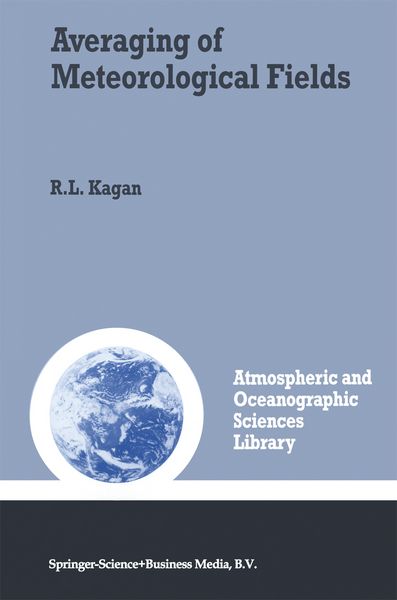
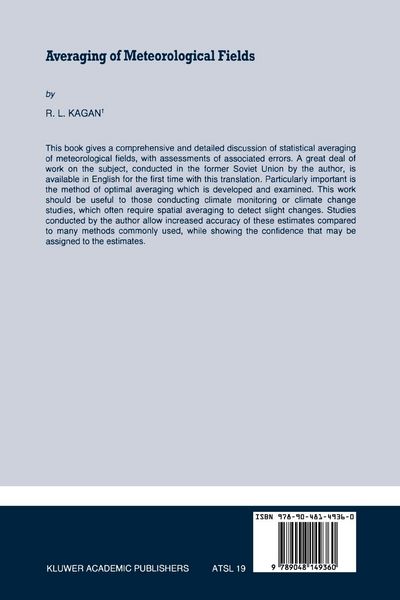
  • Produktbild: Averaging of Meteorological Fields
  • Produktbild: Averaging of Meteorological Fields
Band 19

Averaging of Meteorological Fields

142,99 €

inkl. gesetzl. MwSt., Versandkostenfrei


Beschreibung

Spatial and temporal averaging of observational data is widely used in many problems of meteorology, hydrology and related sciences. Several averaging methods have been proposed by various scientists and are used on a regular basis to obtain data averaged in space orfand in time, to yield data which...

Beschreibung

Spatial and temporal averaging of observational data is widely used in many problems of meteorology, hydrology and related sciences. Several averaging methods have been proposed by various scientists and are used on a regular basis to obtain data averaged in space orfand in time, to yield data which are less influenced by random factors than initial point data are. The significance of averaging meteorological fields has substantially increased nowadays in connection with the problem of global climate change. However important as such change may be, it is very small as compared with the natural variability of atmospheric fields. An accurate averaging is absolutely necessary in order to discover a small climate change signal on the background of strong natural variability that acts as a random noise in this context. It is highly desirable not only to determine the averaged values themselves, but also to estimate the accuracy with which these values are known. To evaluate the accuracy of averaging is not a simple task mainly because the initial point values are not independent from each other, and interconnections between them substantially influence the averaging accuracy.

Produktdetails

Einband

Taschenbuch

Erscheinungsdatum

22.10.2010

Abbildungen

IX, 281 p.

Herausgeber Lev S. Gandin + weitere

Produktdetails

Einband

Taschenbuch

Erscheinungsdatum

22.10.2010

Abbildungen

IX, 281 p.

Herausgeber
Verlag Springer Netherland
Seitenzahl

281

Maße (L/B/H)

23,5/15,5/1,6 cm

Gewicht

446 g

Auflage

Softcover reprint of hardcover 1st ed. 1997

Sprache

Englisch

ISBN

978-90-481-4936-0

Herstelleradresse

Springer-Verlag GmbH
Tiergartenstr. 17
69121 Heidelberg
DE

Email: ProductSafety@springernature.com

Noch keine Bewertungen vorhanden

Verfassen Sie die erste Bewertung zu diesem Artikel

Helfen Sie anderen Kundinnen und Kunden durch Ihre Meinung.

Kundinnen und Kunden meinen

Bewertungen (0)

  • Produktbild: Averaging of Meteorological Fields
  • Produktbild: Averaging of Meteorological Fields
  • 1. Introduction.- 1.1 Spatial and temporal averaging in meteorological problems.- 1.2 Some information on the statistical characteristics of meteorological fields.- 2. Statistical Description of Averaged Fields.- 2.1 Statistical structure of averaged data.- 2.2 Representativeness of point measurements with respect to averaged values.- 2.3 Influence of area shape on the representativeness of a point value.- 3. The Accuracy of Averaging Discrete Data.- 3.1 The accuracy of representing average quantities by discrete data.- 3.2 Approximate evaluation of the averaging accuracy.- 3.3 Optimal averaging of discrete data.- 3.4 Accuracy of averaging the characteristics of statistical structure.- 4. Problems of Averaging Some Meteorological Fields.- 4.1 The representativeness of precipitation data.- 4.2 Accuracy of zonal averaging of air temperature.- 5. Practical Aspects of the Spatial Averaging of Meteorological Fields.- 5.1 Methods of averaging meteorological fields and numerical applications.- 5.2 A brief description of the averaging algorithms.- 5.3 Comparative accuracy of some averaging algorithms.- Conclusions.- List of Symbols.- References.