Gutscheinbedingungen

**Gültig bis 04.08.2026 ab einem Mindestbestellwert von 30€ auf Spielzeug, Schreibwaren, Filme, Geschenke & Trends, Musik, tolino eReader & Zubehör, Hörbücher und Hörbuch-Downloads (außer Abo), nicht preisgebundene Bücher und Kalender online auf thalia.at und in der Thalia App. Einzelne Artikel können ausgeschlossen sein. Aufgrund der Buchpreisbindung sind deutschsprachige Bücher und eBooks ausgenommen. Zusätzlich ausgenommen sind preisgebundene Artikel, Abos & Flatrates, eBooks, Games, Geschenkkarten/-boxen, Shelfies, Software, Zeitschriften sowie einzelne Artikel von tonies®. Pro Einkauf einmal einlösbar. Click & Collect nur bei Onlinevorabzahlung möglich. Keine Barauszahlung. Nicht kombinierbar mit anderen Aktionen und Gutscheinen. Gutschein wird auf max. 500€ Bestellwert angerechnet. Nicht gültig für Versandkosten und Services. Preisgebundene Artikel sind vom Mindestbestellwert ausgeschlossen.

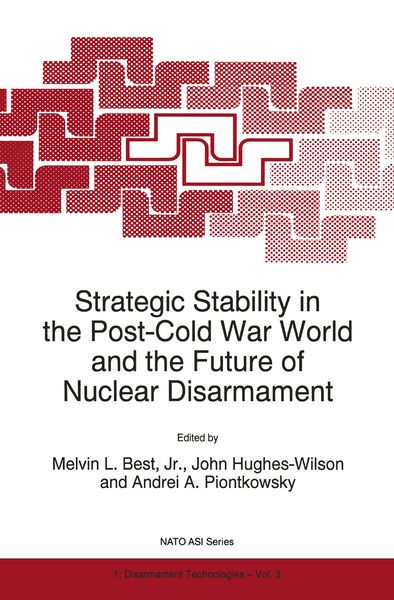
  • Produktbild: Strategic Stability in the Post-Cold War World and the Future of Nuclear Disarmament
  • Produktbild: Strategic Stability in the Post-Cold War World and the Future of Nuclear Disarmament
Band 3 - 12%

Strategic Stability in the Post-Cold War World and the Future of Nuclear Disarmament

12% sparen

192,99 € UVP 219,99 €

inkl. gesetzl. MwSt., Versandkostenfrei


Beschreibung

Produktdetails

Einband

Taschenbuch

Erscheinungsdatum

08.12.2010

Herausgeber

Jr. Melvin L. Best + weitere

Verlag

Springer Netherland

Seitenzahl

330

Maße (L/B/H)

23,5/15,5/1,9 cm

Auflage

Softcover reprint of hardcover 1st ed. 1995

Sprache

Englisch

ISBN

978-90-481-4642-0

Beschreibung

Produktdetails

Einband

Taschenbuch

Erscheinungsdatum

08.12.2010

Herausgeber

Verlag

Springer Netherland

Seitenzahl

330

Maße (L/B/H)

23,5/15,5/1,9 cm

Auflage

Softcover reprint of hardcover 1st ed. 1995

Sprache

Englisch

ISBN

978-90-481-4642-0

Herstelleradresse

Springer-Verlag GmbH
Tiergartenstr. 17
69121 Heidelberg
DE

Email: ProductSafety@springernature.com

Noch keine Bewertungen vorhanden

Verfassen Sie die erste Bewertung zu diesem Artikel

Helfen Sie anderen Kundinnen und Kunden durch Ihre Meinung.

Kundinnen und Kunden meinen

Bewertungen (0)

  • Produktbild: Strategic Stability in the Post-Cold War World and the Future of Nuclear Disarmament
  • Produktbild: Strategic Stability in the Post-Cold War World and the Future of Nuclear Disarmament
  • Preface. 1. Consensus report. 2. Contributing papers. Deterrence, disarmament, and post-cold war stability: enhancing security for both `haves' and `have nots'; R.F. Lehmann II. 2.1: Qualitative - global. On deterrence, balance of power, and geopolitics; R.W. Chandler. Proliferation stability and instability: conditioning factors; F. Ermarth. Verifying the future: towards and international conventional arms control and conversion regime for the 21st century; R. Giles. Crisis stability in a multipolar world; R. Linhard. 2.2: Qualitative - European. Russia and the west: a partnership? R. Braithwaite. Possibilities for cooperation of Russia and the USA in designing, correction and realization of national security doctrines; D.S. Chereshkin. Deterrence and stability; V.I. Krivokhizha. 2.3: Qualitative - Asian. Geo- political stability and the balance of power in East Asia; A. Farrar-Hockley. Strategic stability in the early 2000s: an Indian view of a south Asian model; K. Sundarji. Non-nuclear proliferation and strategic stability in the Asia-Pacific region; Xia Liping. 2.4: Quantitative: geopolitical stability and balance of power. Balance of power versus collective security: a game-theoretic analysis; E.M.S. Niou. Russia's nuclear strategy: 90s and after; A. Piontkowsky, A. Skorokhodov. 2.5: Quantitative: deterrence, crisis stability and first strike stability. Multipolar nuclear stability: incentives to strike and incentives to preempt; J. Bracken. Controlling instabilities caused by rogue governments; G.A. Kent. From MAD to MAD; M. Rudnianski. FSSI as a universalmeasure of stability: from MAD-stability toward MAP-stability; A. Piontkowsky, A. Skorokhodov. 2.6: Quantitative: arms race. Analyzing three-way arms races; F.S. Nyland. New patterns in the arms race: some guidelines; C. Schmidt. Approaches to mathematical modeling of the process of world-wide strategic nuclear conflict used in the former USSR; A.V. Surikov. 2.7: Quantitative: proliferation. Stability, reassurance and non-proliferation; I. Amit. Index.