
Gutscheinbedingungen

**Gültig am 28.06.2026 auf Spielzeug, Schreibwaren, Filme, Geschenke & Trends, Musik, tolino eReader & Zubehör, Hörbücher und Hörbuch-Downloads (außer Abo), nicht preisgebundene Bücher und Kalender online auf thalia.at und in der Thalia App. Einzelne Artikel können ausgeschlossen sein. Aufgrund der Buchpreisbindung sind deutschsprachige Bücher und eBooks ausgenommen. Zusätzlich ausgenommen sind preisgebundene Artikel, Abos & Flatrates, eBooks, Games, Geschenkkarten/-boxen, Shelfies, Software, Zeitschriften sowie einzelne Artikel von tonies®. Pro Einkauf einmal einlösbar. Click & Collect nur bei Onlinevorabzahlung möglich. Keine Barauszahlung. Nicht kombinierbar mit anderen Aktionen und Gutscheinen. Gutschein wird auf max. 500€ Bestellwert angerechnet. Nicht gültig für Versandkosten und Services.

  • Produktbild: The Unity of Science in the Arabic Tradition
  • Produktbild: The Unity of Science in the Arabic Tradition
Band 11 - 12%

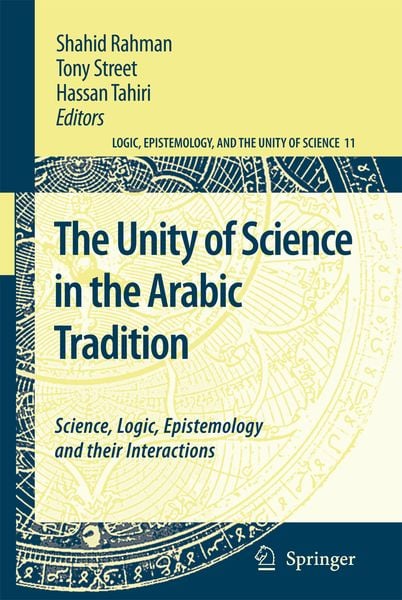
The Unity of Science in the Arabic Tradition Science, Logic, Epistemology and their Interactions

12% sparen

289,99 € UVP 329,99 €

inkl. gesetzl. MwSt., Versandkostenfrei


Beschreibung

Produktdetails

Einband

Taschenbuch

Erscheinungsdatum

30.11.2010

Herausgeber

Shahid Rahman + weitere

Verlag

Springer Netherland

Seitenzahl

390

Maße (L/B/H)

23,5/15,5/2,2 cm

Gewicht

610 g

Auflage

Softcover reprint of hardcover 1st ed. 2008

Sprache

Arabisch, Englisch

ISBN

978-90-481-7870-4

Beschreibung

Rezension

From the reviews:

“This volume is full of such thought-provoking nuggets, and it will certainly make an enjoyable reading to philosophers, historians of philosophy, philosophers of science, historians of Islamic/Arabic culture, grammarians, belletrists, and certainly practicing scientists who wish to take a deep breath, away from their exhausting work at their laboratories, and stop to think of what they were doing.” (George Saliba, Metascience, Vol. 21, 2012)

"This is an impressive contribution both to the history of science and to the history of philosophy... Even for those who are not working in the history of science or philosophy the book is immensely appealing. Just to give an example, I was struck by the link between lemmata and middle terms . I will start by studying the chapter on Self-awareness and knowing that one knows and move next to Avicenna's naturalized epistemology. The whole book is relevant to contemporary philosophical issues. The account of the notion of "tropos" is a case in point."
Paul Gochet, Pôle de Logique, Université de Liege, Belgium

Produktdetails

Einband

Taschenbuch

Erscheinungsdatum

30.11.2010

Herausgeber

Verlag

Springer Netherland

Seitenzahl

390

Maße (L/B/H)

23,5/15,5/2,2 cm

Gewicht

610 g

Auflage

Softcover reprint of hardcover 1st ed. 2008

Sprache

Arabisch, Englisch

ISBN

978-90-481-7870-4

Herstelleradresse

Springer-Verlag GmbH
Tiergartenstr. 17
69121 Heidelberg
DE

Email: ProductSafety@springernature.com

Kundinnen und Kunden meinen

0 Bewertungen

Informationen zu Bewertungen

Zur Abgabe einer Bewertung ist eine Anmeldung im Konto notwendig. Die Authentizität der Bewertungen wird von uns nicht überprüft. Wir behalten uns vor, Bewertungstexte, die unseren Richtlinien widersprechen, entsprechend zu kürzen oder zu löschen.

Die Bewertungen sind nach Format, Anzahl Sterne und Datum sortiert.

Verfassen Sie die erste Bewertung zu diesem Artikel

Helfen Sie anderen Kund*innen durch Ihre Meinung

Kundinnen und Kunden meinen

0 Bewertungen filtern

  • Produktbild: The Unity of Science in the Arabic Tradition
  • Produktbild: The Unity of Science in the Arabic Tradition
  • Introduction: The Major Breakthrough in Scientific Pratice.- Introduction: The Major Breakthrough in Scientific Pratice.- Epistemology and Philosophy of Science.- Ibn S?:n?’s Philosophy of Mathematics.- Avicenna on Self-Awareness and Knowing that One Knows.- A Conceptual Analysis of Early Arabic Algebra.- Avicenna’s Naturalized Epistemology and Scientific Method*.- The Philosophy of Mathematics.- The Birth of Scientific Controversies The Dynamics of the Arabic Tradition and Its Impact on the Development of Science: Ibn al-Haytham’s Challenge of Ptolemy’s Almagest.- Logic Philosophy and Grammar.- Jiha/Tropos-M?dda/H?l? Distinction in Arabic Logic and its Significance for Avicenna’s Modals.- Islamic Logic?.- Logical Fragments in Ibn Khald?n’s Muqaddimah.- Avicenna on the Quantification of the Predicate (with an Appendix on [Ibn Zur?a]).- Name (ism), Derived Name (ism mushtaqq) and Description (wa?f) in Arabic Grammar, Muslim Dialectical Theology and Arabic Logic.- Logic and Metaphysics in Avicenna’s Modal Syllogistic.