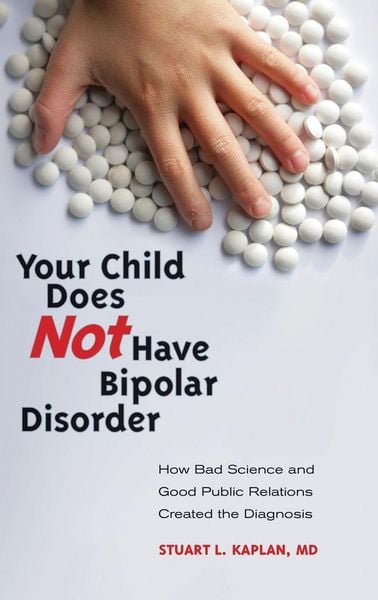
Your Child Does Not Have Bipolar Disorder How Bad Science and Good Public Relations Created the Diagnosis
57,99 €
inkl. gesetzl. MwSt.,
Beschreibung
Produktdetails
Einband
Gebundene Ausgabe
Altersempfehlung
7 - 17 Jahr(e)
Erscheinungsdatum
03.03.2011
Herausgeber
Stuart L. Kaplan M.D.Verlag
BloomsburySeitenzahl
208
Maße (L/B/H)
24/16,1/1,6 cm
Gewicht
482 g
Sprache
Englisch
ISBN
978-0-313-38134-8
An eminent child psychiatrist provides an insider's, whistle-blowing perspective on the promotion of a diagnostic entity that does not exist. Your Child Does Not Have Bipolar Disorder: How Bad Science and Good Public Relations Created the Diagnosis examines this diagnostic fad through a variety of lenses. Author Stuart L. Kaplan, MD, draws heavily on his forty years of experience as a clinician, researcher, and professor of child psychiatry to make the argument that bipolar disorder in children and adolescents is incorrectly diagnosed and incorrectly treated. As Dr. Kaplan explains, the dramatic rise in this particular diagnosis is not based on scientific evidence, nor does it reflect any new discovery or insight about the etiology or treatment of the disorder. In fact, the opposite is the case: the scientific evidence against the existence of child bipolar disorder is so strong that it is difficult to imagine how it has gained the endorsement of anyone in the scientific community. Your Child Does Not Have Bipolar Disorder: How Bad Science and Good Public Relations Created the Diagnosis explains to parents and professionals the faulty reasoning and bad science behind the misdiagnosis of childhood bipolar disorder. Dr. Kaplan critiques the National Institute of Mental Health, academic child psychiatry, the pharmaceutical industry, and the media for their respective roles in advocating this diagnosis. He describes very clearly what the children and adolescents actually do have, explains how it should be treated, and provides real-life clinical scenarios and approaches to treatment that work.
Noch keine Bewertungen vorhanden
Verfassen Sie die erste Bewertung zu diesem Artikel
Helfen Sie anderen Kundinnen und Kunden durch Ihre Meinung.
Kurze Frage zu unserer Seite
Vielen Dank für Ihr Feedback
Wir nutzen Ihr Feedback, um unsere Produktseiten zu verbessern. Bitte haben Sie Verständnis, dass wir Ihnen keine Rückmeldung geben können. Falls Sie Kontakt mit uns aufnehmen möchten, können Sie sich aber gerne an unseren Kund*innenservice wenden.
zum Kundenservice