KI-Beratung Beta

Gutscheinbedingungen

**Gültig am 20.11.2026 ab einem Mindestbestellwert von 30€ auf Spielzeug, Schreibwaren, Filme, Geschenke & Trends, Musik, tolino eReader & Zubehör, Hörbücher und Hörbuch-Downloads, nicht preisgebundene Bücher und Kalender online auf thalia.at und in der Thalia App. Einzelne Artikel können ausgeschlossen sein. Aufgrund der Buchpreisbindung sind deutschsprachige Bücher und eBooks ausgenommen. Zusätzlich ausgenommen sind Abos & Flatrates, Games, Geschenkkarten/-boxen, Shelfies, Software, Zeitschriften sowie einzelne Artikel von tonies®. Pro Einkauf einmal einlösbar. Click & Collect nur bei Onlinevorabzahlung möglich. Keine Barauszahlung. Nicht kombinierbar mit anderen Aktionen und Gutscheinen. Gutschein wird auf max. 500€ Bestellwert angerechnet. Nicht gültig für Versandkosten und Services. Preisgebundene Artikel sind vom Mindestbestellwert ausgeschlossen.

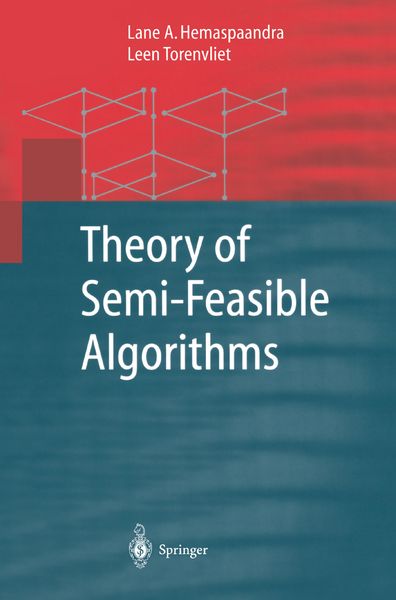
  • Produktbild: Theory of Semi-Feasible Algorithms
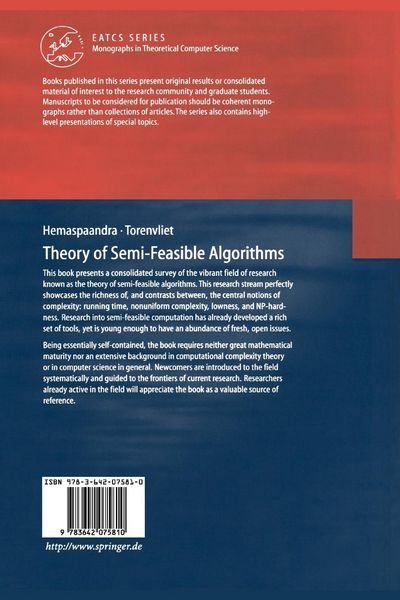
  • Produktbild: Theory of Semi-Feasible Algorithms

Theory of Semi-Feasible Algorithms

99,99 €

inkl. gesetzl. MwSt., Versandkostenfrei


Beschreibung

An Invitation to the Dance It is an underappreciated fact that sets may have various types of complex ity, and not all types are in harmony with each other. The primary goal of this book is to unify and make more widely accessible a vibrant stream of research-the theory of semi-feasible computation-that...

Beschreibung

An Invitation to the Dance It is an underappreciated fact that sets may have various types of complex ity, and not all types are in harmony with each other. The primary goal of this book is to unify and make more widely accessible a vibrant stream of research-the theory of semi-feasible computation-that perfectly showcases the richness of, and contrasts between, the central types of complexity. The semi-feasible sets, which are most commonly referred to as the P selective sets, are those sets L for which there is a deterministic polynornial time algorithm that, when given as input any two strings of which at least one belongs to L, will output one of them that is in L. The reason we saythat the semi-feasible sets showcase the contrasts among types of complexity is that it is well-known that many semi-feasible sets have no recursive algorithms (thus their time complexitycannot be upper-bounded by standard time-complexity classes), yet all semi-feasible sets are simple in a wide range of other natural senses. In particular, the semi-feasible sets have small circuits, they are in the extended low hierarchy, and they cannot be NP-complete unless P = NP. The semi-feasible sets are fascinating for many reasons. First, as men tioned above, they showcase the fact that mere deterministic time complex ity is not the only potential type of complexity in the world of computation.

Rezension

From the reviews:


"This book focuses mainly on the complexity of P-selective sets … . a course from this text would require a highly-motivated instructor who can give the intuitive ideas leaving the details to the book. The book would also serve as a reasonable reference for those doing research in this area." (Lance Fortnow, SIGACT News, Vol. 35 (2), 2004)

Produktdetails

Einband

Taschenbuch

Erscheinungsdatum

09.12.2010

Abbildungen

X, 150 p.

Verlag Springer Berlin

Produktdetails

Einband

Taschenbuch

Erscheinungsdatum

09.12.2010

Abbildungen

X, 150 p.

Verlag Springer Berlin
Seitenzahl

150

Maße (L/B/H)

23,5/15,5/0,9 cm

Gewicht

254 g

Auflage

Softcover reprint of the original 1st edition 2003

Sprache

Englisch

ISBN

978-3-642-07581-0

Herstelleradresse

Springer-Verlag KG
Sachsenplatz 4-6
1201 Wien
AT

Email: ProductSafety@springernature.com

Noch keine Bewertungen vorhanden

Verfassen Sie die erste Bewertung zu diesem Artikel

Helfen Sie anderen Kundinnen und Kunden durch Ihre Meinung.

Kundinnen und Kunden meinen

Bewertungen (0)

  • Produktbild: Theory of Semi-Feasible Algorithms
  • Produktbild: Theory of Semi-Feasible Algorithms
  • 1. Introduction to Semi-Feasible Computation.- 2. Advice.- 3. Lowness.- 4. Hardness for Complexity Classes.- 5. Closures.- 6. Generalizations and Related Notions.- A. Definitions of Reductions and Complexity Classes, and Notation List.- A.1 Reductions.- A.2 Complexity Classes.- A.3 Some Other Notation.- References.