
KI-Beratung Beta

Gutscheinbedingungen

**Gültig am 27.11.2026 auf Spielzeug, Schreibwaren, Filme, Geschenke & Trends, Musik, tolino eReader & Zubehör, Hörbücher und Hörbuch-Downloads, nicht preisgebundene Bücher und Kalender online auf thalia.at und in der Thalia App. Einzelne Artikel können ausgeschlossen sein. Aufgrund der Buchpreisbindung sind deutschsprachige Bücher und eBooks ausgenommen. Zusätzlich ausgenommen sind Abos & Flatrates, Games, Geschenkkarten/-boxen, Shelfies, Software, Zeitschriften sowie einzelne Artikel von tonies®. Pro Einkauf einmal einlösbar. Click & Collect nur bei Onlinevorabzahlung möglich. Keine Barauszahlung. Nicht kombinierbar mit anderen Aktionen und Gutscheinen. Gutschein wird auf max. 500€ Bestellwert angerechnet. Nicht gültig für Versandkosten und Services.

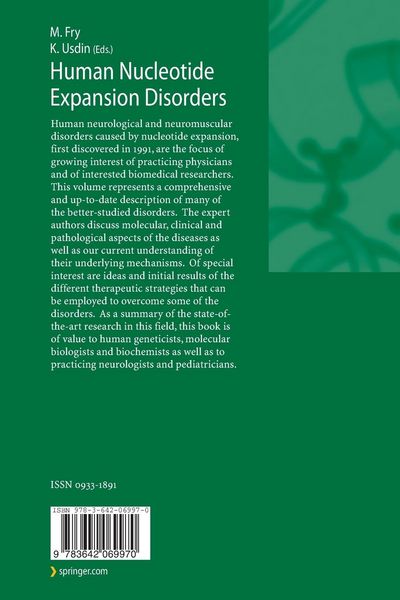
  • Produktbild: Human Nucleotide Expansion Disorders
  • Produktbild: Human Nucleotide Expansion Disorders
Band 19

Human Nucleotide Expansion Disorders

221,99 €

inkl. gesetzl. MwSt., Versandkostenfrei


Beschreibung

Human neurological and neuromuscular disorders caused by nucleotide expansion, first discovered in 1991, are the focus of growing interest of practicing physicians and of interested biomedical researchers. This volume represents a comprehensive and up-to-date description of many of the better-studied...

Beschreibung

Human neurological and neuromuscular disorders caused by nucleotide expansion, first discovered in 1991, are the focus of growing interest of practicing physicians and of interested biomedical researchers. This volume represents a comprehensive and up-to-date description of many of the better-studied disorders. The expert authors discuss molecular, clinical and pathological aspects of the diseases as well as our current understanding of their underlying mechanisms. Of special interest are ideas and initial results of the different therapeutic strategies that can be employed to overcome some of the disorders. As a summary of the state-of-the-art research in this field, this book is of value to human geneticists, molecular biologists and biochemists as well as to practicing neurologists and pediatricians.

Rezension

From the reviews:


"The authors combine their expertise in diverse areas of molecular genetics to produce a general scope for each disease. Additionally, the corresponding clinical features are briefly discussed, and genotype/phenotype correlations are outlined. The overall result is a useful and concise review which will be of interest to researchers in molecular biology and human genetics, as well as professionals in medicine looking to obtain insights into the ever expanding fields of unstable repeat disorders." (Laura E. Machuca-Tzili, Human Genetics, Vol. 125, June, 2009)

Produktdetails

Einband

Taschenbuch

Erscheinungsdatum

20.11.2010

Abbildungen

XVIII, 294 p.

Herausgeber Michael Fry + weitere

Produktdetails

Einband

Taschenbuch

Erscheinungsdatum

20.11.2010

Abbildungen

XVIII, 294 p.

Herausgeber
Verlag Springer Berlin
Seitenzahl

294

Maße (L/B/H)

23,5/15,5/1,7 cm

Gewicht

476 g

Auflage

Softcover reprint of hardcover 1st ed. 2006

Sprache

Englisch

ISBN

978-3-642-06997-0

Herstelleradresse

Springer-Verlag KG
Sachsenplatz 4-6
1201 Wien
AT

Email: ProductSafety@springernature.com

Noch keine Bewertungen vorhanden

Verfassen Sie die erste Bewertung zu diesem Artikel

Helfen Sie anderen Kundinnen und Kunden durch Ihre Meinung.

Kundinnen und Kunden meinen

Bewertungen (0)

  • Produktbild: Human Nucleotide Expansion Disorders
  • Produktbild: Human Nucleotide Expansion Disorders
  • Molecular Bases of Nucleotide Expansions.- Mechanisms of DNA Repeat Expansion.- Disorders Associated with Non-coding Repeats.- Molecular Correlates of Fragile X Syndrome and FXTAS.- The Neglected Fragile X Mutations: FRAXE and FRAXF.- Friedreich Ataxia.- Dodecamer Repeat Expansion in Progressive Myoclonus Epilepsy 1.- Myotonic Dystrophies Types 1 and 2.- Spinocerebellar Ataxia Type 8.- Recent Progress in Spinocerebellar Ataxia Type 10.- Disorders Associated with Coding Repeats.- Polyglutamine Diseases.- The Enigma of Spinocerebellar Ataxia Type 6.- Disorders Associated with Repeats in an Undetermined Location.- Spinocerebellar Ataxia Type 12 and Huntington’s Disease-Like 2: Clues to Pathogenesis.- Postscript.- Current Issues and Therapeutic Prospects.