Gutscheinbedingungen

**Gültig bis 06.07.2026 auf fremdsprachige Bücher online auf thalia.at, in der Thalia App ab einem Mindestbestellwert von 30€ und in allen Thalia Buchhandlungen in Österreich. In den Buchhandlungen nur gültig auf lagernde Ware. Einzelne Artikel können ausgeschlossen sein. Ausgenommen sind preisgebundene Artikel & eBooks. Pro Einkauf einmal einlösbar. Nur gültig gegen Vorlage oder im Onlineshop hinterlegter Bonuscard. Infos zur Einlösung in der Buchhandlung sind auf der Bonuscard-Vorteilspreisseite zu finden. Click & Collect nur bei Onlinevorabzahlung möglich. Keine Einlösung bei Scan & Go-Bezahlung. Keine Barauszahlung. Nicht kombinierbar mit anderen Aktionen und Gutscheinen. Gutschein wird auf max. 500€ Bestellwert angerechnet. Nicht gültig für Versandkosten und Services.

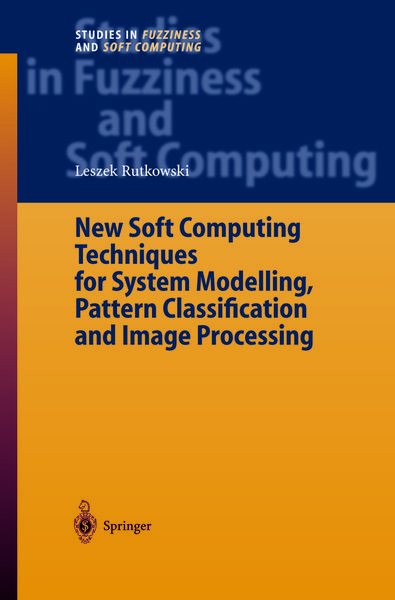
  • Produktbild: New Soft Computing Techniques for System Modeling, Pattern Classification and Image Processing
  • Produktbild: New Soft Computing Techniques for System Modeling, Pattern Classification and Image Processing
Band 143

New Soft Computing Techniques for System Modeling, Pattern Classification and Image Processing

151,99 €

inkl. gesetzl. MwSt., Versandkostenfrei


Beschreibung

Produktdetails

Einband

Taschenbuch

Erscheinungsdatum

04.12.2010

Verlag

Springer Berlin

Seitenzahl

374

Maße (L/B/H)

23,5/15,5/2,1 cm

Gewicht

593 g

Auflage

Softcover reprint of hardcover 1st ed. 2004

Sprache

Englisch

ISBN

978-3-642-05820-2

Beschreibung

Produktdetails

Einband

Taschenbuch

Erscheinungsdatum

04.12.2010

Verlag

Springer Berlin

Seitenzahl

374

Maße (L/B/H)

23,5/15,5/2,1 cm

Gewicht

593 g

Auflage

Softcover reprint of hardcover 1st ed. 2004

Sprache

Englisch

ISBN

978-3-642-05820-2

Herstelleradresse

Springer-Verlag KG
Sachsenplatz 4-6
1201 Wien
AT

Email: GPSR Kontakt

Noch keine Bewertungen vorhanden

Verfassen Sie die erste Bewertung zu diesem Artikel

Helfen Sie anderen Kundinnen und Kunden durch Ihre Meinung.

Kundinnen und Kunden meinen

Bewertungen (0)

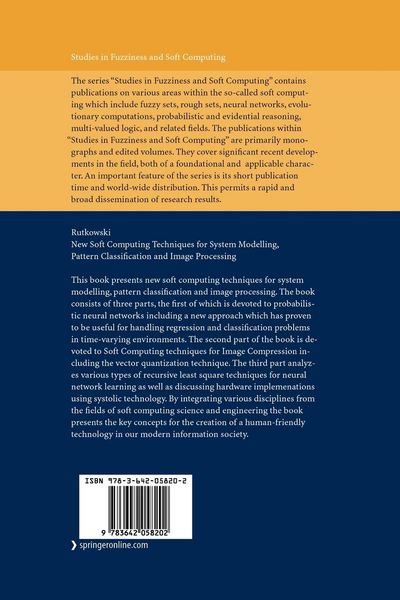
  • Produktbild: New Soft Computing Techniques for System Modeling, Pattern Classification and Image Processing
  • Produktbild: New Soft Computing Techniques for System Modeling, Pattern Classification and Image Processing
  • 1 Introduction.- I Probabilistic Neural Networks in a Non-stationary Environment.- 2 Kernel Functions for Construction of Probabilistic Neural Networks.- 2.1 Introduction.- 2.2 Application of the Parzen kernel.- 2.3 Application of the orthogonal series.- 2.4 Concluding remarks.- 3 Introduction to Probabilistic Neural Networks.- 3.1 Introduction.- 3.2 Probabilistic neural networks for density estimation.- 3.3 General regression neural networks in a stationary environment.- 3.4 Probabilistic neural networks for pattern classification in a stationary environment.- 3.5 Concluding remarks.- 4 General Learning Procedure in a Time-Varying Environment.- 4.1 Introduction.- 4.2 Problem description.- 4.3 Presentation of the general learning procedure.- 4.4 Convergence of general learning procedure.- 4.4.1 Local properties.- 4.4.2 Global properties.- 4.4.3 Speed of convergence.- 4.5 Quasi-stationary environment.- 4.6 Problem of prediction.- 4.7 Concluding remarks.- 5 Generalized Regression Neural Networks in a Time-Varying Environment.- 5.1 Introduction.- 5.2 Problem description and presentation of the GRNN.- 5.3 Convergence of the GRNN in a time-varying environment.- 5.3.1 The GRNN based on Parzen kernels.- 5.3.2 The GRNN based on the orthogonal series.- 5.4 Speed of convergence.- 5.5 Modelling of systems with multiplicative non-stationarity.- 5.6 Modelling of systems with additive non-stationarity.- 5.7 Modelling of systems with non-stationarity of the “scale change” and “movable argument” type.- 5.8 Modelling of systems with a diminishing non-stationarity.- 5.9 Concluding remarks.- 6 Probabilistic Neural Networks for Pattern Classification in a Time-Varying Environment.- 6.1 Introduction.- 6.2 Problem description and presentation of classification rules.- 6.3 Asymptotic optymality of classification rules.- 6.4 Speed of convergence of classification rules.- 6.5 Classification procedures based on the Parzen kernels.- 6.6 Classification procedures based on the orthogonal series.- 6.7 Non-stationarity of the “movable argument” type.- 6.8 Classification in the case of a quasi-stationary environment.- 6.9 Simulation results.- 6.9.1 PNN for estimation of a time-varying probability density.- 6.9.2 PNN for classification in a time-varying environment.- 6.10 Concluding remarks.- II Soft Computing Techniques for Image Compression.- 7 Vector Quantization for Image Compression.- 7.1 Introduction.- 7.2 Preprocessing.- 7.3 Problem description.- 7.4 VQ algorithm based on neural network.- 7.5 Concluding remarks.- 8 The DPCM Technique.- 8.1 Introduction.- 8.2 Scalar case.- 8.3 Vector case.- 8.4 Application of neural network.- 8.5 Concluding remarks.- 9 The PVQ Scheme.- 9.1 Introduction.- 9.2 Description of the PVQ scheme.- 9.3 Concluding remarks.- 10 Design of the Predictor.- 10.1 Introduction.- 10.2 Optimal vector linear predictor.- 10.3 Linear predictor design from empirical data.- 10.4 Predictor based on neural networks.- 10.5 Concluding remarks.- 11 Design of the Code-book.- 11.1 Introduction.- 11.2 Competitive algorithms.- 11.3 Preprocessing.- 11.4 Selection of initial code-book.- 11.5 Concluding remarks.- 12 Design of the PVQ Schemes.- 12.1 Introduction.- 12.2 Open-loop design.- 12.3 Closed-loop design.- 12.4 Modified closed-loop design.- 12.5 Neural PVQ design.- 12.6 Concluding remarks.- III Recursive Least Squares Methods for Neural Network Learning and their Systolic Implementations.- 13 A Family of the RLS Learning Algorithms.- 13.1 Introduction.- 13.2 Notation.- 13.3 Problem description.- 13.4 RLS learning algorithms.- 13.4.1 Single layer neural network.- 13.4.2 Multi-layer neural networks.- 13.5 QQ-RLS learning algorithms.- 13.5.1 Single layer.- 13.5.2 Multi-layer neural network.- 13.6 UD-RLS learning algorithms.- 13.6.1 Single layer.- 13.6.2 Multi-layer neural networks.- 13.7 Simulation results.- 13.7.1 Performance evaluation.- 13.8 Concluding remarks.- 14 Systolic Implementations of the RLS Learning Algorithms.- 14.1 Introduction.- 14.2 Systolic architecture for the recall phase.- 14.3 Systolic architectures for the ETB RLS learning algorithms.- 14.4 Systolic architectures for the RLS learning algorithms.- 14.5 Performance evaluation of systolic architectures.- 14.5.1 The recall phase.- 14.5.2 The learning phase: the ETB RLS algorithm.- 14.5.3 The learning phase: the RLS algorithm.- 14.6 Concluding remarks.- References.