Gutscheinbedingungen

**Gültig bis 22.07.2026 ab einem Mindestbestellwert von 40€ auf Spielzeug, Schreibwaren, Filme, Geschenke & Trends, Musik, tolino eReader & Zubehör, Hörbücher und Hörbuch-Downloads (außer Abo), nicht preisgebundene Bücher und Kalender online auf thalia.at und in der Thalia App. Einzelne Artikel können ausgeschlossen sein. Aufgrund der Buchpreisbindung sind deutschsprachige Bücher und eBooks ausgenommen. Zusätzlich ausgenommen sind preisgebundene Artikel, Abos & Flatrates, eBooks, Games, Geschenkkarten/-boxen, Shelfies, Software, Zeitschriften sowie einzelne Artikel von tonies®. Pro Einkauf einmal einlösbar. Click & Collect nur bei Onlinevorabzahlung möglich. Keine Barauszahlung. Nicht kombinierbar mit anderen Aktionen und Gutscheinen. Gutschein wird auf max. 500€ Bestellwert angerechnet. Nicht gültig für Versandkosten und Services. Preisgebundene Artikel sind vom Mindestbestellwert ausgeschlossen.

Produktbild: Social Robotics
Band 6414

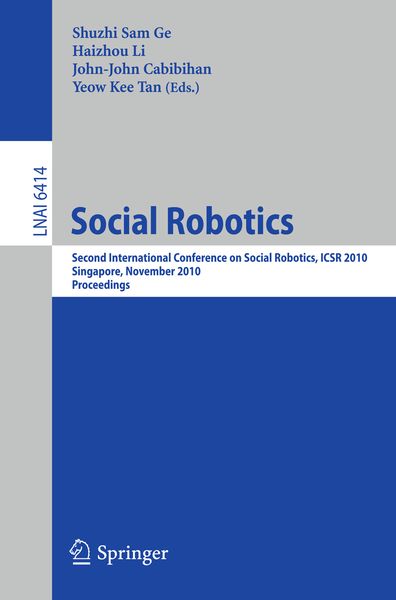
Social Robotics Second International Conference on Social Robotics, ICSR 2010, Singapore, November 23-24, 2010. Proceedings

51,99 €

inkl. gesetzl. MwSt., Versandkostenfrei


Beschreibung

Produktdetails

Einband

Taschenbuch

Erscheinungsdatum

05.11.2010

Herausgeber

Haizhou Li + weitere

Verlag

Springer Berlin

Seitenzahl

412

Maße (L/B/H)

24/15,7/2,8 cm

Gewicht

652 g

Auflage

2010

Sprache

Englisch

ISBN

978-3-642-17247-2

Beschreibung

Produktdetails

Einband

Taschenbuch

Erscheinungsdatum

05.11.2010

Herausgeber

Verlag

Springer Berlin

Seitenzahl

412

Maße (L/B/H)

24/15,7/2,8 cm

Gewicht

652 g

Auflage

2010

Sprache

Englisch

ISBN

978-3-642-17247-2

Herstelleradresse

Springer-Verlag GmbH
Heidelberger Platz 3
14197 Berlin
Deutschland
Email: sdc-bookservice@springer.com
Url: www.springer.com
Telephone: +49 30 827870
Fax: +49 30 8214091

Noch keine Bewertungen vorhanden

Verfassen Sie die erste Bewertung zu diesem Artikel

Helfen Sie anderen Kundinnen und Kunden durch Ihre Meinung.

Kundinnen und Kunden meinen

Bewertungen (0)

  • Produktbild: Social Robotics
  • Design Philosophies and Software Architectures for Robotics.- A Multimodal Human-Robot-Dialog Applying Emotional Feedbacks.- Pseudo Swarm Implementation Using Robotic Agents and Graphical Simulation.- User Identification for Healthcare Service Robots: Multidisciplinary Design for Implementation of Interactive Services.- Using a Social Robot as a Gaming Platform.- Robotic Platform: A XML-Based Extensible Robot Intelligence Architecture (XRIA).- Social Acceptance for Human-Robot Interaction I.- Socializing with Olivia, the Youngest Robot Receptionist Outside the Lab.- Minimal Set of Recognizable Gestures for a 10 DOF Anthropomorphic Robot.- STB: Intentional Stance Grounded Child-Dependent Robot.- Using the Interaction Rhythm as a Natural Reinforcement Signal for Social Robots: A Matter of Belief.- Case Study of a Multi-robot Healthcare System: Effects of Docking and Metaphor on Persuasion.- Learning, Adaptation and Evolution of Robot Intelligence.- State Representation with Perceptual Constancy Based on Active Motion.- Selection of Actions for an Autonomous Social Robot.- On Internal Knowledge Representation for Programming Mobile Robots by Demonstration.- A Software Framework for Multi Player Robot Games.- A Behavior Adaptation Method for an Elderly Companion Robot-—Rui.- An Adaptive Information System for an Empathic Robot Using EEG Data.- Mechatronics and Intelligent Control.- Mind Robotic Rehabilitation Based on Motor Imagery Brain Computer Interface.- COSA Finger: A Coupled and Self-Adaptive Under-actuated Unit for Humanoid Robotic Hand.- A Humanoid Robot Upper Limb System with Anthropomorphic Robot Hand: GCUA Hand II.- Improving Positioning Accuracy of Robotic Systems by Using Environmental Support Constraints – A New Bionic Approach.- Nonlinear Control of a Robot Manipulator with Time-Varying Uncertainties.- Adaptive Motion Synchronization of Bilateral Teleoperation Systems with Time-Varying Communication Delays.- HRI in Assistive Technologies for People with Special Needs.- Design of Robot Assisted Observation System for Therapy and Education of Children with Autism.- Study on an Assistive Robot for Improving Imitation Skill of Children with Autism.- Developing Play Scenarios for Tactile Interaction with a Humanoid Robot: A Case Study Exploration with Children with Autism.- Development of PARO Interventions for Dementia Patients in Dutch Psycho-geriatric Care.- Short Term Effect Evaluation of IROMEC Involved Therapy for Children with Intellectual Disabilities.- Adaptive Robot Design with Hand and Face Tracking for Use in Autism Therapy.- Affective and Cognitive Sciences for Interactive Robots.- Selecting When Acting: How Human Perception Is Tuned to Action Goals and How Robotics Can Benefit from That.- The Evaluation of Empathy, Autonomy and Touch to Inform the Design of an Environmental Monitoring Robot.- Attention Determination for Social Robots Using Salient Region Detection.- Bimodal Emotion Recognition.- Objective Evaluation of Spatial Information Acquisition Using a Visuo-tactile Sensory Substitution Device.- Social Acceptance for Human-Robot Interaction II.- Can I Help You?.- A Persuasive Robotic Agent to Save Energy: The Influence of Social Feedback, Feedback Valence and Task Similarity on Energy Conservation Behavior.- Understanding Communication Patterns for Designing Robot Receptionist.- Do Social Robots Walk or Roll?.- Interaction and Collaboration.- Synthetic Skins with Humanlike Warmth.- Entrainment of Pointing Gestures by Robot Motion.- Emo-dramatic Robotic Stewards.- Fusion and Self-adaptation of Color and Gradient Based Models for Object Detection and Localization in Applications of Service Robots.- Development of Robotic Arm Rehabilitation Machine with Biofeedback That Addresses the Question on Filipino Elderly Patient Motivation.