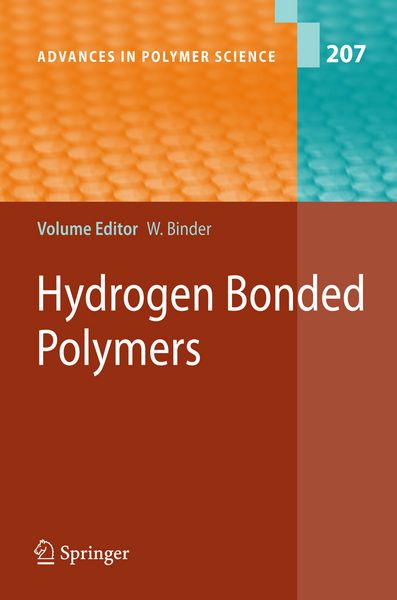
Hydrogen Bonded Polymers
-
- Hardcover
- Taschenbuch ausgewählt
- eBook
-
Sprache:Englisch
198,99 €
inkl. gesetzl. MwSt.,
Beschreibung
Produktdetails
Einband
Taschenbuch
Erscheinungsdatum
22.11.2010
Herausgeber
Wolfgang BinderVerlag
Springer BerlinSeitenzahl
206
Maße (L/B/H)
23,5/15,5/1,3 cm
Gewicht
341 g
Auflage
Softcover reprint of hardcover 1st edition 2007
Sprache
Englisch
ISBN
978-3-642-08813-1
Control of polymeric structure is among the most important endeavours of modern macromolecular science. In particular, tailoring the positioning and strength of intermolecular forces within macromolecules by synthetic me- odsandthusgaining structuralcontrolover the?nalpolymeric materials has become feasible, resulting in the ?eld of supramolecular polymer science. - sides other intermolecular forces, hydrogen bonds are unique intermolecular forces enabling the tuning of material properties via self-assembly processes -1 overawiderangeofinteractionstrengthrangingfromseveralkJmol tosev- -1 eraltensofkJmol . Centralfortheformationofthesestructuresareprecursor molecules of small molecular weight (usually lower than 10 000), which can assembleinsolidorsolutiontoaggregatesofde?nedgeometry. Intermolecular hydrogenbondsatde?nedpositionsofthesebuildingblocksaswellastheir- spectivestartinggeometryandtheinitialsizedeterminethemodeofassembly into supramolecular polymers forming network-, rodlike-, ?brous-, disclike- , helical-, lamellar- and chainlike architectures. In all cases, weak to strong hydrogen-bondinginteractionscanactasthecentralstructure-directingforce fortheorganizationofpolymerchainsandthusthe?nalmaterials'properties. Theimportantcontributionofhydrogenbondstotheareaofsupramole- lar polymer chemistry is de?nitely outstanding, most of all since the potency of hydrogen-bonding systems has been found to be unique in relation to other supramolecular interactions. Thus the high level of structural diversity of many hydrogen-bonding systems as well as their high level of direction- ity and speci?city in recognition-phenomena is unbeaten in supramolecular chemistry. The realization, that their stability can be tuned over a wide range of binding strength is important for tuning the resulting material prop- ties, ranging from elastomeric to thermoplastic and even highly crosslinked duroplastic structures and networks. On the basis of the thermal reversib- ity, new materials with highly tunable properties can now be prepared, - ing able to change their mechanical and optoelectronic properties with very smallchangesofexternalstimuli. Thusthe?eldofhydrogen-bondedpolymers forms the basis for stimuli responsive and adaptable materials of the future.
Kundinnen und Kunden meinen
Verfassen Sie die erste Bewertung zu diesem Artikel
Helfen Sie anderen Kund*innen durch Ihre Meinung
Kurze Frage zu unserer Seite
Vielen Dank für Ihr Feedback
Wir nutzen Ihr Feedback, um unsere Produktseiten zu verbessern. Bitte haben Sie Verständnis, dass wir Ihnen keine Rückmeldung geben können. Falls Sie Kontakt mit uns aufnehmen möchten, können Sie sich aber gerne an unseren Kund*innenservice wenden.
zum Kundenservice