
Gutscheinbedingungen

**Gültig bis 06.07.2026 auf fremdsprachige Bücher online auf thalia.at, in der Thalia App ab einem Mindestbestellwert von 30€ und in allen Thalia Buchhandlungen in Österreich. In den Buchhandlungen nur gültig auf lagernde Ware. Einzelne Artikel können ausgeschlossen sein. Ausgenommen sind preisgebundene Artikel & eBooks. Pro Einkauf einmal einlösbar. Nur gültig gegen Vorlage oder im Onlineshop hinterlegter Bonuscard. Infos zur Einlösung in der Buchhandlung sind auf der Bonuscard-Vorteilspreisseite zu finden. Click & Collect nur bei Onlinevorabzahlung möglich. Keine Einlösung bei Scan & Go-Bezahlung. Keine Barauszahlung. Nicht kombinierbar mit anderen Aktionen und Gutscheinen. Gutschein wird auf max. 500€ Bestellwert angerechnet. Nicht gültig für Versandkosten und Services.

  • Produktbild: Proceedings of the 3rd International Symposium on Autonomous Minirobots for Research and Edutainment (AMiRE 2005)
  • Produktbild: Proceedings of the 3rd International Symposium on Autonomous Minirobots for Research and Edutainment (AMiRE 2005)

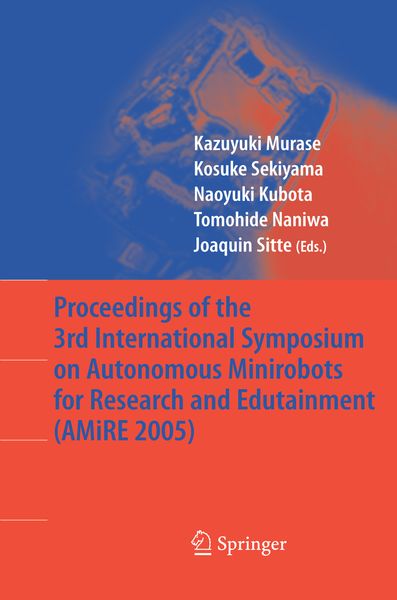
Proceedings of the 3rd International Symposium on Autonomous Minirobots for Research and Edutainment (AMiRE 2005)

201,99 €

inkl. gesetzl. MwSt., Versandkostenfrei


Beschreibung

Produktdetails

Einband

Taschenbuch

Erscheinungsdatum

12.02.2010

Abbildungen

XV, 264 illus., schwarz-weiss Illustrationen

Herausgeber

Kazuyuki Murase + weitere

Verlag

Springer Berlin

Seitenzahl

398

Maße (L/B/H)

23,5/15,5/2,3 cm

Gewicht

629 g

Auflage

Softcover reprint of hardcover 1st ed. 2006

Sprache

Englisch

ISBN

978-3-642-06674-0

Beschreibung

Produktdetails

Einband

Taschenbuch

Erscheinungsdatum

12.02.2010

Abbildungen

XV, 264 illus., schwarz-weiss Illustrationen

Herausgeber

Verlag

Springer Berlin

Seitenzahl

398

Maße (L/B/H)

23,5/15,5/2,3 cm

Gewicht

629 g

Auflage

Softcover reprint of hardcover 1st ed. 2006

Sprache

Englisch

ISBN

978-3-642-06674-0

Herstelleradresse

Springer-Verlag KG
Sachsenplatz 4-6
1201 Wien
AT

Email: GPSR Kontakt

Noch keine Bewertungen vorhanden

Verfassen Sie die erste Bewertung zu diesem Artikel

Helfen Sie anderen Kundinnen und Kunden durch Ihre Meinung.

Kundinnen und Kunden meinen

Bewertungen (0)

  • Produktbild: Proceedings of the 3rd International Symposium on Autonomous Minirobots for Research and Edutainment (AMiRE 2005)
  • Produktbild: Proceedings of the 3rd International Symposium on Autonomous Minirobots for Research and Edutainment (AMiRE 2005)
  • Plenary Talks.- Swarm-bot: A Novel Type of Self-Assembling Robot.- Self-reconfigurable Robots with ATRON Modules.- Technical Sessions Autonomous Agent & Robot.- Universal FPGA-Microcontroller Module for Autonomous Minirobots.- Seeing Empty Space in an Unknown Environment without Silhouettes.- SubSim: An autonomous underwater vehicle simulation package.- Toward Micro Wall-Climbing Robots Using Biomimetic Fibrillar Adhesives.- Teleoperation in Robot.- Teleworkbench: A Teleoperated Platform for Multi-Robot Experiments.- Teleoperation of a Mobile Autonomous Robot using Web Services.- Bluetooth for Autonomous Mini-Robots and Scatternet Formation.- Teleoperation of A Mobile Robot under Office Automation Floors with Visual Assistance.- RoboCup Soccer Simulation.- Developing a Goal Keeper for Simulated RoboCup Soccer and its Performance Evaluation.- An Action Rule Discovery Technique from Simulated RoboCup Soccer Logs.- Adapting Recognition of Shootable Situations by Learning from Experience and Observation in a RoboCup Simulated Soccer Game.- Getting closer: How Simulation and Humanoid League can benefit from each other.- Evaluation for Selecting Method Using Reinforcement Learning with Hand-Coded Rules in RoboCup Soccer Agents.- RoboCup Real Robot.- Yumekobo: An Effective Educational System for RoboCup.- A Method of Sensing own States for Tele-operating Aibos at Ruined Homes.- Trajectory Generation for a Mobile Robot by Reinforcement Learning.- Multi-Layered Fuzzy Behavior Control Method for Autonomous Soccer Robot with MOVIS.- Robot Soccer — Challenges and Future Developments.- FPGA-based Object Detection in Robot Soccer Application.- Robot Soccer KheperaSot League: Challenges and Future Directions.- What Robot Soccer can Contribute to Education and Research — Some Lessons Learned.- Coevolutionary Algorithm for Behavior Acquisition of Soccer Robots.- Visual Information Processing in the Brain.- Relation between Contour Integration and Figure-Ground Separation.- How the early visual system extract angles and junctions embedded within contour stimuli?.- Neural Correlate of Depth Cue Integration Studied with MEG.- Coding of 3D curvature in the parietal cortex (area CIP) of macaque monkey.- A Study of Orientation Selectivity of TAM Network Incorporated Receptive Field Structure.- Vision-based Adaptive Behavior.- Evolutionary Recognition of Corridor and Branch using Adaptive Model with Layered Structure.- A Direct Localization Method Using only the Bearings Extracted from Two Panoramic Views Along a Linear Trajectory.- Early Results in Vision-based Map Building.- Prediction of Fish Motion by Neural Network.- Visual Homing with Learned Goal Distance Information.- Robots for Education.- A Low Cost Controller Board for Teaching Robotics.- Robotics and Robotics Education with Smalltalk.- Education for Creativity by Making Small Line Trace Robot in Department of HAIS, University of Fukui.- Education Using Small Humanoid Robot.- Evolutionary Robots.- Self-Organization of Spiking Neural Network Generating Autonomous Behavior in a Miniature Mobile Robot.- Behavioral Selection Using the Utility Function Method: A Case Study Involving a Simple Guard Robot.- Spiking Neural Network for Behavior Learning of A Mobile Robot.- Safety of Autonomous Evolutionary Robots : Elimination of Certain Behavioral patterns by Complex Systems Analysis.- Swarm Intelligence 1.- Two Steps towards a Mechanically Autonomous Self-replicating System.- Using mini robots for prototyping intersection management of vehicles.- Embodied Cognition in Directed Multi-Agent Systems - Empirical Study on Subjective Distance -.- Crack Detection by Mobile Robot with ECT Sensor.- Swarm Intelligence 2.- Self-organized Path Formation by Ant Robots - An Approach to Understanding Ant’s Acts by Autonomous Distributed Systems -.- Autonomous Self-assembly in a Swarm-bot.- Human-Agent Interaction and Social Robots.- Long-term Interaction between Seal Robots and Elderly People — Robot Assisted Activity at a Health Service Facility for the Aged —.- State Space Self Organization based on Human-Robot Interaction.- Strategies using Facial Expressions and Gaze Behaviors for Animated Agents.- Emotion Behavior Learning System Based on Meta-Parameter Control of Q-Learning with plural Q-values.- System Human in the Loop.- Development of a Companion Robot “SELF”.- An Evaluation of the Methods to Convert Non-segmented “kana” Strings to “kanji-kana” Strings Using Markov Chain Models.- An Evaluation of the Method to Detect Erroneous Sentences of “kana-to-kanji” conversion.- Cyclic Gestures Recognition for Interactive Learning of A Partner Robot.- Late Papers.- Traffic-like Movement on a Trail of Interacting Robots with Virtual Pheromone.- Extending the Temporal Horizon of Autonomous Robots.