
KI-Beratung Beta

Gutscheinbedingungen

**Gültig am 27.11.2026 auf Spielzeug, Schreibwaren, Filme, Geschenke & Trends, Musik, tolino eReader & Zubehör, Hörbücher und Hörbuch-Downloads, nicht preisgebundene Bücher und Kalender online auf thalia.at und in der Thalia App. Einzelne Artikel können ausgeschlossen sein. Aufgrund der Buchpreisbindung sind deutschsprachige Bücher und eBooks ausgenommen. Zusätzlich ausgenommen sind Abos & Flatrates, Games, Geschenkkarten/-boxen, Shelfies, Software, Zeitschriften sowie einzelne Artikel von tonies®. Pro Einkauf einmal einlösbar. Click & Collect nur bei Onlinevorabzahlung möglich. Keine Barauszahlung. Nicht kombinierbar mit anderen Aktionen und Gutscheinen. Gutschein wird auf max. 500€ Bestellwert angerechnet. Nicht gültig für Versandkosten und Services.

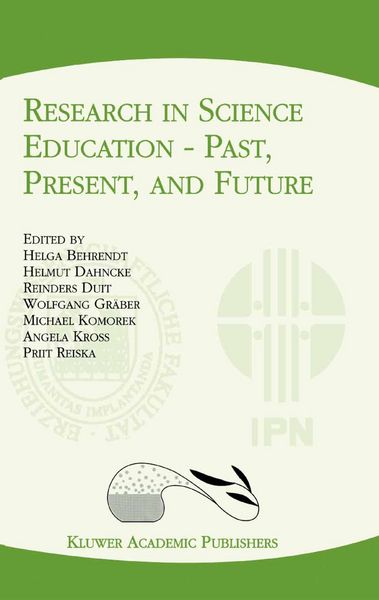
  • Produktbild: Research in Science Education — Past, Present, and Future
  • Produktbild: Research in Science Education — Past, Present, and Future

Research in Science Education — Past, Present, and Future

99,99 €

inkl. gesetzl. MwSt., Versandkostenfrei


Beschreibung

This volume includes articles based on papers presented at the Second International Conference of the European Science Education Research Association (E.S.E.R.A.) held in Kiel, August 31 to September 4, 1999. About 300 colleagues, virtually from around the world - with a particular European focus - participated....

Beschreibung

This volume includes articles based on papers presented at the Second International Conference of the European Science Education Research Association (E.S.E.R.A.) held in Kiel, August 31 to September 4, 1999. About 300 colleagues, virtually from around the world - with a particular European focus - participated. Some 200 papers were presented. Three pages synopses of these papers were published in Proceedings of the conference (edited by Michael Komorek, Helga Behrendt, Helmut Dahncke, Reinders Duit, Wolfgang Gräber and Angela Kross). The participants were asked to submit contributions to the present volume. It contains the invited plenary lectures and a selection of the submitted contributions based on reviews by an international board and the editors. The volume mirrors main lines of research in science education in Europe and around the world. The invited lectures provide overviews of the growth of science education research from the past to the present, including views of future developments. Major emphasis of empirical research still seems to be students' conceptions and conceptual change. About half of the contributions fall into that category. In addition, most of the remaining contributions deal with various cognitive issues of teaching and learning science. It was surprising for us that the number of studies on affective issues and gender differences was much smaller than expected.

Produktdetails

Einband

Taschenbuch

Erscheinungsdatum

01.12.2010

Abbildungen

VIII, 344 p.

Herausgeber Helga Behrendt + weitere

Produktdetails

Einband

Taschenbuch

Erscheinungsdatum

01.12.2010

Abbildungen

VIII, 344 p.

Herausgeber
Verlag Springer Netherland
Seitenzahl

344

Maße (L/B/H)

23,5/15,5/2 cm

Gewicht

540 g

Auflage

Softcover reprint of the original 1st ed. 2001

Sprache

Englisch

ISBN

978-90-481-5631-3

Herstelleradresse

Springer-Verlag KG
Sachsenplatz 4-6
1201 Wien
AT

Email: ProductSafety@springernature.com

Noch keine Bewertungen vorhanden

Verfassen Sie die erste Bewertung zu diesem Artikel

Helfen Sie anderen Kundinnen und Kunden durch Ihre Meinung.

Kundinnen und Kunden meinen

Bewertungen (0)

  • Produktbild: Research in Science Education — Past, Present, and Future
  • Produktbild: Research in Science Education — Past, Present, and Future
  • Views and Visions of Science Education Research.- Science Education Researchers and Research in Transition: Issues and Policies.- Research in Science Education in Europe: Retrospect and Prospect.- Science Content as Problematic - Issues for Research.- Science Education Versus Science in the Academy: Questions - Discussion - Perspectives.- Scientific Literacy — Conceptions and Assessment.- The Assessment of Scientific Literacy in the OECD/PISA Project.- Scientific Literacy: From Theory to Practice.- Making Formative Use of a National Summative Assessment Regime.- A Comparison of STS-teaching and Traditional Physics Lessons - On the Correlation of Physics Knowledge and Taking Action.- Students’ Conceptions.- On the Quantum Thinking of Physics Undergraduates.- Experiences with a Modern Course in Quantum Physics.- Learning Process Studies in the Field of Fractals.- Students’ Understandings of their Internal Structure as Revealed by Drawings.- Personal Context and Continuity of Human Thought; Recurrent Themes in a Longitudinal Study of Pupils’ Understanding of Scientific Phenomena.- Entities of the World and Causality in Children’s Thinking.- Using Media Reports of Science Research in Pupils’ Evaluation of Evidence.- Pupils’ Perceptions of Science Education at Primary and Secondary School.- Teachers’ Conceptions.- Teacher Professionalism and Change: Developing a Professional Self Through Reflective Assessment.- Formative Assessment Using Concept Cartoons: Initial Teacher Training in the UK.- Teaching Chemical Equilibrium in Australian and German Senior High Schools.- The Ideas of Spanish Primary Teachers on how to Develop an Understanding of Processes in Science and their Support in Textbooks.- Pre-service Elementary Teachers Constructing the Nature andLanguage of Science.- Combining Knowledge of Physics and Chemistry in Teaching: The Behaviour of a Narrow Jet of Water in the Presence of Charged Insulators.- Intuitive Rules: A Theory and its Implications to Mathematics and Science Teacher Education.- Conceptual Change — Teaching and Learning Processes.- Conceptual Change Research and the Teaching of Science.- Rhetoric and Science Education.- Development of Complexity through Dealing with Physical Qualities: One Type of Conceptual Change?.- On the Micro-structure of Analogical Reasoning: The Case of Understanding Chaotic Systems.- Role-playing, Conceptual Change, and the Learning Process: A Case Study of 7th Grade Pupils.- Concept Mapping as a Tool for Research in Science Education.- The Need for and the Role of Metacognition in Teaching and Learning the Particle Model.- Evolving Mental Models of Electric Circuits.- Two Models for a Physical Situation: the Case of Optics. Students’ Difficulties, Teachers’ Viewpoints and Guidelines for a ?Didactic Structure?.- The Influence of a Historically Oriented Course on the Content Knowledge of Students in Optics.- Using Everyday and Scientific Conceptions for Developing Guidelines of Teaching Microbiology.- Teaching and Learning the Concept of the Model in Secondary Schools.- Conceptual Change and Student Diversity: The Case of Volcanism at Primary School.- The Development of Prospective Teachers’ Concerns about Teaching Chemistry Topics at a Macro-micro-symbolic Interface.- How to Enhance Students’ Motivation and Ability to Communicate in Science Class-discourse.- How do Boys and Girls use Language in Physics Classes?.- Instructional Media and Lab Work.- Improving the Use of Instructional Illustrations in Learning Chemistry.- Computing in Stereochemistry - 2D or3D Representations?.- Learning Physics with Multimedia- and Experimental-supported Workshop Instruction.- Generating Hypotheses in Scientific Enquiry.- Using Laboratory Work for Purposeful Learning about the Practice of Science.- University Students During Practical Work: Can We Make the Learning Process Intelligible?.- Learning About Investigations - The Teacher’s Role.- Point and Set Paradigms in Students’ Handling of Experimental Measurements.- Beyond the Laboratory-learning Physics Using Real-life Contexts.