
KI-Beratung Beta

Gutscheinbedingungen

**Gültig bis 18.11.2026 auf englischsprachige Klassiker (klassiker-32728) online auf thalia.at und in der Thalia App. Einzelne Artikel können ausgeschlossen sein. Ausgenommen sind preisgebundene Artikel & eBooks. Pro Einkauf einmal einlösbar. Click & Collect nur bei Onlinevorabzahlung möglich. Keine Barauszahlung. Nicht kombinierbar mit anderen Aktionen und Gutscheinen. Gutschein wird auf max. 500€ Bestellwert angerechnet. Nicht gültig für Geschenkkarten, Versandkosten und Services.

  • Produktbild: Society, Behaviour, and Climate Change Mitigation
  • Produktbild: Society, Behaviour, and Climate Change Mitigation
Band 8 - 11%

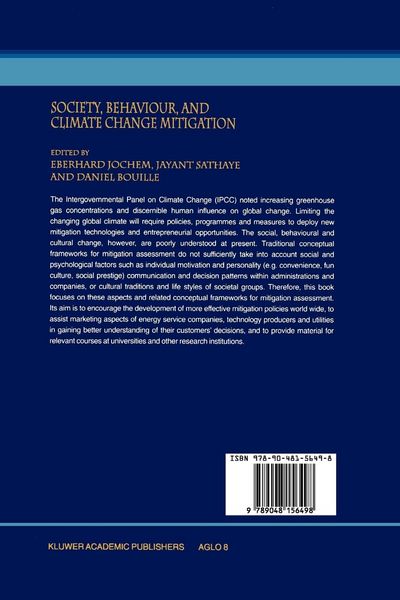
Society, Behaviour, and Climate Change Mitigation

11% sparen

154,99 € UVP 175,99 €

inkl. gesetzl. MwSt., Versandkostenfrei


Beschreibung

The Intergovernmental Panel on Climate change (IPCC) was jointly established by the World Meteorological Organization (WMO) and the United Nations Envir- ment Programme (UNEP) to assess the scientific, technical and socio-economic information relevant for the understanding of the risk of human-induced...

Beschreibung

The Intergovernmental Panel on Climate change (IPCC) was jointly established by the World Meteorological Organization (WMO) and the United Nations Envir- ment Programme (UNEP) to assess the scientific, technical and socio-economic information relevant for the understanding of the risk of human-induced climate change. Since its inception the IPCC has produced a series of comprehensive - sessment Reports, Special Reports and Technical Papers on the state of the und- standing of causes of climate change, its potential impacts, and options for response strategies. In 1998, Working Group III (WG III) of the ongoing Third Assessment was charged by the IPCC Plenary to assess the scientific, technical, environmental, economic and social aspects of the mitigation of climate change and a series of cross-cutting issues such as equity, development and sustainability. Its mandate was changed from a predominantly disciplinary assessment of the economic and social dimensions of climate change in the Second Assessment Report to an interdisciplinary assessment of the options to control the emissions of greenhouse gases and/or enhance their sinks. One key issue of the IPCC Third Assessment Report (TAR) on mitigation of climate change, which has undergone an extensive review by scientists and governments, is the role of present and future behaviour of individuals, households, private and p- lic companies, public authorities and other stakeholders.

Produktdetails

Einband

Taschenbuch

Erscheinungsdatum

22.10.2010

Abbildungen

XII, 242 p.

Herausgeber Eberhard Jochem + weitere

Produktdetails

Einband

Taschenbuch

Erscheinungsdatum

22.10.2010

Abbildungen

XII, 242 p.

Herausgeber
Verlag Springer Netherland
Seitenzahl

242

Maße (L/B/H)

23,5/15,5/1,5 cm

Gewicht

394 g

Auflage

2000

Sprache

Englisch

ISBN

978-90-481-5649-8

Herstelleradresse

Springer-Verlag GmbH
Tiergartenstr. 17
69121 Heidelberg
DE

Email: ProductSafety@springernature.com

Noch keine Bewertungen vorhanden

Verfassen Sie die erste Bewertung zu diesem Artikel

Helfen Sie anderen Kundinnen und Kunden durch Ihre Meinung.

Kundinnen und Kunden meinen

Bewertungen (0)

  • Produktbild: Society, Behaviour, and Climate Change Mitigation
  • Produktbild: Society, Behaviour, and Climate Change Mitigation
  • Incorporating Behavioural, Social, and Organizational Phenomena in the Assessment of Climate Change Mitigation Options.- Cultural Discourses in the Global Climate Change Debate.- Consumption, Motivation and Choice Across Scale: Consequences for Selected Target Groups.- The Legacy of Twenty Years of Energy Demand Management: we know more about Individual Behaviour but next to Nothing about Demand.- Group Identity, Personal Ethics and Sustainable Development Suggesting New Directions For Social Marketing Research.- European Narratives about Human Nature, Society and the Good Life.- Gender-Specific Patterns of Poverty and (Over-)Consumption in Developing and Developed Countries.- Climate Change and Relative Consumption.- Social interactions and conditions for change in energy-related decision-making in SMCs — an empirical socio-economic analysis.- Motivation and decision criteria for energy efficiency in private households, companies and administrations in Russia.