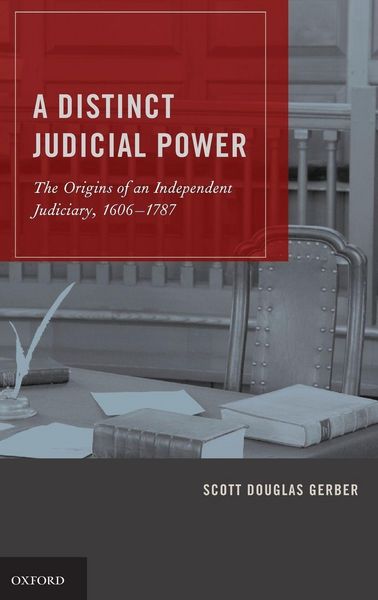
Produktbild: Distinct Judicial Power

Distinct Judicial Power The Origins of an Independent Judiciary, 1606-1787

163,99 €

inkl. gesetzl. MwSt., Versandkostenfrei


Beschreibung

Produktdetails

Einband

Gebundene Ausgabe

Erscheinungsdatum

27.05.2011

Verlag

Oxford Academic

Seitenzahl

436

Maße (L/B/H)

24/16,1/2,8 cm

Gewicht

726 g

Sprache

Englisch

ISBN

978-0-19-976587-4

Beschreibung

Zitat

Beginning with a review of the intellectual history of judicial independence from Aristotle to John Adams, Gerber thoroughly chronicles the rise of protojudicial independence in the original thirteen colonies' foundational texts and practices. Gerber persuasively describes the colonies as lurching toward judicial independence slowly and unevenly, yet steadily. Harvard Law Review. Gerber's book is by far the most comprehensive examination of the manner by which colonial and state constitutions contributed to the federal Constitution His study not only highlights the legacy of the aforementioned area to the creation of Article III of the Constitution, but renews interest in the contribution of John Adams to the development of the courts and opens new ground about the relationship between judicial review and judicial independence. Samuel B. Hoff, Law and Politics Book Review. A valuable summary of the development of local judicial institutions that provides a welcome resource for students of the colonial and Revolutionary eras. Edward A. Purcell, Jr., Tulsa Law Review. There is much to praise in A Distinct Judicial Power. Tracing the history of a separate judicial branch as it developed in America is an important task in itself. Bringing together the experience of every one of the thirteen colonies in the development of its judiciary is a boon to us all. Joyce Lee Malcolm, George Mason University School of Law. Reason Papersber has authored a timely and thorough treatise on judicial review that traces the concept through 3,000 years of political thought. He also has provided an in-depth historical analysis on this country's struggles to create an independent judiciary founded on a compensation and tenure structure not subject to political whim. Gerald Rafferty, Colorado Lawyer Beginning with a review of the intellectual history of judicial independence from Aristotle to John Adams, Gerber thoroughly chronicles the rise of protojudicial independence in the original thirteen colonies foundational texts and practices. Gerber persuasively describes the colonies as lurching toward judicial independence slowly and unevenly, yet steadily. Harvard Law Review

Produktdetails

Einband

Gebundene Ausgabe

Erscheinungsdatum

27.05.2011

Verlag

Oxford Academic

Seitenzahl

436

Maße (L/B/H)

24/16,1/2,8 cm

Gewicht

726 g

Sprache

Englisch

ISBN

978-0-19-976587-4

Herstelleradresse

Libri GmbH
Europaallee 1
36244 Bad Hersfeld
DE

Email: gpsr@libri.de

Noch keine Bewertungen vorhanden

Verfassen Sie die erste Bewertung zu diesem Artikel

Helfen Sie anderen Kundinnen und Kunden durch Ihre Meinung.

Kundinnen und Kunden meinen

Bewertungen (0)

  • Produktbild: Distinct Judicial Power
    • Preface

    • A Note on Methodology

    • The Political Theory of an Independent Judiciary

    • 1: The History of Ideas: From Aristotle's Theory of a Mixed Constitution to John Adams's Modifications of Montesquieu

    • 2: Article III of the Constitution of the United States

    • II The Judicial Power in the Original Thirteen States and Their Colonial Antecedents

    • 3: Virginia: Constitutionalizing Judicial Independence Prior to the U.S. Constitution

    • 4: Massachusetts: A "Safety-Valve" Theory of Judicial Independence

    • 5: New Hampshire: Judicial Review in the Rockingham County Inferior Court

    • 6: Maryland: Chancellor Theodorick Bland and Salaries that "ought to be secured"

    • 7: Connecticut: Disestablishment and Judicial Independence

    • 8: Rhode Island: Last Bastion of Legislative Supremacy

    • 9: North Carolina: Governor Thomas Burke and the Origins of Judicial Review

    • 10: South Carolina: Judicial Review without an Independent Judiciary

    • 11: New Jersey: The First State Court Precedent for Judicial Review

    • 12: New York: Persistent Threats to Judicial Independence

    • 13: Pennsylvania: (Almost) Adopting the Federal Model

    • 14: Delaware: A High Court of Errors and Appeals

    • 15: Georgia: Ineffective and Dependent Judges

    • Judicial Independence, Judicial Review, and Individual Rights

    • 16: Conclusion

    • Appendix: Popular Constitutionalism-The Contemporary Assault on Judicial Review

    • Works Cited

    • Index