
Gutscheinbedingungen

**Gültig nur für Bestellungen an die Wunsch-Poststation bis 10.06.2026 auf Spielzeug, Schreibwaren, Filme, Geschenke & Trends, Musik, tolino eReader & Zubehör, Hörbücher und Hörbuch-Downloads (außer Abo), nicht preisgebundene Bücher und Kalender online auf thalia.at und in der Thalia App. Einzelne Artikel können ausgeschlossen sein. Aufgrund der Buchpreisbindung sind deutschsprachige Bücher und eBooks ausgenommen. Zusätzlich ausgenommen sind preisgebundene Artikel, Abos & Flatrates, eBooks, Games, Geschenkkarten/-boxen, Shelfies, Software, Zeitschriften sowie einzelne Artikel von tonies®. Pro Einkauf einmal einlösbar. Kein Click & Collect möglich. Keine Barauszahlung. Nicht kombinierbar mit anderen Aktionen und Gutscheinen. Gutschein wird auf max. 500€ Bestellwert angerechnet. Nicht gültig für Versandkosten und Services.

  • Produktbild: Jacques Rancière
  • Produktbild: Jacques Rancière

Jacques Rancière

30,99 €

inkl. gesetzl. MwSt., Versandkostenfrei


Beschreibung

Produktdetails

Verkaufsrang

21602

Einband

Taschenbuch

Erscheinungsdatum

11.10.2010

Verlag

John Wiley & Sons Inc

Seitenzahl

224

Maße (L/B/H)

22,7/15,3/2 cm

Gewicht

353 g

Auflage

1. Auflage

Sprache

Englisch

ISBN

978-0-7456-4655-8

Beschreibung

Rezension

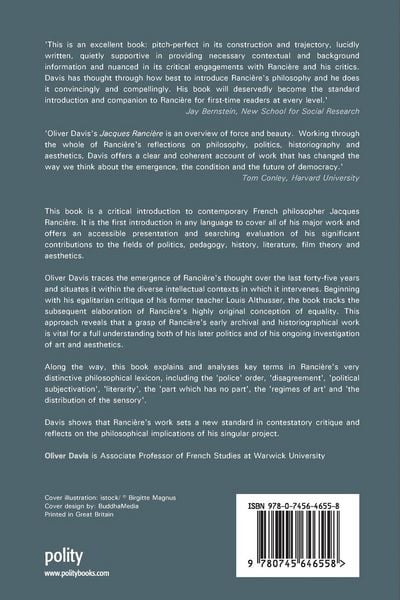
"An absolute model of explanatory clarity, with a level of critical distance made all the more impressive by this being the first monograph on Ranciere in any language."
French Studies
"A solid introduction to Ranciere's thought that should help facilitate the reception of his work in the English-speaking world."
Choice
 
"Well written and accessible ... the chapters are clear and capture the full extent of Rancière's thinking, yet they remain remarkably critical."
Ethical Perspectives
 
"Davis has thought through how best to introduce Rancière's philosophy and he does it convincingly and compellingly. His book will deservedly become the standard introduction and companion to Rancière for first time readers at every level."
Jay Bernstein, New School for Social Research
 
"Oliver Davis's Jacques Rancière is an overview of force and beauty. Working through the whole of Rancière's reflections on philosophy, politics, historiography and aesthetics, Davis offers a clear and coherent account of work that has changed the way we think about the emergence, the condition and the future of democracy."
Tom Conley, Harvard University

Produktdetails

Verkaufsrang

21602

Einband

Taschenbuch

Erscheinungsdatum

11.10.2010

Verlag

John Wiley & Sons Inc

Seitenzahl

224

Maße (L/B/H)

22,7/15,3/2 cm

Gewicht

353 g

Auflage

1. Auflage

Sprache

Englisch

ISBN

978-0-7456-4655-8

Herstelleradresse

Libri GmbH
Europaallee 1
36244 Bad Hersfeld
DE

Email: gpsr@libri.de

Kundinnen und Kunden meinen

0 Bewertungen

Informationen zu Bewertungen

Zur Abgabe einer Bewertung ist eine Anmeldung im Konto notwendig. Die Authentizität der Bewertungen wird von uns nicht überprüft. Wir behalten uns vor, Bewertungstexte, die unseren Richtlinien widersprechen, entsprechend zu kürzen oder zu löschen.

Die Bewertungen sind nach Format, Anzahl Sterne und Datum sortiert.

Verfassen Sie die erste Bewertung zu diesem Artikel

Helfen Sie anderen Kund*innen durch Ihre Meinung

Kundinnen und Kunden meinen

0 Bewertungen filtern

Die Leseprobe wird geladen.
  • Produktbild: Jacques Rancière
  • Produktbild: Jacques Rancière
  • Preface vii

    Acknowledgements xiii

    1 The Early Politics: From Pedagogy to Equality 1

    Althusser's lesson 2

    Platonic inequality in Marx, Sartre and Bourdieu 15

    Jacotot and radical equality 25

    2 History and Historiography 36

    Les Révoltes Logiques (1975-81) 36

    The Nights of Labor: The Workers' Dream in Nineteenth-Century France [1981] 52

    The Names of History: On the Poetics of Knowledge [1992] 57

    Conclusion 72

    3 The Mature Politics: From Policing to Democracy 74

    Politics and 'the police' 76

    Rancière's structural account of democracy: the 'wrong' and the miscount 80

    Political 'subjectivation' 84

    The aesthetic dimension of politics: the 'division' or 'distribution' of 'the sensory' (le partage du sensible) 90

    Overall assessment of Rancière's account of politics 92

    4 Literature 101

    'What is literature?' 102

    Writing, literarity . . . and literature 107

    Rancière as reader 115

    5 Art and Aesthetics 126

    Aesthetic experience and equality: with Kant and Gauny, against Bourdieu 128

    The regimes of art 134

    Film and film theory 138

    Contemporary art, politics and community 152

    Afterword 160

    Notes 162

    References 191

    Index 207