• Produktbild: Worlds Out of Nothing
  • Produktbild: Worlds Out of Nothing
- 13%

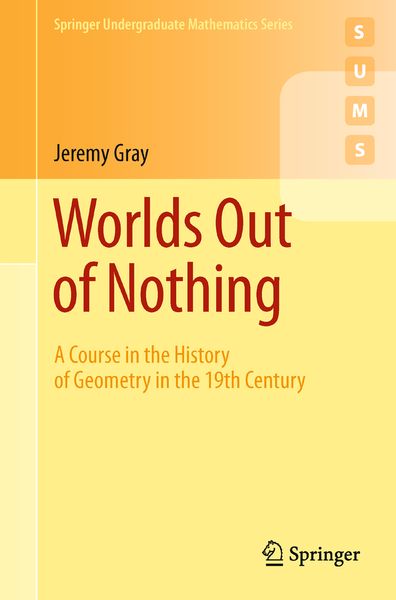
Worlds Out of Nothing A Course in the History of Geometry in the 19th Century

13% sparen

35,99 € UVP 41,79 €

inkl. gesetzl. MwSt., Versandkostenfrei


Beschreibung

Produktdetails

Einband

Taschenbuch

Erscheinungsdatum

03.12.2010

Abbildungen

XXVI, 71 illus., schwarz-weiss Illustrationen

Verlag

Springer London

Seitenzahl

384

Maße (L/B/H)

23,3/15,4/2,7 cm

Gewicht

646 g

Auflage

2. Auflage

Sprache

Englisch

ISBN

978-0-85729-059-5

Beschreibung

Rezension

From the reviews:

"Gray’s new book will become both a classic reference and a model on how to write a useful course text. With original source material woven in with historical context, this book is a fun read as it examines geometry historically as a connected sequence of diverse ideas … . it includes a useful index and extensive bibliography. If you enjoy mathematics, buy this and read it! Summing Up: Highly recommended. General readers; lower-division undergraduates through faculty." (J. Johnson, CHOICE, Vol. 44 (11), July, 2007)

"Gray (Open Univ., UK) does it again. Complementing his works on Jinos Bolyai or the world of different geometries, Gray's new book will become both a classic reference and a model on how to write a useful course text. With original source material in with historical context, this book is a fun read as it examines geometry historically as a connected sequence of diverse ideas: duality in projective geometry, the problem of parallels in non-Euclidean geometries, the nature of surfaces in differential geometry, and concern for geometry as a true "measure" of space (physical or philosophical). Documenting mathematicians' contributions within this historical sequence, the book becomes a fascinating Who's Who: Poncelet, Desargues, Pascal, Gergonne, Saccheri, Lambert, Legendre, Gauss, Bolyai, Lobachevski, Möbius, Plücker, Beltrami, Klein, Poincaré, Hilbert, and Einstein. Finally, the book's unusual twist is its inclusion of three chapters on writing and critical reading about the history of mathematics; these chapters alone make the book valuable to those helping students improve as writers of mathematics. An offshoot of a University of Warwick course, it includes a useful index and extensive bibliography. If you enjoy mathematics, but this and read it! Summing up: Highly recommended. General readers; lower-division undergraduates through faculty." -
J. Johnson, Western Washington University

"This isan outstanding text for the well-prepared student who has a basic knowledge of linear algebra, matrix theory, calculus of several variables, and geometry. … an important addition to the mathematical and historical literature. Albeit primarily a textbook for a one-semester upper level or graduate course in the history of mathematics, it will be appreciated and enjoyed by those interested in geometry, history, philosophy, and pedagogy. … The book contains an excellent bibliography. … it provides a useful reference for anyone interested in geometry." (James J. Tattersall, Mathematical Reviews, Issue 2008 b)

"The 19
th
century was certainly an exciting time in geometry. To chronicle all of that excitement in one place is a monumental task; to have done so with real clarity and attention to detail, as Jeremy Gray has done, is an impressive achievement. … Gray has succeeded on several levels: as a historical chronicler, as a mathematical scholar, and as an advisor to teachers. Worlds Out Of Nothing is a first-rate addition to the geometry enthusiast’s bookshelf." (Mark Bollman, MathDL, January, 2008)

“The book under review provides a course on the history of geometry in the 19th century. … In the book the emphasis is put on understanding the historical significance of the new geometry. In this way it can fill the gap between what is usually taught today in geometry … and the historical considerations, it can provide the historical and philosophical background of the geometry developed in the 19th

century.” (Roman Murawski, Zentralblatt MATH, Vol. 1205, 2011)

Produktdetails

Einband

Taschenbuch

Erscheinungsdatum

03.12.2010

Abbildungen

XXVI, 71 illus., schwarz-weiss Illustrationen

Verlag

Springer London

Seitenzahl

384

Maße (L/B/H)

23,3/15,4/2,7 cm

Gewicht

646 g

Auflage

2. Auflage

Sprache

Englisch

ISBN

978-0-85729-059-5

Herstelleradresse

Libri GmbH
Europaallee 1
36244 Bad Hersfeld
DE

Email: gpsr@libri.de

Noch keine Bewertungen vorhanden

Verfassen Sie die erste Bewertung zu diesem Artikel

Helfen Sie anderen Kundinnen und Kunden durch Ihre Meinung.

Kundinnen und Kunden meinen

Bewertungen (0)

  • Produktbild: Worlds Out of Nothing
  • Produktbild: Worlds Out of Nothing
  • Mathematics in the French Revolution.- Poncelet (and Pole and Polar).- Theorems in Projective Geometry.- Poncelet’s Traité.- Duality and the Duality Controversy.- Poncelet, Chasles, and the Early Years of Projective Geometry.- Euclidean Geometry, the Parallel Postulate, and the Work of Lambert and Legendre.- Gauss (Schweikart and Taurinus) and Gauss’s Differential Geometry.- János Bolyai.- Lobachevskii.- Publication and Non-Reception up to 1855.- On Writing the History of Geometry – 1.- Across the Rhine – Möbius’s Algebraic Version of Projective Geometry.- Plücker, Hesse, Higher Plane Curves, and the Resolution of the Duality Paradox.- The Plücker Formulae.- The Mathematical Theory of Plane Curves.- Complex Curves.- Riemann: Geometry and Physics.- Differential Geometry of Surfaces.- Beltrami, Klein, and the Acceptance of Non-Euclidean Geometry.- On Writing the History of Geometry – 2.- Projective Geometry as the Fundamental Geometry.- Hilbert and his Grundlagen der Geometrie.- The Foundations of Projective Geometry in Italy.- Henri Poincaré and the Disc Model of non-Euclidean Geometry.- Is the Geometry of Space Euclidean or Non-Euclidean?.- Summary: Geometry to 1900.- What is Geometry? The Formal Side.- What is Geometry? The Physical Side.- What is Geometry? Is it True? Why is it Important?.- On Writing the History of Geometry – 3.