Gutscheinbedingungen

**Gültig bis 12.08.2026 auf fremdsprachige Bücher online auf thalia.at und in der Thalia App. Einzelne Artikel können ausgeschlossen sein. Ausgenommen sind preisgebundene Artikel & eBooks. Pro Einkauf einmal einlösbar. Click & Collect nur bei Onlinevorabzahlung möglich. Keine Barauszahlung. Nicht kombinierbar mit anderen Aktionen und Gutscheinen. Gutschein wird auf max. 500€ Bestellwert angerechnet. Nicht gültig für Geschenkkarten, Versandkosten und Services.

  • Produktbild: Thinking about Evolution
  • Produktbild: Thinking about Evolution

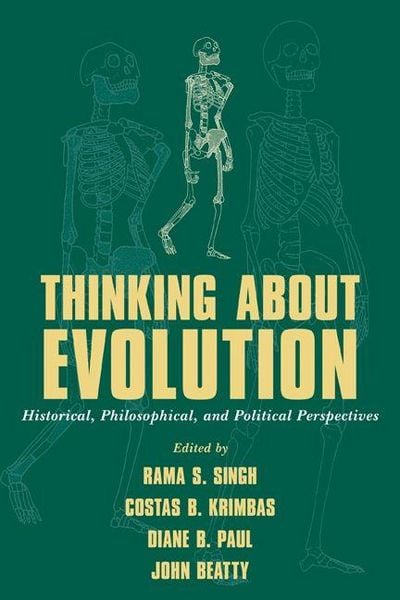
Thinking about Evolution Historical, Philosophical, and Political Perspectives

95,99 €

inkl. gesetzl. MwSt., Versandkostenfrei


Beschreibung

Produktdetails

Einband

Taschenbuch

Erscheinungsdatum

11.01.2011

Herausgeber

Singh Rama S. + weitere

Verlag

Cambridge Academic

Seitenzahl

626

Maße (L/B/H)

23,4/15,6/3,3 cm

Gewicht

870 g

Sprache

Englisch

ISBN

978-0-521-17831-0

Beschreibung

Produktdetails

Einband

Taschenbuch

Erscheinungsdatum

11.01.2011

Herausgeber

Verlag

Cambridge Academic

Seitenzahl

626

Maße (L/B/H)

23,4/15,6/3,3 cm

Gewicht

870 g

Sprache

Englisch

ISBN

978-0-521-17831-0

Herstelleradresse

Libri GmbH
Europaallee 1
36244 Bad Hersfeld
DE

Email: gpsr@libri.de

Noch keine Bewertungen vorhanden

Verfassen Sie die erste Bewertung zu diesem Artikel

Helfen Sie anderen Kundinnen und Kunden durch Ihre Meinung.

Kundinnen und Kunden meinen

Bewertungen (0)

  • Produktbild: Thinking about Evolution
  • Produktbild: Thinking about Evolution
  • Preface; Introduction; 1. Does culture evolve? Richard Lewontin; Part A. History of and in Evolutionary Biology: 2. The nature of evolutionary biology: an interchange among Richard Lewontin, Diane Paul, John Beatty and Costas Krimbas; 3. Hannah Arendt and Karl Popper: Darwinism, Fatalism and Totalitarianism John Beatty; 4. The genetics of experimental populations: L'Heritier and Teisser's population cages Jean Gayon and Michel Veuille; 5. Did eugenics rest on an elementary mistake? Diane Paul and Hamish Spencer; 6. Can the norm of reaction save the gene concept? Rafi Falk; 7. The apportionment of human diversity twenty-five years later Maryellen Ruvolo and Mark Seielstad; 8. The Indian caste system: origin, evolution and impact on human diversity Rama Singh; Part B. Philosophy of Evolutionary Biology: 9. Selfish genes or developmental systems? Russel Gray; 10. The evolutionary definition of selective agency, the validation of the theory of hierarchical selection, and the fallacy of the selfish gene Stephen J. Gould; 11. Reductionism in genetics and the human genome project Sahotra Sarkar; 12. Organism and environment Peter Godfrey-Smith; 13. Levels and units of selection Lisa Lloyd; 14. In defense of neo-Darwinism: Popper's 'Darwinism as a metaphysical programme' revisited Costas Krimbas; 15. The two faces of fitness Elliot Sober; 16. Evolvability: adaptation and modularity Jeffrey C. Schank and Bill Wimsatt; 17. Organism and environment revisited Robert Brandon; 18. An 'irreducible' component of cognition Massimo Piattelli-Palmarini; Part C. The Politics of Evolutionary Biology: 19. What causes cancer? A political history of recent debates Robert Proctor; 20. Battling the undead: how (and how not) to resist genetic determinism Philip Kitcher; 21. The rise of neurogenetic determinism Steven Rose; 22. Behavior genetics: Galen's prophecy or Malpighi's legacy? Evan Balaban; 23. Identity politics and biology Ruth Hubbard; 24. The agroecosystem: the modern vision in crisis, the alternative evolving John Vandermeer; 25. Political economy of agricultural genetics Jean-Pierre Berlan; 26. The butterfly ex machina Richard Levins; 27. Evoking transmutational dread: military and civilian uses of nuclear and genetic alchemies Robert Haynes; 28. From natural selection to natural construction to disciplining unruly complexity: the challenge of integrating ecological dynamics into evolutionary theory Peter Taylor.