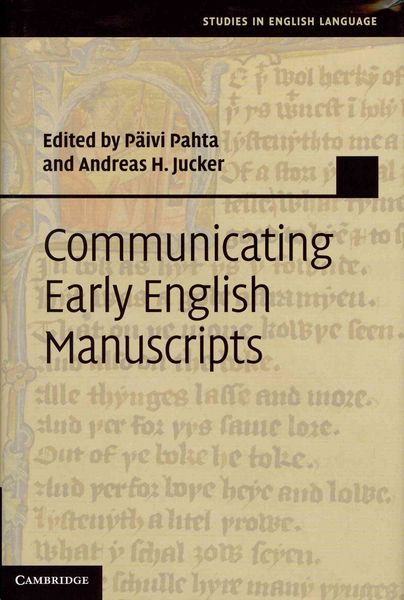

Communicating Early English Manuscripts
-
- Hardcover ausgewählt
- Taschenbuch
-
Sprache:Englisch
101,99 €
inkl. gesetzl. MwSt.,
Beschreibung
Produktdetails
Einband
Gebundene Ausgabe
Erscheinungsdatum
27.01.2011
Abbildungen
17 b/w illus. 17 tables, Zeichnungen, nicht spezifiziert, Raster, nicht spezifiziert, Tabellen, schwarz-weiss
Herausgeber
Päivi Pahta + weitereVerlag
Cambridge AcademicSeitenzahl
314
Maße (L/B/H)
23,5/15,7/2,1 cm
Gewicht
560 g
Sprache
Englisch
ISBN
978-0-521-19329-0
In an obvious way, manuscripts communicate. This is the first book to focus on the communicative aspects of English manuscripts from the fourteenth to the nineteenth century. It investigates how the authors and scribes of these manuscripts communicated with their audiences, how the characters depicted in these manuscripts communicate with each other, and how the manuscripts communicate with scholars and audiences in the 21st century. It covers a wide variety of genres, such as stories, scientific writing, witchcraft records, personal letters, war correspondence, courtroom records, and plays. The volume demonstrates how these handwritten texts can be used to analyse the history of language as communication between individuals and groups, and discusses the challenges these documents present to present-day scholars. It is unique in bringing together studies by distinguished international experts examining primary handwritten sources from the perspectives of several fields, including historical pragmatics, historical sociolinguistics, corpus linguistics and literary scholarship.
Noch keine Bewertungen vorhanden
Verfassen Sie die erste Bewertung zu diesem Artikel
Helfen Sie anderen Kundinnen und Kunden durch Ihre Meinung.
Kurze Frage zu unserer Seite
Vielen Dank für Ihr Feedback
Wir nutzen Ihr Feedback, um unsere Produktseiten zu verbessern. Bitte haben Sie Verständnis, dass wir Ihnen keine Rückmeldung geben können. Falls Sie Kontakt mit uns aufnehmen möchten, können Sie sich aber gerne an unseren Kund*innenservice wenden.
zum Kundenservice