KI-Beratung Beta

Gutscheinbedingungen

**Gültig bis 18.11.2026 auf englischsprachige Klassiker (klassiker-32728) online auf thalia.at und in der Thalia App. Einzelne Artikel können ausgeschlossen sein. Ausgenommen sind preisgebundene Artikel & eBooks. Pro Einkauf einmal einlösbar. Click & Collect nur bei Onlinevorabzahlung möglich. Keine Barauszahlung. Nicht kombinierbar mit anderen Aktionen und Gutscheinen. Gutschein wird auf max. 500€ Bestellwert angerechnet. Nicht gültig für Geschenkkarten, Versandkosten und Services.

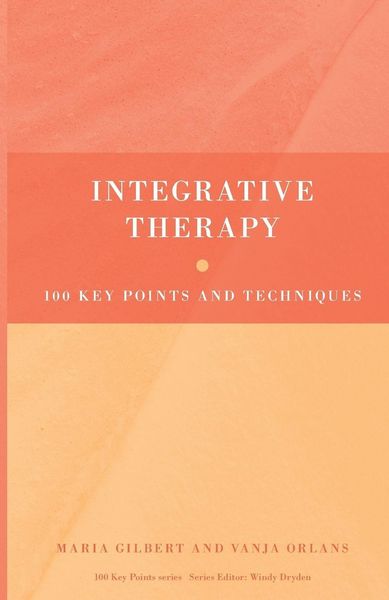
  • Produktbild: Integrative Therapy
  • Produktbild: Integrative Therapy

Integrative Therapy 100 Key Points and Techniques

Aus der Reihe 100 Key Points

35,99 €

inkl. gesetzl. MwSt., Versandkostenfrei


Beschreibung

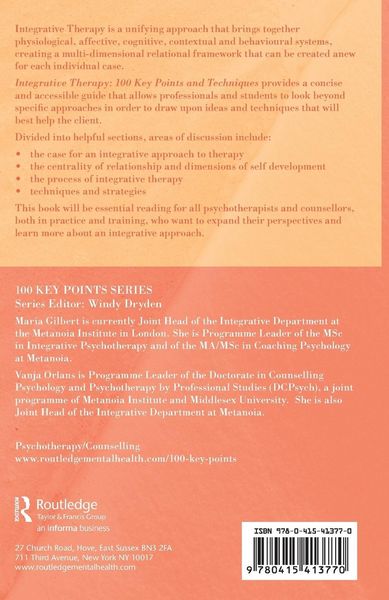
Integrative Therapy is a unifying approach that brings together physiological, affective, cognitive, contextual and behavioural systems, creating a multi-dimensional relational framework that can be created anew for each individual case.

Integrative Therapy: 100 Key Points and Techniques provides a concise...

Beschreibung

Integrative Therapy is a unifying approach that brings together physiological, affective, cognitive, contextual and behavioural systems, creating a multi-dimensional relational framework that can be created anew for each individual case.

Integrative Therapy: 100 Key Points and Techniques provides a concise and accessible guide that allows professionals and students to look beyond specific approaches in order to draw upon ideas and techniques that will best help the client.

Divided into helpful sections, areas of discussion include:

  • the case for an integrative approach to therapy
  • the centrality of relationship and dimensions of self development
  • the process of integrative therapy
  • techniques and strategies

This book will be essential reading for all psychotherapists and counsellors, both in practice and training, who want to expand their perspectives and learn more about an integrative approach.

Produktdetails

Einband

Taschenbuch

Erscheinungsdatum

17.11.2010

Verlag Taylor & Francis
Seitenzahl

266

Produktdetails

Einband

Taschenbuch

Erscheinungsdatum

17.11.2010

Verlag Taylor & Francis
Seitenzahl

266

Maße (L/B/H)

19,8/12,9/1,4 cm

Gewicht

287 g

Sprache

Englisch

ISBN

978-0-415-41377-0

Herstelleradresse

Libri GmbH
Europaallee 1
36244 Bad Hersfeld
DE

Email: gpsr@libri.de

Noch keine Bewertungen vorhanden

Verfassen Sie die erste Bewertung zu diesem Artikel

Helfen Sie anderen Kundinnen und Kunden durch Ihre Meinung.

Kundinnen und Kunden meinen

Bewertungen (0)

Die Leseprobe wird geladen.
  • Produktbild: Integrative Therapy
  • Produktbild: Integrative Therapy
  • Acknowledgements. PART I: The Case for an Integrative Approach to Psychotherapy. The Current Professional Context. Philosophy, Values and Ethics Supporting an Integrative Framework for Practice . Criticisms of Integration. Competencies for an Integrative Psychotherapy. Our Framework for an Integrative Psychotherapy. PART II: A Review of the Literature on Integration. The History of Integration. Definitions of Integration. Theoretical Integration: Meta-Theoretical Models. Support for Integration from Outcome Research. Common Factors as a Basis for Integration. The Client as the Most Important 'Common Factor' in Change . Technical Eclecticism. Assimilative Integration. Complementarity: Combining two methods. Affective neuroscience and integration. PART III: The Centrality of Relationship from the Time of Infancy. The Primacy of Affect in Development. Early Experience and the Development of the Brain. Affect Regulation and the Development of Self. Affective neuroscience: The work of Panksepp and Damasio. The Social Brain: The Function of the Orbitofrontal Cortex. Attachment Styles: The Work of Bowlby and Colleagues. Intergenerational Patterns of Attachment . Infant Observation Studies: The work of Stern and Others. Winnicott and the Ordinary 'Good Enough' Mother. Affect Dysregulation and Adult Pathology: The Work of Schore. Early Relational Trauma and its Effects. Self and Interactive Regulation Throughout the Lifespan. PART IV: Dimensions of Self Development. The Co-Created Self in Relationship. Different Dimensions of Self Experience. The Biological: Relationship of Self to Body. The Intrapsychic: Relationship of Self to Self. The Interpersonal and Intersubjective: Relationship of Self to Others. The Intercultural Dimension: Culture, Race and Wider Context. The Transpersonal Dimension. Internalised Relationship Maps: RIG's, Schema and Internal Working Models. Developing a Narrative to Make Sense of Life - and Psychotherapy. Mentalization: Developing the Reflective Function. Traumatic Memory Processes and Dissociation. PART V: Problem Formulation for the Integrative Psychotherapist. Drawing on a Range of Concepts for Problem Formulation. Relational Perspectives on Problem Formulation. Diagnosis and the DSM-IV-TR: Pros and Cons. Anxiety and Depression: Common Presenting Issues. From Personality Style to Personality Disorder. Developmental Perspectives in Problem Formulation. Existential Life Issues in Problem Formulation. Chronic Relational Trauma and Single Traumatic Events. Complex Post -Traumatic Stress Disorder. Constructing an Integrative Problem Formulation. PART VI: The Process of Integrative Psychotherapy. The First Session: Important Considerations. What Therapy for Which Client in What Context? Psychotherapeutic Change: The Role of Love and Hope. Assessment in Psychotherapy. Therapeutic Relationship Dimensions: An Overview. The Working Alliance and Effective Therapy. The Person-to-Person or 'Real' Relationship. Transference and Countertransference. The Reparative or Developmentally Needed Relationship. The Transpersonal Relationship. The Representational Relationship. Different Views on Working with the Transference. Repetitive and Selfobject Dimensions of the Transference . Implicit and Explicit Levels of Relationship. The Co-Created Unconscious or 'Analytic Third'. Reciprocal Mutual Influence: A Two-Person Psychology . Conceptions of Time in Integrative Psychotherapy. Inclusion: A Process Goal of Therapy . An Integrative Approach to Trauma. Therapeutic Alliance Ruptures: Research and Clinical Perspectives. The Integrative Psychotherapist as Researcher. Developing One's Own Unique Style of Integration. PART VII: Techniques and Strategies for the Integrative Psychotherapist. Implicit Relational Knowing: Working