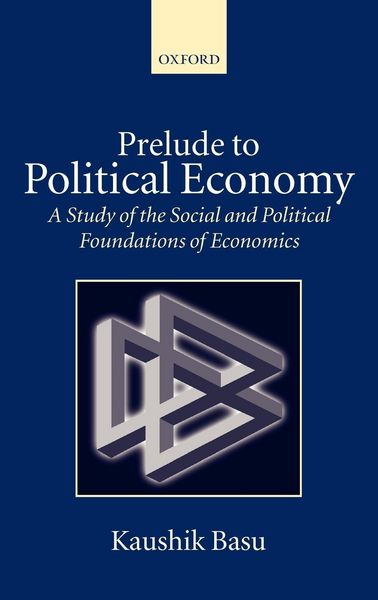
Prelude to Political Economy ' a Study of the Social and Political Foundations of Economics ' A Study of the Social and Political Foundations of Economics
-
- Englisch ausgewählt
81,99 €
inkl. gesetzl. MwSt.,
Beschreibung
Produktdetails
Einband
Gebundene Ausgabe
Erscheinungsdatum
28.09.2000
Verlag
Oxford AcademicSeitenzahl
308
Maße (L/B/H)
24/16,1/2,1 cm
Gewicht
580 g
Sprache
Englisch
ISBN
978-0-19-829671-3
Mainstream economics was founded on many strong assumptions. Institutions and politics were treated as irrelevant, government as exogenous, social norms as epiphenomena. As an initial gambit this was fine. But as the horizons of economic inquiry have broadened, these assumptions have become hindrances rather than aids. If we want to understand why some economies succeed and some fail, why some governments are effective and others not, why some communities prosper while others stagnate, it is essential to view economics as embedded in politics and society. Prelude to Political Economy is a study of this embeddedness; it argues for an 'inclusive' approach to institutions and the state.
Modern economics recognizes that individuals' pursuit of their own selfish ends can result in socially suboptimal outcomes - the Prisoner's Dilemma being the stark example. It has been suggested that what we need in such an eventuality is 'third-party' intervention, which can take the form of imposing punishment on players. Kaushik Basu objects to this method of wishing third parties out of thin air. He argues that if a third party that could impose its will on others were available, then it should have been modeled as a player to start with.
The adoption of such an inclusive approach has implications for our conception of the state and the law. It means that the law cannot be construed as a factor that changes the game that citizens play. It is instead simply a set of beliefs of citizens; and, as such, it is similar to social norms. What the law does for an economy, so can social norms. The book discusses how the nature of policy advice and our conception of state power are affected by this altered view of the state and the law.
As corollaries, the book addresses a variety of important social and philosophical questions, such as whether the state should guarantee freedom of speech, whether determinism is compatible with free will, and whether the free market can lead to coercion.
Noch keine Bewertungen vorhanden
Verfassen Sie die erste Bewertung zu diesem Artikel
Helfen Sie anderen Kundinnen und Kunden durch Ihre Meinung.
Kurze Frage zu unserer Seite
Vielen Dank für Ihr Feedback
Wir nutzen Ihr Feedback, um unsere Produktseiten zu verbessern. Bitte haben Sie Verständnis, dass wir Ihnen keine Rückmeldung geben können. Falls Sie Kontakt mit uns aufnehmen möchten, können Sie sich aber gerne an unseren Kund*innenservice wenden.
zum Kundenservice