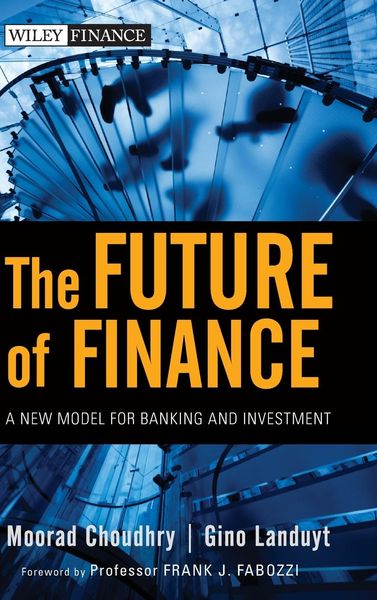
Produktbild: The Future of Finance
- 12%

The Future of Finance A New Model for Banking and Investment

Aus der Reihe Wiley Finance Editions
12% sparen

71,99 € UVP 82,20 €

inkl. gesetzl. MwSt., Versandkostenfrei


Beschreibung

Produktdetails

Einband

Gebundene Ausgabe

Erscheinungsdatum

02.11.2010

Verlag

John Wiley & Sons

Seitenzahl

224

Maße (L/B/H)

23,5/15,7/1,7 cm

Gewicht

487 g

Auflage

1. Auflage

Sprache

Englisch

ISBN

978-0-470-57229-0

Beschreibung

Produktdetails

Einband

Gebundene Ausgabe

Erscheinungsdatum

02.11.2010

Verlag

John Wiley & Sons

Seitenzahl

224

Maße (L/B/H)

23,5/15,7/1,7 cm

Gewicht

487 g

Auflage

1. Auflage

Sprache

Englisch

ISBN

978-0-470-57229-0

Herstelleradresse

Libri GmbH
Europaallee 1
36244 Bad Hersfeld
DE

Email: gpsr@libri.de

Kundinnen und Kunden meinen

0 Bewertungen

Informationen zu Bewertungen

Zur Abgabe einer Bewertung ist eine Anmeldung im Konto notwendig. Die Authentizität der Bewertungen wird von uns nicht überprüft. Wir behalten uns vor, Bewertungstexte, die unseren Richtlinien widersprechen, entsprechend zu kürzen oder zu löschen.

Die Bewertungen sind nach Format, Anzahl Sterne und Datum sortiert.

Verfassen Sie die erste Bewertung zu diesem Artikel

Helfen Sie anderen Kund*innen durch Ihre Meinung

Kundinnen und Kunden meinen

0 Bewertungen filtern

Die Leseprobe wird geladen.
  • Produktbild: The Future of Finance
  • Foreword.
     
    Preface.
     
    Introduction.
     
    Market Instability.
     
    Derivatives and Mathematical Modeling.
     
    Senior Management and "Staying in the Game".
     
    Macro-prudential Financial Regulation and Cycle-Proof Regulation.
     
    The Way Forward.
     
    Conclusion.
     
    Part I: A Review of the Financial Crash.
     
    Chapter 1: Globalization, Emerging Markets, and the Savings Glut.
     
    Globalization.
     
    A Series of Emerging Market Crises.
     
    Low Yield Environment Due to New Players on the Financial Markets.
     
    Artificially Low Exchange Rates.
     
    Recommendations and Solutions for Global Imbalances.
     
    Chapter 2: The Rise of Derivatives and Systemic Risk.
     
    Systemic Risk.
     
    Derivative Market Systemic Risk: Solutions for Improvement.
     
    Chapter 3: The "Too-Big-To-Fail" Bank, Moral Hazard, and Macroprudential Regulation.
     
    Banks and Moral Hazard.
     
    Addressing Too-Big-to Fail: Mitigating Moral Hazard Risk.
     
    Macroprudential Regulation: Regulating Bank Systemic Risk.
     
    Conclusion.
     
    Chapter 4: Corporate Governance and Remuneration in the Banking Industry.
     
    Bonuses and a Moral Dilemma.
     
    A Distorted Remuneration Model.
     
    Unsuitable Personal Behavior.
     
    Conclusion.
     
    Chapter 5: Bank Capital Safeguards: Additional Capital Buffers and Reverse Convertibles.
     
    Capital Issues in a Bear Market.
     
    Looking for New Capital Instruments.
     
    Counter-Cyclical Capital Management.
     
    Chapter 6: Economic Theories under Attack.
     
    A Belief in Free and Self Adjusting Markets.
     
    Modigliani and Miller.
     
    Markowitz and Diversification Tested.
     
    Minsky Once Again.
     
    Lessons to Be Learned for Central Banks.
     
    Conclusion.
     
    Part II: New Models for Banking and Investment.
     
    Chapter 7: Long-Term Sustainable Investment Guidelines.
     
    The Investment Landscape after the Crisis.
     
    Government Debts and Demographics.
     
    A New Economic Environment.
     
    The Inflation Dragon.
     
    Currencies and a Changing Geo-Political Landscape.
     
    Exchange Traded Funds: A Flexible Asset Class.
     
    Conclusion.
     
    Chapter 8: Bank Asset-Liability and Liquidity Risk Management.
     
    Basic Concepts of Bank Asset-Liability Management.
     
    Asset and Liability Management: The ALCO.
     
    ALCO Reporting.
     
    Principles of Bank Liquidity Risk Management.
     
    Measuring Bank Liquidity Risk: Key Metrics.
     
    Internal Funding Rate Policy.
     
    Conclusion.
     
    Chapter 9: A Sustainable Bank Business Model: Capital, Liquidity and Leverage.
     
    The New Bank Business Model.
     
    Corporate Governance.
     
    Liquidity Risk Management.
     
    The Liquid Asset Buffer.
     
    Conclusion.
     
    Notes.
     
    References.
     
    About the Authors.
     
    Index.