Gutscheinbedingungen

**Gültig bis 06.07.2026 auf fremdsprachige Bücher online auf thalia.at, in der Thalia App ab einem Mindestbestellwert von 30€ und in allen Thalia Buchhandlungen in Österreich. In den Buchhandlungen nur gültig auf lagernde Ware. Einzelne Artikel können ausgeschlossen sein. Ausgenommen sind preisgebundene Artikel & eBooks. Pro Einkauf einmal einlösbar. Nur gültig gegen Vorlage oder im Onlineshop hinterlegter Bonuscard. Infos zur Einlösung in der Buchhandlung sind auf der Bonuscard-Vorteilspreisseite zu finden. Click & Collect nur bei Onlinevorabzahlung möglich. Keine Einlösung bei Scan & Go-Bezahlung. Keine Barauszahlung. Nicht kombinierbar mit anderen Aktionen und Gutscheinen. Gutschein wird auf max. 500€ Bestellwert angerechnet. Nicht gültig für Versandkosten und Services.

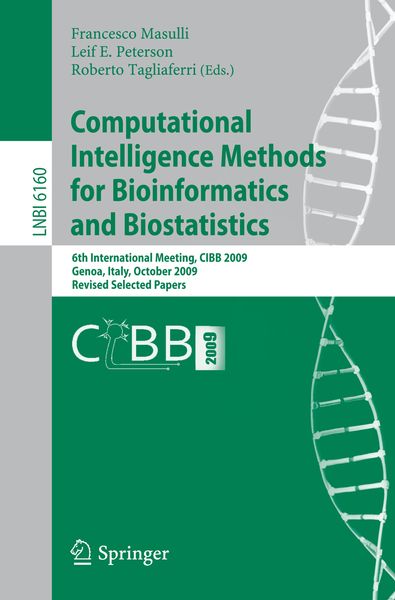
Produktbild: Computational Intelligence Methods for Bioinformatics and Biostatistics
Band 6160

Computational Intelligence Methods for Bioinformatics and Biostatistics 6th International Meeting, CIBB 2009, Genoa, Italy, October 15-17, 2009, Revised Selected Papers

51,99 €

inkl. gesetzl. MwSt., Versandkostenfrei


Beschreibung

Produktdetails

Einband

Taschenbuch

Erscheinungsdatum

11.08.2010

Herausgeber

Francesco Masulli + weitere

Verlag

Springer Berlin

Seitenzahl

320

Maße (L/B/H)

24/15,8/2 cm

Gewicht

511 g

Auflage

2010

Sprache

Englisch

ISBN

978-3-642-14570-4

Beschreibung

Produktdetails

Einband

Taschenbuch

Erscheinungsdatum

11.08.2010

Herausgeber

Verlag

Springer Berlin

Seitenzahl

320

Maße (L/B/H)

24/15,8/2 cm

Gewicht

511 g

Auflage

2010

Sprache

Englisch

ISBN

978-3-642-14570-4

Herstelleradresse

Springer Nature Customer Service Center GmbH
Europaplatz 3
69115 Heidelberg
DE
ProductSafety@springernature.com

Noch keine Bewertungen vorhanden

Verfassen Sie die erste Bewertung zu diesem Artikel

Helfen Sie anderen Kundinnen und Kunden durch Ihre Meinung.

Kundinnen und Kunden meinen

Bewertungen (0)

  • Produktbild: Computational Intelligence Methods for Bioinformatics and Biostatistics
  • Tools for Bioinformatics.- The ImmunoGrid Simulator: How to Use It.- Improving Coiled-Coil Prediction with Evolutionary Information.- Intelligent Text Processing Techniques for Textual-Profile Gene Characterization.- SILACAnalyzer - A Tool for Differential Quantitation of Stable Isotope Derived Data.- Gene Expression Analysis.- Non-parametric MANOVA Methods for Detecting Differentially Expressed Genes in Real-Time RT-PCR Experiments.- In Silico Screening for Pathogenesis Related-2 Gene Candidates in Vigna Unguiculata Transcriptome.- Penalized Principal Component Analysis of Microarray Data.- An Information Theoretic Approach to Reverse Engineering of Regulatory Gene Networks from Time–Course Data.- New Perspectives in Bioinformatics.- On the Use of Temporal Formal Logic to Model Gene Regulatory Networks.- Predicting Protein-Protein Interactions with K-Nearest Neighbors Classification Algorithm.- Simulations of the EGFR - KRAS - MAPK Signalling Network in Colon Cancer. Virtual Mutations and Virtual Treatments with Inhibitors Have More Important Effects Than a 10 Times Range of Normal Parameters and Rates Fluctuations.- Special Session on “Using Game-Theoretical Tools in Bioinformatics”.- Basics of Game Theory for Bioinformatics.- Microarray Data Analysis via Weighted Indices and Weighted Majority Games.- Special Session on “Combining Bayesian and Machine Learning Approaches in Bioinformatics: State of Art and Future Perspectives”.- Combining Replicates and Nearby Species Data: A Bayesian Approach.- Multiple Sequence Alignment with Genetic Algorithms.- Special Session on “Data Clustering and Bioinformatics” (DCB 2009).- Multiple Clustering Solutions Analysis through Least-Squares Consensus Algorithms.- Projection Based Clustering of Gene Expression Data.- Searching a Multivariate Partition Space Using MAX-SAT.- A Novel Approach for Biclustering Gene Expression Data Using Modular Singular Value Decomposition.- Special Session on “Intelligent Systems for Medical Decisions Support” (ISMDS 2009).- Using Computational Intelligence to Develop Intelligent Clinical Decision Support Systems.- Different Methodologies for Patient Stratification Using Survival Data.- 3-D Mouse Brain Model Reconstruction from a Sequence of 2-D Slices in Application to Allen Brain Atlas.- A Proposed Knowledge Based Approach for Solving Proteomics Issues.