KI-Beratung Beta

Gutscheinbedingungen

**Gültig am 27.11.2026 auf Spielzeug, Schreibwaren, Filme, Geschenke & Trends, Musik, tolino eReader & Zubehör, Hörbücher und Hörbuch-Downloads, nicht preisgebundene Bücher und Kalender online auf thalia.at und in der Thalia App. Einzelne Artikel können ausgeschlossen sein. Aufgrund der Buchpreisbindung sind deutschsprachige Bücher und eBooks ausgenommen. Zusätzlich ausgenommen sind Abos & Flatrates, Games, Geschenkkarten/-boxen, Shelfies, Software, Zeitschriften sowie einzelne Artikel von tonies®. Pro Einkauf einmal einlösbar. Click & Collect nur bei Onlinevorabzahlung möglich. Keine Barauszahlung. Nicht kombinierbar mit anderen Aktionen und Gutscheinen. Gutschein wird auf max. 500€ Bestellwert angerechnet. Nicht gültig für Versandkosten und Services.

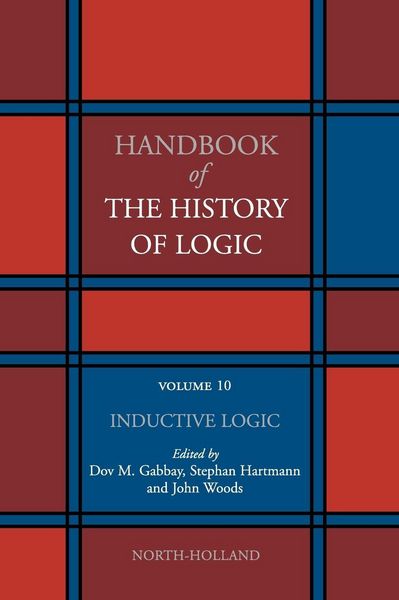
  • Produktbild: Inductive Logic
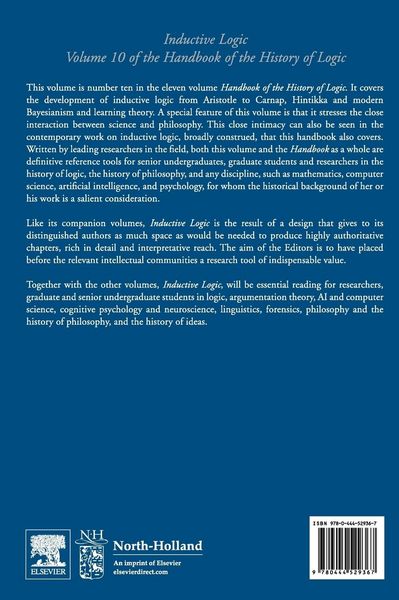
  • Produktbild: Inductive Logic

Inductive Logic

221,99 €

inkl. gesetzl. MwSt., Versandkostenfrei


Beschreibung

Inductive Logic is number ten in the 11-volume Handbook of the History of Logic. While there are many examples were a science split from philosophy and became autonomous (such as physics with Newton and biology with Darwin), and while there are, perhaps, topics that are of exclusively philosophical interest,...

Beschreibung

Inductive Logic is number ten in the 11-volume Handbook of the History of Logic. While there are many examples were a science split from philosophy and became autonomous (such as physics with Newton and biology with Darwin), and while there are, perhaps, topics that are of exclusively philosophical interest, inductive logic - as this handbook attests - is a research field where philosophers and scientists fruitfully and constructively interact. This handbook covers the rich history of scientific turning points in Inductive Logic, including probability theory and decision theory. Written by leading researchers in the field, both this volume and the Handbook as a whole are definitive reference tools for senior undergraduates, graduate students and researchers in the history of logic, the history of philosophy, and any discipline, such as mathematics, computer science, cognitive psychology, and artificial intelligence, for whom the historical background of his or her work is a salient consideration.

Produktdetails

Einband

Gebundene Ausgabe

Erscheinungsdatum

01.06.2011

Herausgeber Dov M. Gabbay + weitere
Verlag Elsevier LTD

Produktdetails

Einband

Gebundene Ausgabe

Erscheinungsdatum

01.06.2011

Herausgeber
Verlag Elsevier LTD
Seitenzahl

800

Maße (L/B/H)

25,9/18,5/4,1 cm

Gewicht

1793 g

Sprache

Englisch

ISBN

978-0-444-52936-7

Noch keine Bewertungen vorhanden

Verfassen Sie die erste Bewertung zu diesem Artikel

Helfen Sie anderen Kundinnen und Kunden durch Ihre Meinung.

Kundinnen und Kunden meinen

Bewertungen (0)

Die Leseprobe wird geladen.
  • Produktbild: Inductive Logic
  • Produktbild: Inductive Logic
  • Introduction (Dov Gabbay, Stephan Hartman and John Woods)

    Induction before Hume (J. R. Milton)

    Hume and the Problem of Induction (Marc Lange)

    The Debate between Whewell and Mill on the Nature of Scientific Induction (Malcolm Forster)

    An Explorer upon Untrodden Ground: Peirce on Abduction (Stathis Psillos)

    The Modern Epistemic Interpretations of Probability: Logicism and Subjectivism (Maria Carla Galavotti)

    Popper and Hypothetico-deductivism (Alan Musgrave)

    Hempel and the Paradoxes of Confirmation (Jan Sprenger)

    Carnap and the Logic of Induction (Sandy Zabell)

    The Development of the Hintikka Program (Ilkka Niiniluoto)

    Hans Reichenbach's Probability Logic (Frederick Eberhardt and Clark Glymour)

    Goodman and the Demise of Syntactic and Semantics Models (Robert Schwartz)

    Development of Subjective Bayesianism (James Joyce)

    Varieties of Bayesianism (Jonathan Weisberg)

    Inductive Logic and Empirical Psychology (Nick Chater, Mike Oaksford, Ulrike Hahn and Evan Heit)

    Inductive Logic and Statistics (Jan-Willem Romeijn)

    Statistical Learning Theory (Ulrike von Luxburg and Bernhard Schoelkopf)

    Formal Learning Theory in Context (Daniel Osherson and Scott Weinstein)

    Mechanizing Induction (Ronald Ortner and Hannes Leitgeb)

    Index